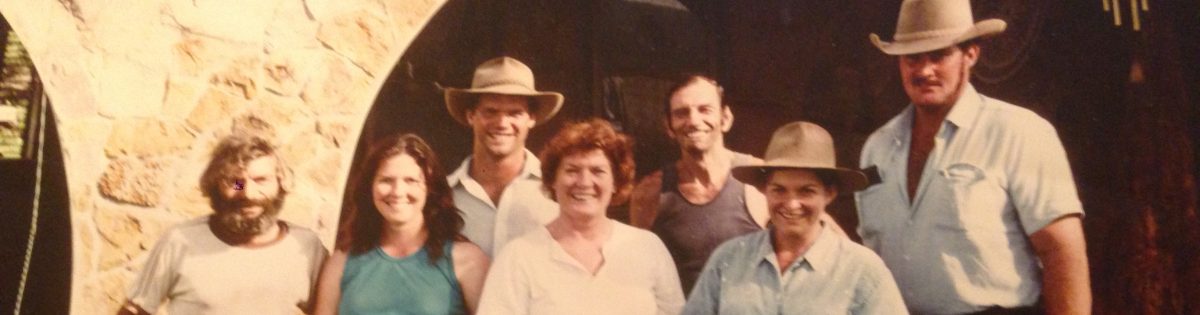
The next morning we began the work at the core of outback station life. The non-negotiables in cattle country include putting your mark on your cattle, making certain that only the most desirable animals breed, and cashing in those animals ready for the meat works. These tasks fall under the heading Herd Management, and it’s work accomplished with a trained eye, strong arms, and an unending capacity for physical work in the yards.
Our first step involved branding, castrating, dehorning, and ear-tagging the calves. If calves are separated from their mothers for too long mom will reject them when they are finally reunited, heedless of their woebegone lamentations. So in the blue light of dawn we began running the youngest of our captives one-by-one down a small laneway and into the calf catch. This contraption resembles, as much as anything, a Venus flytrap. When the operator closes the device two metal bars snugly hold the calf’s neck as its torso and belly are sandwiched firmly. With the animal confined, the hinged device is dropped, holding the beleaguered critter on its side. From there the rump is easily accessed for branding, the ears for tagging and marking, and the testicles for removal.
I was stationed at the branding oven, a fifty-five gallon drum converted for this use by Uncle Dick. He’d removed a portion of the bottom third so it could be loaded with firewood, and added a shelf to the top section. He’d then welded a three foot chimney atop. When the bottom was thick with embers, the branding irons laying upon the shelf heated red-hot. We’d set a supply of firewood close at hand. Over the course of the long day, I placed the station brand and year marker on the rump of 200+ calves.
None of the critters were too excited about their prospects as they lined up in the race and became considerably less enthusiastic as we did our work upon them. I tried hard to be quick and accurate with my branding. Each hit with the hot irons filled the air with a sizzle and the aroma of singed hair and toasted flesh. I was working the hot irons in close proximity to either Marlee or Charlie as they were deftly castrating the males. With two quick slits, a tug, and a slice the young fellas were emasculated, and their destiny for the meat works sealed. Most of the testicles were placed in a burn bucket, but occasionally Charlie would humor Hunter and the other dogs by tossing a couple of the plum-sized organs into the dust, where they were enthusiastically gobbled by the hard-working canines.
“You’ll have a prairie oyster yourself, Dave?” asked Marlee with a challenging grin. I suppose she’d seen my consternation at watching the dogs fight over the raw nuggets.
“Yeah… I’m not that crazy about raw beef. Munching a mickey nut doesn’t have much appeal, thanks,” I deflected.
“Oh, no,” chirped Danielle. “We’ll cook one proper for you, mate.”
“Right,” I said incredulously. “We’re going to have a little cooking class here in the middle of the yards, are we?”
“Naw, Dave,” said Charlie, joining in, “we’ll just do this.” The big man cut a couple of slits crosswise on the freshly extracted testicle he held in his hand and set it on top of the branding barrel. Within a few moments it resembled a football shaped sausage, nicely browned, juicy and halfway appealing, if you didn’t know what it was.
I eyed the article suspiciously. “So what’s it taste like?”
“Chicken,” answered Bundy with a wry smile.
“Well, chicken nuggets, anyway,” said Peter, to laughter all around.
Charlie pulled from his pocket a different knife than he’d been using for the neutering duty and cut the calf nugget into four quarters. He popped one of them in his mouth and said,” go ahead.”
If I didn’t like liver, or sweetbreads, or even the fried calf brains I’d once tried, I would’ve had no hope that this bush morsel would’ve had any charms. But given that I do like organ meats, and am a big fan of sausage, I popped the sizzling quarter into my mouth and found it rather tasty. tongue I can’t promise I’ll replace my usual fried eggs and pork sausage with fried eggs and bull’s balls on any kind of regular basis. Our taste buds reside as much in the culturally conditioned portions of our brain as they do on the surface of our tongues. But the curious truth is I didn’t find mickey balls at all unpleasant.
“It’s not all bad,” I said with a note of surprise.
“It’s the first rule of station life, Dave,” said Bundy with a grin. “Don’t ever turn down tucker.”
“Are we gonna see you fighting Hunter and the lot for the rest of your lunch then, Dave?” asked Peter mischievously.
He’d been busy at the animal’s heads, working a distinctive hole punch onto the broad fan of the calves left ears. The resulting divot made visual identification across a distance easier. He’d then use a compact set of snippers to nip the sharp tip of the young cattle’s developing horns.
With the procedures completed two of us would stand the calf catch back up, release the latch, and the newly marked and castrated calf would scamper away, bleating and shaking off its insults. The next patient would be run into the catch and we’d repeat the operation. Occasionally, a calf would give us a feint, or in some other way throw off the timing of its movement. If the catch operator got fooled and closed the mechanism a beat too late to seize the neck he would release the mechanism, and one of us would need to do a little bulldogging. I was particularly enthusiastic about this duty, as it didn’t require any expertize. I’d corner the calf within the small pen, then throw myself upon the little fella and wrestle it to the ground. I held the struggling animal while the others did the necessary tasks upon it. By my third bulldogging session, a profuse sweat had combine with the pounded bull dust into a layer of filth caking my chest and jeans. I didn’t care; I felt useful. I enjoyed the challenge of getting the calves to the ground, especially the larger ones. I was just sorry the camera crew wasn’t there to immortalize my manly exertions amid the dirt and muck.
Sara, with perfect timing, appeared at the yards midmorning on the second morning of our exhausting labors tagging and branding and cutting. She arrived with two large thermoses of hot tea and some baked snacks. I’d become a fan of the British tea break. I’d never been much of a coffee drinker; more than a single cup tended to make my stomach queasy. But with this sweet and milky tea I could slurp several cups with no price to pay.
Sara also brought some news.
“I just heard from the driver,” she said, referring to the fellow bringing the live cattle hauler to the homestead yards. “He’s gotten bogged on the jump up.”
“Did he unhook?” Charlie asked with a level gaze.
“No, Charlie. It sounds like he decided to be game and drag both trailers up at once.”
“Well, I reckon he’ll pay more attention to our instructions next time.” The big man paused. “Dave, when we’re finished here you and I will drive out to the grader at 22 Mile. We’ll top the grader off with fuel. You follow me to the jump-up. If we’re right from there, you can head back. I’ll drag the drongo up and follow him in.”
“Christ, Charlie, that will take all night!” Danielle said incredulously.
“Yup,” said Charlie.
I expected some manner of derisive comment regarding the unwise truckee to follow, but none came. Charlie let the evident foolishness of the man’s poor decision hang in the air as sufficient testimony of its deficiency. On reflection I realized that any potshots Charlie might have directed towards the easy target would have diminished Charlie himself, in a way. Kicking a man when he’s down brings attention to the kicker, a distraction from the pertinent question–why is the man down in the first place? What might he have done to keep himself from being in that position? And that’s the nut of the matter, isn’t it? Any gratuitous shots do the sufferer a favor, don’t they, by turning them into a victim of someone else’s malevolence rather than a sufferer by his own malfeasance?
I can’t know Charlie’s exact train of thought in the moment, but it doesn’t matter. I’d long since come to admire Charlie’s manner of dealing with people. His mastery of machinery and capable touch with animals were impressive, but his ability to run a crew required knowledge of the human spirit, an art much more subtle than that required to move machine or beast. I hadn’t once heard him raise his voice in anger. His quiet manner and direct instructions generated an authority organic and absolute. His inclination was to give a person enough rope to either bind himself to coworkers, or hang by themselves. This respect for the autonomy and assumed competence of others was appreciated and reciprocated by everyone I saw engage with Charlie Ahlers.
Charles W. H. Ahlers was born on the tablelands upon the leeward side of the Great Dividing Range which parallels the eastern coastline of the Australian continent. Charlie’s grandfather once controlled an entire valley around the played-out gold mining claims along the Palmer River in northern Queensland. By the time Charlie arrived, Maitland Downs had been reduced by inheritance and sale to a section of several hundred thousand acres. Charlie’s father worked cattle from his earliest memory, the classic cattleman who spent so much of his life outdoors that, to his dying day, he could not sleep in an enclosed bedroom. If he wasn’t at the stock camp, George Ahlers would be found spending his nights on the veranda of the family home at Maitland Downs. Growing up, Charlie was too busy learning important things to waste time at school; his formal education finished after eighth grade. His talents lie outside the classroom. His precocious understanding for machinery of all sorts had him by the time he was ten disassembling then bringing to life the rusted mechanical relics found abandoned in generous supply around station junkyards.
In the days before ubiquitous motorized and mechanized technology, stockman needed to know how to work cattle artfully; driving them into submission with helicopters and quad bikes was not an option. This craft of working with stock from horseback, eye to eye, has been sacrificed to the conveniences of the contemporary world. I suppose an analogy might be found in the world of penmanship; the cattle work practiced by Charlie’s family was as calligraphy is to the word processor. Both get the job done, but the process is very different. And there was a fluidity and elegance to the former, lacking in the robotic clickety-clack of the modern style.
So George would have taught his son something of the old ways, imbued in him a sense of the finesse required when dealing with animals. I’d noticed Charlie’s restraint when face-to-face with Bullo’s horses and cattle, sensed his frustration when we were reduced to bullying the animals into submission. In the old ways, all animals are slowly and patiently habituated to human contact. This process alleviated some of the panic I’d seen among the animals at Bullo, where Charles Henderson had practiced no such subtlety.
That Charlie Ahlers maintained amidst the noise and dust of Bullo as much of his birthright finesse as possible, his quiet manner of dealing with marginally domesticated animals, was admirable. Charlie truck displayed a bumper sticker which read “How can I soar like an eagle when I’m surrounded by turkeys!”. Charlie’s solution was not to go on a turkey shoot. Instead, he aimed to turn every resource around him–human and animal alike–into eagles.
Late that evening, when we’d finished our bruising day with the calves and after humping multiple bales of hay into the pens, and filling all the water troughs, when we would typically take the welcome stroll back to the house for a shower and a meal, Charlie and I instead drove the King straight to the workshop. We loaded an empty 55-gallon drum, strapped it down, then filled it with diesel fuel. We swung by the homestead, where Marlee handed us each two steak sandwiches on thickly sliced bread, spread with treacle. We filled two jugs with drinking water and were on our way.
“So you tell the drivers to bring their trailers up the jump-up one at a time?” I asked, between hopping out to open the several homestead gates.
“Most of them don’t need to be told. This fella must be new.”
“New to Bullo, or new to the job? I mean, isn’t it obvious that the jump up is pretty steep?”
“It’s deceptive, actually. It’s hard to get a read on how steep it is because it’s quite long. I mean, if you take a good look at it it’s obvious, but if you just plow right on without paying attention to what you doing you’ll be buggered in a hurry. That must be what this fella did.”
“That seems like a silly way to run a business. This truck is his livelihood.”
“Don’t underestimate the power of lazy, Dave. It takes twice as long to unhitch two trailers and get them up one at a time than it takes to do it in one shot. If you’re running on ego and hope, you might give it a go. But a man has to know his machinery, and the land. And his own limitations. Miss any one of those three and you’ll find yourself waiting for help, or worse.”
Charlie made this point looking directly at me. Though he offered it with a slight smile, I took his words as warning as much as observation. The stakes in station life are high. Whether the danger was losing a night’s sleep, a cattle trailer, or life and limb, the possibility of failure is constantly at hand. Had I stumbled when chased by the angry cow in the yards the day before I would have been trampled, gored, even. Perhaps I would have gotten up dazed but okay. Perhaps I would’ve been helicoptered to a hospital and died. Either possibility was real. And the deciding element was my ability to put one foot in front of the other without stumbling over a rock, or a root, or my own feet. Tightrope walkers put no more at risk than I had in that precipice of a moment. Yet it was simply one moment in a day of moments, within a week of moments, within, for these people, a lifetime of moments. And within that context of impending menace, great jobs must be undertaken and completed. The word “tough” doesn’t even begin to describe the spirit which animates even the most ordinary day in the Australian outback.
“Well, you know what Einstein said about foolish people, don’t you, Charlie?”
“What’s that, Dave?”
“He said, ‘the difference between genius and stupidity, is that genius has its limits’”.
The big man and I shared a chuckle, then settled quietly into the black night.
When we reached the grader Charlie climbed aboard, fired ‘er up, and headed along the track towards the long rise which leads from the highway into Bullo. After several hours, the stranded truck came into view. The driver had unrolled his swag next to the cab and, as we pulled up, he was unbuckling a wooden leg and preparing to climb into bed.
“I was starting to think you’d be here in the morning,” the slight man said, holding his artificial limb in his hand, embarrassment visible on his face. I suspect the embarrassment had nothing to do with the limb, however, and everything to with the look Charlie was giving him.
“Nope. We need to get these cattle loaded in the morning. Let’s get you up the hill.” As he spoke Charlie was opening the utility box which housed chains. “I’ll hook you up and we’ll walk it up. Slow and steady. But first I need to top off my tank.”
I pulled the Toyota next to the grader, inserted the hose, and began hand cranking fifty-five gallons of diesel into the earthmoving machine. When I finished Charlie thanked me and bid me home. It was nearly 2 o’clock in the morning before I climbed in bed. Charlie would have spent an hour in the tow operation, then traveled the fifty miles trailing the trucker on the grader. There would have been no chance he arrived home more than an hour before daybreak.
Yet the next morning Charlie beat me to the breakfast table. There was nothing in his manner or talk which revealed whether he’d stayed awake, or had gotten a few minutes of shut-eye. With the new day
dawning there was work to be done.
And when there was work to be done there has never been a better choice for the job, no man more capable or willing, than Charles William Harding Ahlers.
 Barking in Nutwood
Beautiful words about an incredible man and mentor.. Charles Ahlers
LikeLike
Honoring his memory was a prime motivation of mine to write this book. We were lucky to know him…
LikeLike