The final stretch of roadway takes us alongside a wide airstrip, separated from the dirt track by a barbed wire fence. Several mobs of plump cows idle within, laconically chewing their cud in the shade of the few lone trees. Horses make their first appearance, dozens of them, in a large meadow bordered on one side by the fence and the other by a meandering line of Ghost Gums. The horses bristle and scurry as we pass. The wide green airstrip gives the place a welcome fertility that makes me smile. I draw a deep breath; people live here.
Within moments we arrive at a single-story homestead sprawled along the edge of the airstrip. It’s surrounded by a welded wire fence which contains several multi-hued horses, a bounding calf, a motley array of dogs, and one attractive redhead wearing an apron as she steps through the gate.
“Hello!” She says warmly as I climb out of the cab. “I’m Sara. Welcome to Bullo!” Sara extends her hand with a broad smile. She has the healthy glow of country life about her, with radiant skin and bright eyes. Her matronly figure is all curves and warmth.
“Hello. I’m Dave. Glad to be here, finally!”
“It’s a long way, to be sure. When did you leave Sydney?”
I recount my path of the past several days.
“Well, come inside and we’ll get you supper. You must be famished!”
I acknowledge I am. Peter hands me my bag and I follow Mrs. Henderson, wondering whether everyone in these parts is always as cheery as these two. She turns and calls out to Peter.
“Better go see Uncle Dick. He’s in the workshop; Charlie said he may need your help with a bit of lifting.”
“Right-o!” Responds my amiable chauffeur, who accelerates the truck towards a hodgepodge of buildings in the distance.
A row of French doors face us as we walk towards the house, accompanied by the pack of hounds. We avoid the French doors and skirt a large concrete tank standing at the left end of the house. Behind the tank, which fills during the wet season to provide household water year-round, a set of double doors opens onto a concrete-floored room.
This residence takes ‘open concept’ to a whole new level. One single step past the threshold and I can see through the kitchen, past a bright sitting area, through several large paneless windows, past the airstrip, over a river, onto a range of low-lying mountains, above which a waxing gibbous moon crowns the deep vista.
“Plenty spacious,” I say with a smile in my voice.
Mrs. Henderson leads me to a small room at the corner of the house. Louvered windows rise from floor to ceiling on both walls, giving the sun’s fading rays free play over the small desk and chair contained within, the only furnishings present. A child’s charcoal drawing of a bird hangs on the wall. A tiled platform forms the back half of the room, upon which lays a thick foam mattress.
“This’ll be yours for now,” says Sara cheerfully. “Peter’s across the way. You lot will be fine here; no need to bunk out in the stock camp while these rooms sit empty.”
I nod assent, though I’m uncertain what exactly she’s referring to. Doesn’t everyone live in a house? I settle my few belongings, then wander into the kitchen where Sara is carving industrially on a roast. The pack of five dogs watch with keen interest.
“Now that’s a great table!” I say, referring to the square solid butcher block upon which she works.
“Yes,” she said, “it’s marvelous! We used to have our own abattoir, just down by the powerhouse. We put many head of cattle a day through it. This was one of the butchering tables.”
The dark stocky table shows signs of much carnivorous labor, its ten-inch-thick surface having been worn irregular from the daily onslaught of knife and cow. It doesn’t occur to ask why they’d had an abattoir, or why they don’t anymore, or, for that matter, what exactly an abattoir is.
“Here comes the power!” Sara says without looking up from her carving.
As I’m considering what she might possibly be talking about I’m interrupted by a full spectrum of sensations. Lights flash on, ceiling and desktop fans start churning, several refrigerators begin buzzing, a microwave runs a few seconds before dying with a ping. From the dining room, Kenny Rogers is suddenly in full voice, his lamentation over Lucille and her inopportune decision to end their relationship having been clipped mid-chorus when the power last ceased.
“Uncle Dick fires up the generator around this time,” Sara explains, referring to a massive diesel engine babied by the elderly mechanic, who turns it on and off each morning and evening.
I power down the dense slabs of roast beef between thick slices of homemade bread, then take a moment to poke around my new surroundings.
The home is distinguished for an unabashedly exposed design. A row of wide arches, open to the weather, form the eastern exterior wall. For its entire length there exists neither wooden doors nor window glass to shelter the interior space from wind or water. In this tropical region, the weather always and ever comes from the northwest, protected by the row of French doors on the opposite side of the home. Southeastern exposures, such as this entire front, can be left wide open as a country porch.
The great space is sparsely furnished. A concrete floor begins at the arches, and spreads through a large living and dining space, ending at the French doors in the rear. Several well-cushioned chairs are arrayed around a television set, upon which sits a VCR. One wall supports a thickly cushioned built-in couch, perhaps twenty feet long. Between the dining space and the living room, a wrought-iron trellis arches overhead. The dining room holds a long formal dining table adequate for seating a dozen people. A low credenza sits in one corner, home to the stereo setup broadcasting crooner Rogers, who’s moved on to a cautionary dissertation on poker strategy.
Two doors lead off the dining room. One is closed, the other leads into a windowless room heaped with sacks of feed and meal and tools. A mini trampoline reclines against the wall. Off this room a hallway sits crowded with leather, and metal trinkets. From the living room. a single door leads into an office cluttered with books and papers. Another closed door blocks my explorations. On the opposite side of the house, near my bedroom, two bamboo-frame couches face each other across a low wooden table. A chessboard sits upon the table in readiness.
The large kitchen counter upon which I’d eaten my meal joins the living space with the capacious kitchen. Beyond the kitchen is a large sink and a reach-in freezer. Two very large refrigerators stand next to the freezer. My bedroom door is several feet from the freezer. Across from my room are two more doors. One leads into an empty bedroom and the other opens onto a pile of clothing and paraphernalia. I take this to be Peter’s room.
The overall impression of the place is of stone and light, uncluttered space, comfortable but with the bare minimum of furnishings. The construction is similarly utilitarian. Throughout the house stand massive wooden pillars, two feet thick and fifteen feet tall. This ample bulk holds up the corrugated tin roof. In most places the tin itself is visible, though the sitting area and several of the bedrooms have a drop ceiling hiding the electrical wires and fixtures seen elsewhere neatly strung from space to space.
The interior and exterior walls are flagstone of differing size and shaded from pink to rose. The rock has been gathered from the surrounding hills, then artfully pieced together. The final effect is a homey pastel quiltwork, even as the stonework and massive hand-raised pillars bring a fortress-like quality to the interior of the house.
I walk out the large arches forming the front of the rambling house. Surrounded by five small boab trees sits a keyhole-shaped swimming pool, cool and inviting. The pool has a hand-dug look to it, with its uneven sides and bottom. A collar of stones set in concrete circles its rim. There are several animals grazing within the fence separating the yard from the airstrip. This fence continues around the house, boxing in a couple acres of green lawn.
I continue walking away from the house towards the airstrip. The easing heat and cool shade of dusk blend with the quiet animation of the scattered animals. As I survey the flat valley and distant hills, an inkling of connection to this place arises within, a curiosity to know the story of the station’s evolution from scorched outback wilderness to its present placid hospitality.
The airstrip appears to be a half-mile long. Along its full length, at regular intervals, white markers made of fifty-five gallon drums split lengthwise lie. The far side of the airstrip is bounded by a barbed wire fence. As my eyes follow the fence line to the farthest white drums, I notice a gray pickup truck urging several animals along. As they grow closer, I make out two cows trotting resignedly in front. Behind the wheel sits a comely young woman.
By the time the entourage crosses the airstrip in front of me, I’m infused with anticipation for greeting the lovely lass. I’m tickled to see that she feels the same way, for she’s waving vigorously! I return her hail with zeal. She continues waving enthusiastically and I, overcome with warm regard, call out, “Hello! You must be Danielle!”
At the sound of my voice the two bovines veer sharply, break into a lumbering gallop, and head back up the airstrip. The truck accelerates in a circle and blocks the cows’ escape. The two beasts again lope along in front of the truck, whose occupant I’m astonished to see is again waving heartily. As I contemplate the extraordinary warmth of these rural people, I notice the young woman’s face reads more annoyed than pleased. With mortifying insight I realize I’m standing in the gate through which she intends to shepherd the wary cows, and what I took as an ostentatious welcome has been in fact an attempt to move me the hell out of the way.
I scramble abashedly away from the gate, catching my pant leg on the barbed wire in my haste. The cows lope through, followed by the young lady in a rumpled hat. She gives me a bemused look, through which I see she is as lovely as I’d thought. She has her mother’s coloring, yet her outdoor lifestyle has not yet shaded its youthful gloss. Her bright white teeth and clear eyes signal a wholesomeness born of uncomplicated pursuits. As she hops out of her vehicle, I see she’s shapely, and fit. She offers a restrained smile.
“I’ll bet you’re David. I’m Danielle.” The rounded lilt of her Australian accent gives her words a charm which I’m not entirely certain she intends.
“Hi Danielle. Sorry about messing you up there. I… I didn’t realize…”
“It’s okay. They didn’t go far. Just watch what you’re doing around here. There’s a lot that needs to be done without you cocking things up.” She squints and tilts her head. “It would be a fair guess you’ve never milked a cow, I reckon?”
I see here an opportunity to regain a measure of my self-esteem. “Well, actually, I have done it a few times.”
I’m telling the truth, strictly, having puttered at the task during several summer visits to a relative’s farm in Ohio. Though Uncle Mitch milked his small herd by machine it was still necessary to strip the last bit of milk after the mechanical suckers had done their job. I’d done that on several occasions. At least twice. Fifteen years ago.
“Good, then. You can give me a hand.”
We walk into the house, through the living room, and into the feed room. Danielle hands me a five-gallon bucket and instructs me to fill it in the same manner she fills hers. In go several pitchers of bran this and seed that until the grainy mixture resembles a coffee-and-donut-man’s breakfast nightmare. We walk to the back of the house, where we dump our load into two small wooden troughs near a corral. As we walk towards the two lazily grazing beasts, they greet us with baleful regard, as if disbelieving we could want to interrupt yet again their bovine occupations on this pleasant afternoon.
“Daisy, Pumpkin, let’s go, let’s go,” Danielle calls out with exaggerated pitch. “Come on girls. Let’s go!” The cows rotate their ears our direction but neither moves.
“I guess they don’t know about their feast,” I suggest, referring to the troughs we’d filled.
“Oh, they know all right. They’re just being stroppy. Getting me back for making them run all the way along the airstrip.”
We circle behind the two cows. They move with little urgency towards the troughs, their pendulous udders swinging preposterously. When twenty yards away, they break into a loping trot and descend on the food and commence eating with a throaty huff.
“Put that rope over her head,” Danielle says, referring to a short rope tied to the small corral. I open the loop at the end, but when I attempt to drop it over Pumpkin’s head the animal backs up several steps and eyes me warily.
“Quickly! Put it around her feed bucket!”
I drop the loop around the trough and back away. Pumpkin resumes her feeding and Danielle slips the loop over Pumpkin’s small horns and around her thick neck.
“She’s all yours,” Danielle says, crouching under Daisy. I hunker down and tentatively grasp Pumpkin’s teats. I squeeze. Nothing comes out. I tug. Nothing. I squeeze and tug. Nothing happens. I squeeze again. Nothing. I can sense Danielle’s eyes upon me. Feeling a rising tide of humiliation, I stretch the poor animal’s rubbery spigot with a firm tug. A white rivulet stirs the dust beside my bucket as Pumpkin’s sloppy tail whips my face.
“You need to wet them first,” Danielle offers with the tone used to tell a pianist to raise the keyboard cover.
“Right,” I say. I spit on my fingertips and resume my efforts. Another dust storm.
“Okay, I’ll show you.” Danielle’s reproving tone shows she’s seen through my earlier bravado. For the second time in twenty minutes I’m looking quite the nitwit.
“Look,” she says, “you keep the teats wet using a little milk.” She douses her hand with a rapid stream. “You pinch up in the bag like this, then pull down. Some people use two fingers, some their whole hand. I use my fingers, mostly because Daisy has such tiny teats, but you can use whatever works best for you.” Her tone is firm but kind. “Keep the teats working because milk is being made by the action. When two are dry, move to the other two. Strip all four before you’re finished. Got it?”
This sounds easy enough; putting her words into action is not. I squeeze and tug and try two fingers and I try my whole hand, but after five minutes only a few pathetic ounces of milk swish in the bottom of my metal bucket. Danielle, meanwhile, had drawn several gallons with forceful squirts that foam and ring in her bucket.
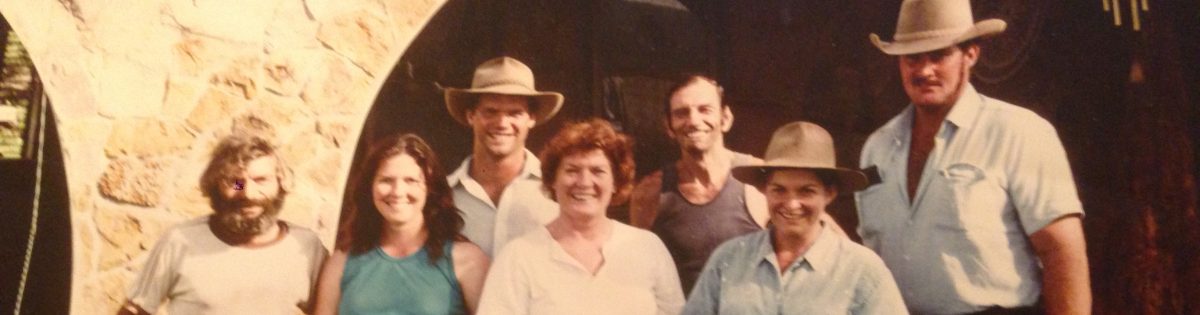
At this point Peter reappears, accompanied by three men. It’s a varied crew, including a large man, a small man with a rich beard, and a very thin older fellow. They all wear shorts, two wear T-shirts; the big man sports a button-up shirt with the sleeves torn off at the shoulder, revealing stout arms. The small fellow carries a bundle of cloth, the thin one an empty pitcher. They stride through the pedestrian gate and head our direction. Thankful for the diversion, I draw away from the cow and stand up. Danielle continues with Daisy.
“Dave, meet Charlie,” Peter indicates the large man. I extend my hand. A vast hand reaches out and kneads my soft offering.
“Hello Dave,” Charlie says, then, nodding towards my bucket, grins. “Not making much headway, are you?”
“No, I’m afraid I don’t have the knack quite yet.”
“Pumpkin doesn’t know you; she’s probably not letting her milk down,” he says pleasantly. I take his words as more descriptive than sympathetic. I venture that he’s in his late thirties. His square, businesslike face is surrounded by a curly thicket of vanilla hair and sideburns, which run below his ears. His eyes are clear and direct as they look down at me from his six foot four inches. He’s thickly muscled with a block-like solidity.
“And Uncle Dick,” Peter continues.
“Aloe Dive,” says the skinny old fella, his thin face split by a racehorse-sized smile. “Good ti see ya, mite. A yaink, eh? Good lot, dem.” I find Uncle Dick’s syrupy accent nearly incomprehensible. “Cupla me mites uz Yainks back a wize. Dinkum lods, dey wah.” I smile and nod at the utterance, despite having absolutely no idea what is being conveyed.
“And this is John Patrick Stirling Bartholomew Jordan,” Peter looks mischievously at the smaller man, who grins self-consciously. I lower my gaze to the slight man’s face. He’s peering back at me through a hedge of bristled gray hair nesting atop his head, and a profuse gray beard which rings his face like a Christmas wreath.
“Aw, forget about all that,” the little fellow dismisses Peter with a wave of his hand. “I’m Stumpie,” he says in an accent only slightly more intelligible than Uncle Dick’s. “Well, I reckon I’ll get this inside afor it goes bad,” he says, referring to a carton of eggs he holds. He directs a quick smile at me, popping his eyes wide as if he’d said something spectacular, furrows his brow, looks furtively about, and walks off in a jumble of knees, elbows, and hair. Charlie nods my direction, Dick says something opaque in the friendliest possible manner, and the two follow Stumpie inside.
Peter turns towards Pumpkin, slaps the animal’s rump, and says, “It’ll be a bullet if you don’t let your milk down for me, you old bitch!”
Peter squats in the spot I’d vacated and is soon filling the bucket with metronomic jets of cow juice. We finish as the last light of day drains from the sky. Danielle loosens the cows’ tethers and we walk inside the house, carrying the two buckets of milk. These we strain through a muslin cloth and pour into six half-gallon pitchers before depositing four of them in one of the large refrigerators. The other two we set in the reach-in freezer for a quick chill.
With this, the day’s duties are completed. Danielle leads me to the front room, where Sara and Charles are taking in the cool evening air from the sturdy handmade loungers arranged a step inside the arches. Charlie has a beer. He offers me one; Danielle goes to get it when I accept with a thanks.
“You’re welcome, but they’ll be two dollars each from now on,” he says in a manner which manages to be both easy-going and authoritative.
In the same easy tone, he questions me regarding my previous agricultural experience and relevant skills. We both quickly come to see how little I’m bringing to the station.
Like so many in my generation, I’d spent most of my time in book learning. As a college grad I’d learned communication theory and American history and Russian literature, very little of which would be useful at Bullo River Station. I’d gotten myself through UCLA working as a chauffeur, but knew nothing of cars or mechanics, my experience with animals had been limited to several brief visits to a dairy farm, and as a waiter at fancy restaurants I had served the rich and famous but didn’t know how to cook. As the conversation progresses, Charlie seems to accept my ineptitude easily enough, but I become increasingly uncomfortable.
“Listen; I can work,” I offer as consolation. “I enjoy physical labor. I like to sweat. I like to see something tangible accomplished at the end of the day. I can’t imagine myself as a bureaucrat or some such thing, your working life passing by in a stream of paperwork, sand through your fingers.”
I’m becoming quite demonstrative, despite having zero professional experience doing hard physical labor. I possess no more than an abstract appreciation for the nobility of manual labor. I’d imagined how very — what, manly? –- sweating under a hot sun would feel, but have no bodily experience to help calibrate my enthusiasm. I have no idea what it is to ache and not baby my pain, to struggle with goliath tasks with no option besides struggle, to wake up with nothing more pleasant to anticipate than climbing back in bed.
No matter; I plunge ahead. “I learn quickly and I stick to something, and I’m careful. The essence of what I offer is simply my time, and my very best efforts.”
Charlie holds my eyes for a few beats. “We’ll give you a look. If you carry your weight, we’ll have you on for the season.”
“I appreciate that, and the hospitality you’ve shown in inviting me here. I’ll give you my best.”
“Right-o,” he says as he purses his lips. His chin drops in an abbreviated nod which signals the end of the matter.
I ask, “So what are we working on tomorrow?”
“Nothing,” he says.
“Eh?”
“We’re going fishing.”
Yay! Fishing! “Great! Where?”
“In the Bullo, for barramundi. And now,” Charlie says, looking at his watch, “Dick’ll be cutting the power off in a minute. Best get to bed.”
With that, we make our way to our rooms. Within five minutes the distant sound of the powerhouse goes quiet, Kenny Rogers fades to silent in a descending octave, and the lights dim to dark.
 Barking in Nutwood
Such an interesting group of characters developed in this chapter. All are so very likable. And all are unlike people we meet every day here in mainstream USA.
I like that we start to see more of our author Dave’s sense of humor, infrequently presented but when it is, it’s my kind of humor .. dry and witty, often giving me a really laugh-out-loud moment. So much fun!
Onward to the next chapter, to go fishing …
LikeLike
“As I survey the flat valley and distant hills, an inkling of connection to this place arises within, a curiosity to know the story of the station’s evolution from scorched outback wilderness to its present placid hospitality.”
Here enlies the epitome of why I continue to read this story!
The best part of reading what you have written, is having listened to you tell a story. With your voice and your nuances coming to life as I read each word. Daggummit Dave!, you got me. I’m going to read to the end.
LikeLiked by 1 person
Chris, your words warm me! Storytellers are barking at the moon without listeners; having you onboard completes the circle…amd please, I look forward to your comments along the way — positive, negative, or indifferent. They’re all welcome! And I hope you enjoy the ride…
LikeLike