Three — Meet, and Milk the Bovine Ilk

The final stretch of roadway takes us alongside a wide airstrip, separated from the dirt track by a barbed wire fence. Several mobs of plump cows idle within, laconically chewing their cud in the shade of the few lone trees. Horses make their first appearance, dozens of them, in a large meadow bordered on one side by the fence and the other by a meandering line of Ghost Gums. The horses bristle and scurry as we pass. The wide green airstrip gives the place a welcome fertility that makes me smile. I draw a deep breath; people live here.

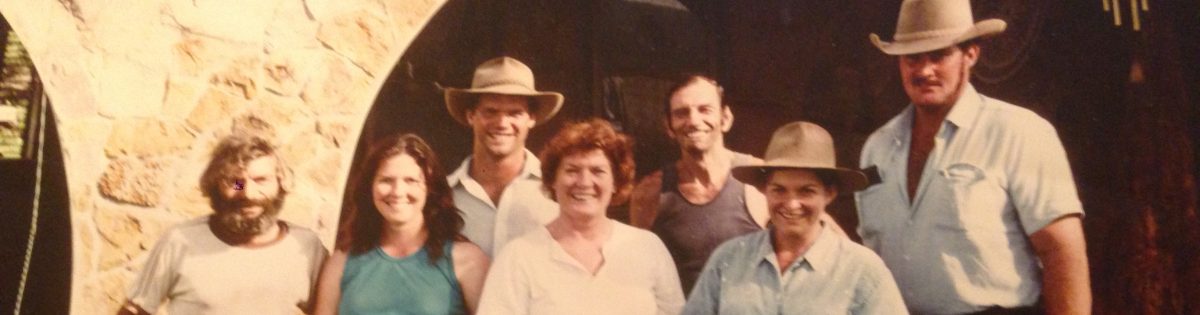
Within moments we arrive at a single-story homestead sprawled along the edge of the airstrip. It’s surrounded by a welded wire fence which contains several multi-hued horses, a bounding calf, a motley array of dogs, and one attractive redhead wearing an apron as she steps through the gate.

“Hello!” She says warmly as I climb out of the cab. “I’m Sara. Welcome to Bullo!” Sara extends her hand with a broad smile. She has the healthy glow of country life about her, with radiant skin and bright eyes. Her matronly figure is all curves and warmth.

“Hello. I’m Dave. Glad to be here, finally!”

“It’s a long way, to be sure. When did you leave Sydney?”

I recount my path of the past several days.

“Well, come inside and we’ll get you supper. You must be famished!”

I acknowledge I am. Peter hands me my bag and I follow Mrs. Henderson, wondering whether everyone in these parts is always as cheery as these two. She turns and calls out to Peter.

“Better go see Uncle Dick. He’s in the workshop; Charlie said he may need your help with a bit of lifting.”

“Right-o!” Responds my amiable chauffeur, who accelerates the truck towards a hodgepodge of buildings in the distance.

A row of French doors face us as we walk towards the house, accompanied by the pack of hounds. We avoid the French doors and skirt a large concrete tank standing at the left end of the house. Behind the tank, which fills during the wet season to provide household water year-round, a set of double doors opens onto a concrete-floored room.

This residence takes ‘open concept’ to a whole new level. One single step past the threshold and I can see through the kitchen, past a bright sitting area, through several large paneless windows, past the airstrip, over a river, onto a range of low-lying mountains, above which a waxing gibbous moon crowns the deep vista.

“Plenty spacious,” I say with a smile in my voice.

Mrs. Henderson leads me to a small room at the corner of the house. Louvered windows rise from floor to ceiling on both walls, giving the sun’s fading rays free play over the small desk and chair contained within, the only furnishings present. A child’s charcoal drawing of a bird hangs on the wall. A tiled platform forms the back half of the room, upon which lays a thick foam mattress.

“This’ll be yours for now,” says Sara cheerfully. “Peter’s across the way. You lot will be fine here; no need to bunk out in the stock camp while these rooms sit empty.”

I nod assent, though I’m uncertain what exactly she’s referring to. Doesn’t everyone live in a house? I settle my few belongings, then wander into the kitchen where Sara is carving industrially on a roast. The pack of five dogs watch with keen interest.

“Now that’s a great table!” I say, referring to the square solid butcher block upon which she works.

“Yes,” she said, “it’s marvelous! We used to have our own abattoir, just down by the powerhouse. We put many head of cattle a day through it. This was one of the butchering tables.”

The dark stocky table shows signs of much carnivorous labor, its ten-inch-thick surface having been worn irregular from the daily onslaught of knife and cow. It doesn’t occur to ask why they’d had an abattoir, or why they don’t anymore, or, for that matter, what exactly an abattoir is.

“Here comes the power!” Sara says without looking up from her carving.

As I’m considering what she might possibly be talking about I’m interrupted by a full spectrum of sensations. Lights flash on, ceiling and desktop fans start churning, several refrigerators begin buzzing, a microwave runs a few seconds before dying with a ping. From the dining room, Kenny Rogers is suddenly in full voice,  his lamentation over Lucille and her inopportune decision to end their relationship having been clipped mid-chorus when the power last ceased.

“Uncle Dick fires up the generator around this time,” Sara explains, referring to a massive diesel engine babied by the elderly mechanic, who turns it on and off each morning and evening.

I power down the dense slabs of roast beef between thick slices of homemade bread, then take a moment to poke around my new surroundings.

The home is distinguished for an unabashedly exposed design. A row of wide arches, open to the weather, form the eastern exterior wall. For its entire length there exists neither wooden doors nor window glass to shelter the interior space from wind or water. In this tropical region, the weather always and ever comes from the northwest, protected by the row of French doors on the opposite side of the home. Southeastern exposures, such as this entire front, can be left wide open as a country porch.

The great space is sparsely furnished. A concrete floor begins at the arches, and spreads through a large living and dining space, ending at the French doors in the rear. Several well-cushioned chairs are arrayed around a television set, upon which sits a VCR. One wall supports a thickly cushioned built-in couch, perhaps twenty feet long. Between the dining space and the living room, a wrought-iron trellis arches overhead. The dining room holds a long formal dining table adequate for seating a dozen people. A low credenza sits in one corner, home to the stereo setup broadcasting crooner Rogers, who’s moved on to a cautionary dissertation on poker strategy.

Two doors lead off the dining room. One is closed, the other leads into a windowless room heaped with sacks of feed and meal and tools. A mini trampoline reclines against the wall. Off  this room a hallway sits crowded with leather, and metal trinkets. From the living room. a single door leads into an office cluttered with books and papers. Another closed door blocks my explorations. On the opposite side of the house, near my bedroom, two bamboo-frame couches face each other across a low wooden table. A chessboard sits upon the table in readiness.

The large kitchen counter upon which I’d eaten my meal joins the living space with the capacious kitchen. Beyond the kitchen is a large sink and a reach-in freezer. Two very large refrigerators stand next to the freezer. My bedroom door is several feet from the freezer. Across from my room are two more doors. One leads into an empty bedroom and the other opens onto a pile of clothing and paraphernalia. I take this to be Peter’s room.

The overall impression of the place is of stone and light, uncluttered space, comfortable but with the bare minimum of furnishings. The construction is similarly utilitarian. Throughout the house stand massive wooden pillars, two feet thick and fifteen feet tall. This ample bulk holds up the corrugated tin roof. In most places the tin itself is visible, though the sitting area and several of the bedrooms have a drop ceiling hiding the electrical wires and fixtures seen elsewhere neatly strung from space to space.

The interior and exterior walls are flagstone of differing size and shaded from pink to rose. The rock has been gathered from the surrounding hills, then artfully pieced together. The final effect is a homey pastel quiltwork, even as the stonework and massive hand-raised pillars bring a fortress-like quality to the interior of the house.

I walk out the large arches forming the front of the rambling house. Surrounded by five small boab trees sits a keyhole-shaped swimming pool, cool and inviting. The pool has a hand-dug look to it, with its uneven sides and bottom. A collar of stones set in concrete circles its rim.  There are several animals grazing within the fence separating the yard from the airstrip. This fence continues around the house, boxing in a couple acres of green lawn.

I continue walking away from the house towards the airstrip. The easing heat and cool shade of dusk blend with the quiet animation of the scattered animals. As I survey the flat valley and distant hills, an inkling of connection to this place arises within, a curiosity to know the story of the station’s evolution from scorched outback wilderness to its present placid hospitality.

The airstrip appears to be a half-mile long. Along its full length, at regular intervals, white markers made of fifty-five gallon drums split lengthwise lie. The far side of the airstrip is bounded by a barbed wire fence. As my eyes follow the fence line to the farthest white drums, I notice a gray pickup truck urging several animals along. As they grow closer, I make out two cows trotting resignedly in front. Behind the wheel sits a comely young woman.

By the time the entourage crosses the airstrip in front of me, I’m infused with anticipation for greeting the lovely lass. I’m tickled to see that she feels the same way, for she’s waving vigorously! I return her hail with zeal. She continues waving enthusiastically and I, overcome with warm regard, call out, “Hello! You must be Danielle!”

At the sound of my voice the two bovines veer sharply, break into a lumbering gallop, and head back up the airstrip. The truck accelerates in a circle and blocks the cows’ escape. The two beasts again lope along in front of the truck, whose occupant I’m astonished to see is again waving heartily. As I contemplate the extraordinary warmth of these rural people, I notice the young woman’s face reads more annoyed than pleased. With mortifying insight I realize I’m standing in the gate through which she intends to shepherd the wary cows, and what I took as an ostentatious welcome has been in fact an attempt to move me the hell out of the way.

I scramble abashedly away from the gate, catching my pant leg on the barbed wire in my haste. The cows lope through, followed by the young lady in a rumpled hat. She gives me a bemused look, through which I see she is as lovely as I’d thought. She has her mother’s coloring, yet her outdoor lifestyle has not yet shaded its youthful gloss. Her bright white teeth and clear eyes signal a wholesomeness born of uncomplicated pursuits. As she hops out of her vehicle, I see she’s shapely, and fit. She offers a restrained smile.

“I’ll bet you’re David. I’m Danielle.” The rounded lilt of her Australian accent gives her words a charm which I’m not entirely certain she intends.

“Hi Danielle. Sorry about messing you up there. I… I didn’t realize…”

“It’s okay. They didn’t go far. Just watch what you’re doing around here. There’s a lot that needs to be done without you cocking things up.” She squints and tilts her head. “It would be a fair guess you’ve never milked a cow, I reckon?”

I see here an opportunity to regain a measure of my self-esteem. “Well, actually, I have done it a few times.”

I’m telling the truth, strictly, having puttered at the task during several summer visits to a relative’s farm in Ohio. Though Uncle Mitch milked his small herd by machine it was still necessary to strip the last bit of milk after the mechanical suckers had done their job. I’d done that on several occasions. At least twice. Fifteen years ago.

“Good, then. You can give me a hand.”

We walk into the house, through the living room, and into the feed room. Danielle hands me a five-gallon bucket and instructs me to fill it in the same manner she fills hers. In go several pitchers of bran this and seed that until the grainy mixture resembles a coffee-and-donut-man’s breakfast nightmare. We walk to the back of the house, where we dump our load into two small wooden troughs near a corral. As we walk towards the two lazily grazing beasts, they greet us with baleful regard, as if disbelieving we could want to interrupt yet again their bovine occupations on this pleasant afternoon.

“Daisy, Pumpkin, let’s go, let’s go,” Danielle calls out with exaggerated pitch. “Come on girls. Let’s go!” The cows rotate their ears our direction but neither moves.

“I guess they don’t know about their feast,” I suggest, referring to the troughs we’d filled.

“Oh, they know all right. They’re just being stroppy. Getting me back for making them run all the way along the airstrip.”

We circle behind the two cows. They move with little urgency towards the troughs, their pendulous udders swinging preposterously. When twenty yards away, they break into a loping trot and descend on the food and commence eating with a throaty huff.

“Put that rope over her head,” Danielle says, referring to a short rope tied to the small corral. I open the loop at the end, but when I attempt to drop it over Pumpkin’s head the animal backs up several steps and eyes me warily.

“Quickly! Put it around her feed bucket!”

I drop the loop around the trough and back away. Pumpkin resumes her feeding and Danielle slips the loop over Pumpkin’s small horns and around her thick neck.

“She’s all yours,” Danielle says, crouching under Daisy. I hunker down and tentatively grasp Pumpkin’s teats. I squeeze. Nothing comes out. I tug. Nothing. I squeeze and tug. Nothing happens. I squeeze again. Nothing. I can sense Danielle’s eyes upon me. Feeling a rising tide of humiliation, I stretch the poor animal’s rubbery spigot with a firm tug. A white rivulet stirs the dust beside my bucket as Pumpkin’s sloppy tail whips my face.

“You need to wet them first,” Danielle offers with the tone used to tell a pianist to raise the keyboard cover.

“Right,” I say. I spit on my fingertips and resume my efforts. Another dust storm.

“Okay, I’ll show you.” Danielle’s reproving tone shows she’s seen through my earlier bravado. For the second time in twenty minutes I’m looking quite the nitwit.

“Look,” she says, “you keep the teats wet using a little milk.” She douses her hand with a rapid stream. “You pinch up in the bag like this, then pull down. Some people use two fingers, some their whole hand. I use my fingers, mostly because Daisy has such tiny teats, but you can use whatever works best for you.” Her tone is firm but kind. “Keep the teats working because milk is being made by the action. When two are dry, move to the other two. Strip all four before you’re finished. Got it?”

This sounds easy enough; putting her words into action is not. I squeeze and tug and try two fingers and I try my whole hand, but after five minutes only a few pathetic ounces of milk swish in the bottom of my metal bucket. Danielle, meanwhile, had drawn several gallons with forceful squirts that foam and ring in her bucket.

At this point Peter reappears, accompanied by three men. It’s a varied crew, including a large man, a small man with a rich beard, and a very thin older fellow. They all wear shorts, two wear T-shirts; the big man sports a button-up shirt with the sleeves torn off at the shoulder, revealing stout arms. The small fellow carries a bundle of cloth, the thin one an empty pitcher. They stride through the pedestrian gate and head our direction. Thankful for the diversion, I draw away from the cow and stand up. Danielle continues with Daisy.

“Dave, meet Charlie,” Peter indicates the large man. I extend my hand. A vast hand reaches out and kneads my soft offering.

“Hello Dave,” Charlie says, then, nodding towards my bucket, grins. “Not making much headway, are you?”

“No, I’m afraid I don’t have the knack quite yet.”

“Pumpkin doesn’t know you; she’s probably not letting her milk down,” he says pleasantly. I take his words as more descriptive than sympathetic. I venture that he’s in his late thirties. His square, businesslike face is surrounded by a curly thicket of vanilla hair and sideburns, which run below his ears. His eyes are clear and direct as they look down at me from his six foot four inches. He’s thickly muscled with a block-like solidity.

“And Uncle Dick,” Peter continues.

“Aloe Dive,” says the skinny old fella, his thin face split by a racehorse-sized smile. “Good ti see ya, mite. A yaink, eh? Good lot, dem.” I find Uncle Dick’s syrupy accent nearly incomprehensible. “Cupla me mites uz Yainks back a wize. Dinkum lods, dey wah.” I smile and nod at the utterance, despite having absolutely no idea what is being conveyed.

“And this is John Patrick Stirling Bartholomew Jordan,” Peter  looks mischievously at the smaller man, who grins self-consciously. I lower my gaze to the slight man’s face. He’s peering back at me through a hedge of bristled gray hair nesting atop his head, and a profuse gray beard which rings his face like a Christmas wreath.

“Aw, forget about all that,” the little fellow dismisses Peter with a wave of his hand. “I’m Stumpie,” he says in an accent only slightly more intelligible than Uncle Dick’s. “Well, I reckon I’ll get this inside afor it goes bad,” he says, referring to a carton of eggs he holds. He directs a quick smile at me, popping his eyes wide as if he’d said something spectacular, furrows his brow, looks furtively about, and walks off in a jumble of knees, elbows, and hair. Charlie nods my direction, Dick says something opaque in the friendliest possible manner, and the two follow Stumpie inside.

Peter turns towards Pumpkin, slaps the animal’s rump, and says, “It’ll be a bullet if you don’t let your milk down for me, you old bitch!”

Peter squats in the spot I’d vacated and is soon filling the bucket with metronomic jets of cow juice. We finish as the last light of day drains from the sky. Danielle loosens the cows’ tethers and we walk inside the house, carrying the two buckets of milk. These we strain through a muslin cloth and pour into six half-gallon pitchers before depositing four of them in one of the large refrigerators. The other two we set in the reach-in freezer for a quick chill.

With this, the day’s duties are completed. Danielle leads me to the front room, where Sara and Charles are taking in the cool evening air from the sturdy handmade loungers arranged a step inside the arches. Charlie has a beer. He offers me one; Danielle goes to get it when I accept with a thanks.

“You’re welcome, but they’ll be two dollars each from now on,” he says in a manner which manages to be both easy-going and authoritative.

In the same easy tone, he questions me regarding my previous agricultural experience and relevant skills. We both quickly come to see how little I’m bringing to the station.

Like so many in my generation, I’d spent most of my time in book learning. As a college grad I’d learned communication theory and American history and Russian literature, very little of which would be useful at Bullo River Station. I’d gotten myself through UCLA working as a chauffeur, but knew nothing of cars or mechanics, my experience with animals had been limited to several brief visits to a dairy farm, and as a waiter at fancy restaurants I had served the rich and famous but didn’t know how to cook. As the conversation progresses, Charlie seems to accept my ineptitude easily enough, but I become increasingly uncomfortable.

“Listen; I can work,” I offer as consolation. “I enjoy physical labor. I like to sweat. I like to see something tangible accomplished at the end of the day. I can’t imagine myself as a bureaucrat or some such thing, your working life passing by in a stream of paperwork, sand through your fingers.”

I’m becoming quite demonstrative, despite having zero professional experience doing hard physical labor. I possess no more than an abstract appreciation for the nobility of manual labor. I’d imagined how very — what, manly? –- sweating under a hot sun would feel, but have no bodily experience to help calibrate my enthusiasm. I have no idea what it is to ache and not baby my pain, to struggle with goliath tasks with no option besides struggle, to wake up with nothing more pleasant to anticipate than climbing back in bed.

No matter; I plunge ahead. “I learn quickly and I stick to something, and I’m careful. The essence of what I offer is simply my time, and my very best efforts.”

Charlie holds my eyes for a few beats. “We’ll give you a look. If you carry your weight, we’ll have you on for the season.”

“I appreciate that, and the hospitality you’ve shown in inviting me here. I’ll give you my best.”

“Right-o,” he says as he purses his lips. His chin drops in an abbreviated nod which signals the end of the matter.

I ask, “So what are we working on tomorrow?”

“Nothing,” he says.

“Eh?”

“We’re going fishing.”

Yay! Fishing! “Great! Where?”

“In the Bullo, for barramundi. And now,” Charlie says, looking at his watch, “Dick’ll be cutting the power off in a minute. Best get to bed.”

With that, we make our way to our rooms. Within five minutes the distant sound of the powerhouse goes quiet, Kenny Rogers fades to silent in a descending octave, and the lights dim to dark.


Two — Goin’ Bush

Moments later I’m alone in the swampy atmosphere, watching the bus disappear towards the X/Y axis of road and horizon. The relentless heat stokes my worries; the scene is as bleak as everything else I’ve seen since leaving the coast.  My animate presence within only accentuates its barren vastness.

“Am I making a horrible mistake?” I wonder. It had all happened so quickly. After seven long years working my way through UCLA undergrad, I’d been desperate to discover what the world outside Los Angeles might offer. I bought a plane ticket to Australia, figuring that the smoothest introduction to international travel would be found in an English-speaking country. In Canberra I met someone who knew someone who was friends with a ranching family. Would I like to experience an authentic Outback cattle station?

Sure, I thought. Why not? Then, a phone call, a promise to work for my upkeep, a bus ticket, and here I find myself, standing at the head of a rutted track leading into a daunting unknown. The hills into which the dirt road leads are broken and dilapidated; an abandoned Bronx tenement whose defaced weariness holds no promise of better things within. What manner of squatters could inhabit such a place, scratching out a meager living within the domain of this miserly landlord?

From the base of the hills a dust cloud arises, then grows as it moves my way. Fifteen minutes later, a boxy red pickup truck with the timeworn look of a Pueblo elder draws up and is enveloped in its self-generated dust storm. Out bounds a sinewy young man in dusty boots, schoolboy shorts, a muscle shirt, and a stained and battered felt hat.

“How you going, mate?” he says with a broad smile as he strides towards me. “Me name’s Peter. Yours’d be Dave, I reckon?”

A firm raw hand seizes mine, releases it, then drops to my luggage and with an easy motion swings my bag into the back of the pickup.

“Hop in, mate. We’ve got a bit of a ride ahead of us,” he says, his cheerful voice tuned to the rising sound of the Australian Question Inflection. His demeanor suggests he thinks the ride ahead is a trifle. “Sorry I’m late,” he offers, “I stopped a few times to blow out a couple o’ dingoes.”

I nod vacantly.

“Been waitin’ long?” he asks.

“Not too long,” I say. Just long enough to contemplate sprinting down the road to catch the bus before it clears the horizon.

“Plenty hot, eh?” he says with the sparkle of a man who has just seen his firstborn child. Though I don’t know what to make of his demeanor, I’m glad he’s at least noticed the heat.

“You’d be glad you wadn’t here last week, mate. Hotter than a keen Sheila in woolen knickers, it was. Drive you to buggery to put up with it year-round, I reckon.”

He looks at me squarely, his white teeth flashing an honest welcome. Even with zero understanding of his utterance I find him likable. His entire demeanor lacks artifice, from his lank sun-bleached hair to his relaxed frame to his handsome face with its light powder of road rouge. Were he born on the other side of the world, he’d have qualified as All-American. I guess he’s around twenty-three years old, four years younger than I.

“You’re not from here then, either?” I ask.

“Naw, me family’s in Victoria.”

“Your parents are retired?” I assume, imagining old folks enjoying the rewards of a hard life on the land.

“No, mate, working there. Me dad teaches psychology at the University of Melbourne and me mum’s a music teacher at Melbourne Church of England Girl’s Grammar School.” Peter waggles his head and smiles as he puts some mustard on the high-falootin’ name.

I’m surprised; Peter is the child of educators? I’d noticed a subtle anti-intellectual bent in Australia; Aussies don’t like tall poppies, guys who think they’re better than their mates. Is this then what the offspring of the intelligentsia are reduced to, seeking forgotten corners in order to live lives unmolested by social censure?

“How is it you ended up here?” I ask with an exaggerated delicacy.

“Aw, I haven’t ended up anywhere just yet mate. But it’s a good hard life here. I like it.”

He leaves it at that, so I don’t pursue the matter. Besides, any answer of his to my question was likely to be no more sensible than any I might offer to explain my presence in that moment.

As we draw closer to the low hills, they reveal more details of their weathered face. Sedimentary layers are exposed in uneven array. Precarious piles of shattered rock stand balanced where the elements have stacked them. These ancient hills look as if they’ve been onboard Australia’s entire trip across the oceans from primeval Pangaea.

We rise upon the alluvial fan spreading out from the hills, curve to the right, and launch upon a steep grade. This is the rise into the Bullo River Valley, I’m soon to learn, the first of several impediments which shape life on the remote station.

“It’s a proper jump-up, this,” Peter says, grinning. “We’ll be getting the grader out here in a couple o’ days to give it a bit of a workout before the road trains have to come in.”

I am by now familiar with the three-trailered Australian semis; looking at the steep and narrow dirt incline, it’s difficult to imagine anything fifty yards long with sixty-eight wheels even contemplating such a proposition.

“You don’t mean they pull all three trailers up here at once?” I ask.

“One at a time, matey. They’ll pull one up, unhook it at the top, go back for the second, then the third. Takes a while.”

It remains difficult to imagine these mighty vehicles doing such a thing; even after reducing their load by two, they’d still be the size of the semis we’re used to seeing on American highways. I realize I’ve entered a whole new level of doing, and I’m pleased to notice that the prospect excites me.

An entirely different landscape reveals itself as we reach the top of the incline, several hundred feet above the austere plain I’d traversed via Greyhound. To the left and right the red cliffs snake away in gentle undulations. Ahead of us another vastness unfolds, this one garnished by the pale green of abundant feathery scrub trees. Great fields of yard-high spear grass add a darker hue. From the starkness below it’s impossible to know such relative verdure exists so nearby. Here above, the land is gently hilled, endless, unaltered by humans; I could have been Balboa standing above the Pacific Ocean, an astronaut on the steps of the lunar module. It is the kind of unexpected and inviting scene that inflames explorer’s passions—before it bleaches their bones.

My cheerful companion has stopped the truck. “Makes me think of home,” he says, just above a whisper.

“But it’s quite different from Victoria, isn’t it?”

“Aye. It sure is. Looking at this makes me realize just how far away Victoria is.”

He looks my way, and I nod empathically, mirroring his wistful smile.


Several minutes later we reach a homemade metal gate. Years before, Charlie Henderson, late scion of Bullo River Station, had spelled out the name of the property using narrow metal pipe welded to the gate frame. I hop out, swing open the gate, and we enter.

Six months would pass before I again set foot on land not owned by the Hendersons.

Within half an hour, the landscape again changes considerably. The road pitches and curls as we make our way over small hills and through dry creek beds. Stunted, gnarled trees appear. We round a wide curve and I see my first Boab tree.

These iconic landmarks live hundreds of years, reaching thirty or more feet in circumference. Unlike our Giant Sequoias, however, these Top End goliaths never grow very tall, perhaps forty feet or so. Their branches sprout solely from the tops where the trees narrow dramatically. This gives the trees a curvaceous shape similar to the glass containers from which they get their nickname—bottle trees. These quirky fixtures of the outback landscape are central features in aboriginal survival and folklore.

The terrain has become friendlier, with its occasional streams and voluptuous trees. Combined with Peter’s upbeat presence, I’m feeling better about my enterprise. The moment takes on the excitement of the first day at a new school; smells are exotic and varied, the foreign scenes rush upon me with subtle details of color and aspect. I hang my elbow out the window and open myself to the purples, yellows, greens, and — mostly — the broad views, rolling by in unfamiliar shape and combination.

The dirt track upon which we ride had been scratched out along the path of least resistance through the surrounding swells. We find ourselves for a moment in fine silt which then gives way to stretches of coarse stone or hardpan earth. Broken shelves of flat rock bounce us up hill and down.  We slow for dry creek beds, whose uneven amblings heave us sharply nonetheless. I begin to gain respect for our stout truck. Its utilitarian appearance—devoid of fancy options or stylish flourishes—matches its untroubled ability to roll us towards our destination.

I listen as Peter explains life at Bullo River.

“Dave,” — he pronounces it ‘Dive’—“Bullo is different from other stations I’ve worked on. It’s a hillbilly operation compared to most. I reckon that comes from being family run.” I read a combination of admiration and resignation in the cast of his eyes and twist of his mouth as he makes the point.

“Things may be changing, however. It’s now run by Charlie Ahlers, who’s married the eldest daughter, Marlee Henderson. Charlie’s a true bushman, a famous chopper pilot here in the Top End.”

“So there’s no fat management corporation about who can buy you fancy new tools when you need them or some bloody prize bull to improve your stock. For you and me, this means we’ve got to be clever often and do without even oftener.” Again, the fluorescent smile.

“Charlie runs the place. He’s a clever bastard all right, too. Listen and do what he says and you’ll be right as rain. Dick about and you’ll be history, mate. Marlee’s his wife, a boss in her own right, and her younger sister is Danielle. Sara Henderson is their mum’s name.”

“Marlee? That’s her name?”

“It’s short for Murray Lee. I reckon her Pop was settin’ up for a boy.  Didn’t miss the mark by much, though. Looks like a woman, sure, but she’s a tough ‘un, that bird.” Again, the wide grin.

“How many hands besides the two of us?” I ask.

“We’re it for now. Couple of Aboriginal stockmen will be along soon, though, I hear. Of course, there’s Uncle Dick and Stumpie, but they don’t work the yards.”

“Uncle Dick and Stumpie? What are they, family?”

“Aye, in a manner of speaking, mate. Dick’d be the mechanic, and Ol’ Stump’s the camp cook. We won’t see much of him until we set up stock camp. I reckon they’ve both been here a while. Dick’s right handy with the wrench, and Stump has a knack for handlin’ wildlife. His birdcage is a sight to see!”

“But they don’t do other duties, the things you and I’ll be doing?”

“Naw, matey. They’re part of the furniture of the place, to my eye. And ya don’t take your bed with you when you head out in the mornin’, now do ya?”

“So that’s it? Eight people on half a million acres?!” The idea confounds me. I realize I have no notion what station work involves. I’d imagined sizable crews of riders fanning out over great distances, each self-sufficient in food and equipment. Instead, I’ll be working with three women and four men on a half million acres.

“Doing what?”

“Mustering, mostly. Getting ready, processing the cattle, tearing down, then setting up again. Mustering itself is done these days with helicopters, typically. Our job will involve setting up portable yards at each yard site, then disassembling and moving it to the next yard site, after we’ve branded and castrated and shipped off the proper stock to the meat works. Physical work, all day.”

I’m realizing I’ve seen far too many John Wayne movies. “No horseback riding, no evenings around the campfire, singing and farting and telling lies?”

“Aye, Dave, there’ll be a bit of that. Especially the fartin’,” Peter laughs, enjoying a guffaw at the expense of the Yank, who by the look on his face was coming to realize this was to be no extended Marlboro commercial.


We fall quiet and my attention returns to the passing scenery. Several hundred yards away a large hill slopes upward, its sides home to the same low-level foliage which covers the rest of the scene. I’m scrutinizing its colony of termite mounds — and questioning my odd compulsion to kick them over — when one mound grows two powerful legs and springs into the bush.

“Look!” I hoot. “A kangaroo!” I scramble for my camera.

“Slow down, Dave. He’d be long gone by the time you unpack your gear. You’ll see plenty of ‘em around here, though. Besides, that wasn’t a proper roo. It was a wallaby.” Peter registers my disappointment. “Tell you what—I’ll see if I can’t snag the next one with the roo bars on the ute, give you a close-up look!” Peter laughs.

I glance at the blocky metal framework mounted on the front bumper of our truck. The idea of pulverizing an innocuous wisp of fur and feet with such an engine is absurd overkill.  I look at Peter with a comically mortified expression.

“Serve you a dinner of roo-bar steak. Make you a dinkum Aussie,” Peter laughs, delighted at the countenance his imagery has placed on my face.

I find myself laughing at his airy sadism, even as I remember how sickened I’d felt one night back home when I’d rolled over an innocent rabbit with a quadraphonic crunch.

An hour into our ride, we curve to our right and descend to the banks of a river. This is the Bullo River, the station’s namesake. It flows right to left, thirty wide yards wide. Overhanging trees grow thickly along its banks, shading the playful eddies which accompany the water downstream. Just that suddenly we’ve left behind the arid emptiness of the Tanami and come upon a place where Tom and Huck would’ve felt at home spending a day of lazy truancy.

An item absent from the scene makes me wonder how we are to avoid spending a stretch of time here ourselves. There’s no bridge to carry us across the waters. We pause on the near bank as Peter shifts into four-wheel-drive, then rolls directly into the flow. Over our wheels the waters rise, above the front bumper, over the fender. I lift my feet as water floods the cab’s floorboards. We’re in the middle of a wide river, though not in a boat, and I’m feeling as though I’m a passenger on an aquatic version of those preposterous early flying machines.

The comparison exists in my apprehension only, however. On his way out Peter had waded into the middle of the river to confirm its suitability for fording. The diesel engine and high carriage keep everything critical to the operation of the truck dry. So momentarily we leave the river riffling in our wake and, dripping like a sodden hound, putt humidly up the opposite bank.

Another hour’s drive finds us on the fringe of a second wide, flat valley. Lunch-bucket cattle, very unlike the plump and docile dairy daisies I’m accustomed to back home, appear more frequently. They’re standing in suspicious clutches of ten to twenty, their eyes fixed upon us as their jaws circle in metronomic bovinian cadence. After we pass, their heads again drop towards whatever sustenance the parsimonious earth offers, their tails rejoining the battle against winged hordes of flies.

We pass through a gate, then another, then a third, at which point we enter a magnificent stand of fifty and seventy-foot-tall Ghost Gum eucalyptus. Corymbia bella in their gleaming array are as evocative of Australia’s Top End as is the Parthenon redolent of Athenian majesty.  The evening light illuminates their smooth plaster-of-paris bark, stout sentinels reflecting the soft light with clarity and a brilliant economy.

For me, these trees prove to be guardians of a portal, not into a glorious past, but rather my unknown future. For just past this stand of gums lies one final gate, beyond which I am committed to this exotic antipodal enterprise. As I hop out to swing the homestead gate open for the first of a thousand times, I see a low building on the horizon, a humble home to whose occupants I’ve promised the entirety of my time and effort for the better part of the coming year.

What I can’t know on this innocent evening is the character of the experiences we are to share, moments which begin to swirl and coalesce from within the nebula of possibility as we roll the final mile to our destination.


One — Into the Great Empty

“Should I take this as a warning?” I worry, staring upward into a vault of blue sky so immaculate it feels unnatural. I typically welcome clear skies; it’s dark clouds and tumult which have ever preceeded trouble in my world. But here, the barren sky is itself the storm, relentless and unforgiving, its abject vacancy intimating an end to my own presence.

I’ve been rolling parallel to the curved horizon of the Australian Outback for two days now, watching endless shards of sunlight scour with intentional velocity the hardpan otherworld a windowpane away. With each mile the Greyhound bores me into the sun-burned hinterlands of this great continent a voice arises within, questioning how long I ought expect to endure in a landscape where ancient stone alone persists.

I’m heading to work on a cattle station. Though I’d arrived in Australia only recently, a wide-eyed tourist expecting to pet kangaroos and put a shrimp on the barbie, a chance encounter opened the possibility of seasonal employment on a working cattle station. Youthful curiosity had me accept reflexively, naively steamrolling any sightseeing plans — or any sensible contemplation of what “working on a cattle station” might actually involve.

What value I’m bringing to this forbidding place stands as another sensible question. I know nothing of cattle, having been raised amid the suburban comforts of middle-class America. As the Outback reveals itself, I feel a waning confidence I’ve brought along a single resource useful when confronting a place where mere existence is hardly a given. If the youthful grit of innocent determination counts as an asset; well, I’ve packed that, at least. I’ll give all I have to avoid making a hapless nuisance of myself. But even this is an untempered resolve, and as I watch the sun carbonize the armored world outside the bus window I can’t help but worry when within this forge my own melting point might be found.


Under the brilliant light a paradoxical truth reveals itself; this land without landmark’s most visible characteristic is found in the sights I’m not seeing — buildings, streets, towns, human beings. Though I’m a man who enjoys peace and quiet, I’m sensing the Australian Outback offers itself as a place to test that enthusiasm against the abject peace of hermetic self-sufficiency, and deathly quiet. While Australia rivals the United States in square mileage it contains a mere fraction of its population.  European settlers long ago abandoned the unwelcoming interior and its mysterious indigenous population to cluster along the grassy fringes of Australia’s coastlands, leaving the Outback as a refuge for eccentric crackpots — a subset of whom, I’m starting to fear, would introduce themselves as cattle ranchers.


Not to suggest I’ve seen any evidence of that quixotic crowd, however.  The sole concession to animate life I see outside my window remains the occasional convulsed shrub forcing itself upon the unwelcoming earth. The first Europeans in Australia tagged this landscape the Tanami Desert, echoing the Warlpiri Aboriginal word meaning ‘never die”. I can only assume those early explorers succumbed to exposure before learning the Aboriginal word for the much more apt ‘prepare to die’. The native reference is to several life-sustaining oases hidden within the otherwise bakelite geography—a bit of inside baseball likely no more than maddening rumor to those parched early explorers staggering cluelessly about in service of Queen and country.

My own final destination, Bullo River Station, lies within the loneliest area of all: the Northern Territory. Australia’s Top End begins where the last vestige of Queensland’s green forest ends, then extends west as a roughhewn plain for a thousand kilometers before ceding its horizon to Western Australia in unspectacular ceremony. Banjo Paterson — Aussie’s Will Rogers — called the Northern Territory “a vast half-finished sort of region, wherein Nature has been apparently practicing how to make better places.” Australia being some of the oldest dirt on our planet the crumbling and sunbaked Territory might ought be viewed as the childhood handiwork of a tentative God, that clay pinch pot brought home from elementary school which remains on the mantle not for its craftsmanship so much as the inertia of its familiarity, a sentimental historicity which ratifies its worth as time passes.

I comfort myself with the thought that any bones of the departed which lie scattered beneath such merciless skies likely remain in showroom condition — pristine white, disinfected by radiation, fit to be reanimated by whatever marooned spirit might find the artifacts useful in this roasted world of meager. I welcome this strange image as a whisper of self-preservation; the idea some vestige of my being might outlast my adventure here brings a wry smile to my lips.

I pause to study my fellow travelers, to wonder what idiosyncratic impulses led them to join me in fording the pre-Cambrian vastness pressing from all directions upon our foreign capsule. A young teenager wearing a comically over-sized cowboy hat sits nearby, behind a backpacking couple from France, loosely dressed and hairy. An aboriginal woman tends two playful, bright-eyed children. My seat mate—a native of Thursday Island in the Banda Sea north of Australia — occasionally offers asides in a sing-song and barely comprehensible patois which sounds to my ear a mixture of Brixton, Bahasa, and street-corner Beatbox.

Eventually, the sun cedes its tyranny without fanfare, its wake a simple evanescent monotone. The ghostly sunset provokes in me a reflection on the resilient spirit of the Aborigines who’ve made their lives here since time was, itself, an inchoate mist.

At last light the bus pulls two wheels off the pavement. This is not the first time I’ve heard the two tires on my left hit dirt; the paved road long ago merged into a single lane. Mind; I don’t mean one lane each direction, I mean one single lane, period. Whenever oncoming traffic approaches, each vehicle pulls two wheels off the road like jousters on a field of sand, then flashes headlong into the unchartable vastness the other leaves behind.

This time we pull off and stop, however. The French couple has requested a photo op at the border between Queensland, behind, and the Northern Territory, ahead. We tourists clamber into the yet sweltering twilight to find the border delineated by a bullet-riddled sign reading:


“WELC ME TO THE N RTH RN TERRIT RY; AUSTR LIA’S UTBACK.”


The aerated sign is the sole prominence upon the slabbed landscape. I chuckle at the Chamber of Commerce for erecting as much a target as a hello, its formalized welcome perhaps fig-leafing a concession to the restless trigger fingers of the locals. I pose for a few snapshots with the other foreigners, our self-conscious shuffle eyed patiently by the locals through the tinted glass of the public coach.


A silent and inky night eventually yields to the pale glow of a spartan sunrise. Within an hour, the incandescent sunlight is again blasting dust off everything it hits, disintegrating all ambient particles along the way. By midday even individual molecules light up with an animated glow, crashing and boiling as they scramble for cover, revealing by their absence unclouded detail of crisp line and subtle color across the landscape. It seems unnatural — an insult even — to be traversing such geography at eighty air-conditioned miles per hour, threading the pitched battle raging between stone and sun in such fervor, and since time beyond memory.

But traverse it we do. At our midday lunch stop I feel for the first time the true weight of the Outback heat. As I descend the bus steps a blast of atomic proportion slams into me, seizes me, permeates me so completely I fear my body is breaking down into its basic elements, prepped to be carried aloft on the heat waves dancing all around. Moisture springs from my brow and within twenty steps beads on my forehead. I remember stories of Arctic explorers whose spittle freezes in the air before hitting the ground; I sense my own bodily fluids having the opposite experience — abandoning me, wafting as a mist into the sodden sky.

We’ve arrived at Timber Creek Wayside Station, home for the moment to a scattering of leathered men hunkered panting over stubbies of Victoria Bitter, a clique of Aboriginal girls circling a pool table, a florid woman leaning wearily behind the counter. With a distinct lack of enthusiasm the sanguine-cheeked woman takes my order. My Foster’s Lager arrives ice cold and dewy but my cheese sandwich proves less pleasing: its two slices of bleached white bread and scrap of synthetic cheese lands in my belly like a soap bubble.

I slake my appetite with a second tinnie of Fosters and turn my attention to my surroundings. The intensity of the heat is impossible to ignore, its presence heightening and dulling the senses simultaneously — I’m keenly aware of every motion but have no enthusiasm for anything demanding effort. A pickup pulls into the gravel parking lot with a scatter of window glare and popping of rubber on rock. A door slams, its sound resonant in the viscous air. Flies march across the counter, drone in my ears. Old men hunched on barstools gasp, and slurp their beer. The muted crack of billiard balls wells in from the native exertions across the room. I warp the matrix to rise and engage with these exotic locals.

I join the dozen or so Aboriginals lounging in limber disarray, watching four girls surrounding the pool table. I’m happy to get my first good look at these native Australians. The men wear simple shirts and dark, rough pants. Most sport cowboy hats. They speak in clipped phrases which intimate at English but whose content I can’t quite discern. They laugh with their bellies. All have beers.

And such extraordinary faces! Clear white eyes shine above broad noses and wide friendly mouths. Thick jaw bones pull their features into strong configurations. Their hair hangs in loose ringlets.

I’m eager to learn their names, anticipating variations of the wonderfully rhythmic place names I’ve seen on my map. One of the pool players pauses near me; I seize my opportunity.

“Hi! My name’s David. I’m from America.”

The woman, likely in her early twenties, glances around before saying quietly, “I’m Ethel.”

Ethel? The people who gave the world Wagga Wagga and Boggabilla and Tedbindilla name their daughters Ethel?

“Is that your real name? I mean, your given name?”

“Aye.” She looks at me with a look which questions whether I’m always rattled by the unremarkable.

“May I ask your last name?”

“White. Ethel White.” She smiles uncomfortably at the odd American with the discordant reaction and resumes her game.

I’m left with the echo of her plain name and the uneasy thought that a people who filled this land with music now inherit names stripped of melody. America’s subjugated first nations still claim names that connect them to their past. Here, only Ethel White is offered by this inheritor of an ancient line, a name I take to be a placeholder where I expected a history would lie.

Sudden drama interrupts my befuddlement. An inebriated young aboriginal male staggers to the pool table and loudly assaults the girls with brusque invective. What provoked him is a mystery—surely my conversation with Ethel had been too innocuous to prompt such a response? He spends several long moments chasing the girls around the pool table, spewing venom with his slurred words and broadcasting the deepest hatred through heavy-lidded eyes. I search for a reaction from anyone in the establishment and find only passive indifference.

After a few moments the pub’s short-order cook resignedly takes action. The employee seizes the smaller man and pushes him with great authority out the front door. When the Aborigine returns several minutes later to rejoin his tirade the bouncer, with an air more of ritual than malice, puts his foot squarely in the teenager’s belly and sends him reeling backwards onto the pavement outside.

“If he comes in again put your fist in his face, mate,” the sweaty man advises before resuming with grim ennui his cooking.

The teenager lies on the sidewalk in a disjointed heap for several minutes before he gets up and, to my astonishment, reenters the building to resume his malicious harangue upon the scowling young women. Despite my disquiet I decline to take the cook’s suggestion. When an older man finally corrals the teen and leads him away the pool game resumes, the air thick with indifference but my mind unsettled, even more a stranger to this land than the alien I was before our stop.

I’m still disconcerted by the episode at Timber Creek when the bus slows and driver Don calls out, “Well, Yank, this’ll be your stop, I reckon.” Out the window to my left stands a slender metal signpost. A cockeyed sign reads “Bullo River Station 77 km”.

To the right, a dirt road stretches its dusty way towards a range of lonely mountains.

Barking in Nutwood — An Australian Odyssey

Ol’ Homer was surely a better man than I.

Working with, what — a burnt stick and a field of papyrus? — he managed to recount the epic stories of his day. Meanwhile, here I sit, all the technical wizardry of the twenty-first century at my fingertips and nothing more to relate than the quotidian details of one short summer on one cattle ranch in the middle of nowhere, yet the task feels insurmountable.

The crux of the problem, besides the sheer blinding blankness of the page upon which the story is supposed to unfold, lies with the events of the summer in question containing within them an irresolvable world of meaning and accomplishment, comedy and tragedy.

Now, I’m not aspiring to a comprehensive study of life on Bullo River Station.  That task has been ably undertaken by Mrs. Sara Henderson, the unsinkable matron of Bullo, in an enjoyable series of books which brought her deserved renown in her native Australia.  Rather, this is meant to be a purely subjective telling of an extraordinary summer spent by a green tumbleweed of a young man, blown across the globe into a world as remote as the deepest trenches of the wide Pacific which then separated him from the life he knew.

Because Bullo River flows through all I do even now, three decades after I left the vast confinement of that singular place, I may as well relate the events in the present tense.  I am that man, and that summer is now.