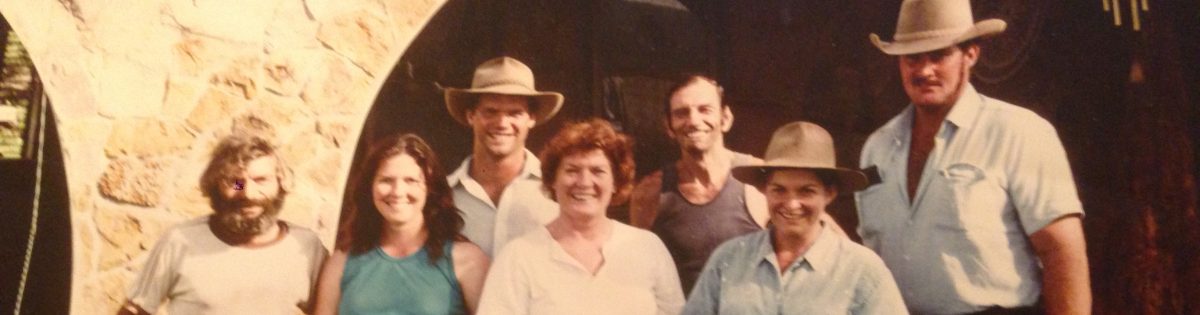
Twenty-Three — Storm Clowns Gather

With the road train in place, we were able to spend the morning of our third day in the yards loading cattle. We ran the animals in single file through a chute and up the ramp onto the trailers. Each trailer had two decks, and the decks were divided into small pens which held two or three animals apiece. After several hours, and with a maximum of clattering and trumpeting, the decks were loaded, the ramps raised, the gates secured, and the road train started ponderously back towards the distant highway, and, ultimately, to the meat works.

It’s easy in our contemporary world to conceptualize our favorite chops and steaks as saran-wrapped entities we pull from the butcher section of the local supermarket, and think no further. But I believe all meat-eaters should be required, at least once in our lives, to spend a moment eye to eye with the animals we deign to toss upon our barbecues. I’m sure the experience would mark the last time some people would eat meat. I don’t suspect it’s true for oysters or scallops, but beef in its living form has an unavoidable sentience. Cattle are mothers and fathers and children with big eyes who feel pain and fear and, to those humans who are paying attention, relief, when left to their own devices. To cultivate them in order to kill them in order to eat them is a pretty damn dramatic thing to do.

I’m not one of those people who stopped eating meat after experiencing the reality of it, however. The experience did not conflate my understanding of the philosophical, perhaps the theological, distinction between humans and animals.  If I believed that humans are simply cattle with bigger brains I would have no justification for eating cattle. The world where the smart guys eat the dumb ones is not a world I’d care to live in. No; I believe that humans are distinct from all other animals in that we have a spark of the divine in us, an aspect of our being which transcends this world. I realize this is an act of faith, perhaps an act merely of wishful thinking. But because I operate on this understanding, I feel it’s appropriate and morally defensible to utilize animals to our end.

But this opportunity brings with it a balancing obligation. I think our elevated status requires that we treat animals with the respect that honors that part of them which intersects our own experience–that is, their status as sentient beings. I think we’re obliged to treat them decently, handle them gently as possible, minimize their suffering. I think we should be scrupulous about not disrespecting the sacrifice stock animals make for us by wasting the gifts of meat, eggs, milk.

I realize this talk is thin gruel for animal rights activists, that to their thinking any suffering we inflict upon animals debases us, voids our status as elevated in any manner. But I think animal rights activists ultimately debase humanity itself by consigning us to simply another cell within the confines of an idealized natural world. Nature is not a gentle mother. Nature is brutal, merciless, predatory, incessantly at war with itself. In that tumult it finds a balance, certainly, but that balance is achieved by pooling the blood of one critter against an equal measure of the other. If we are simply animals among animals, if there is nothing special about us, then our predations upon other animals–be it cattle, or any other–is the most natural thing of all. If the activist’s world view was logically consistent they’d acknowledge that, in the state of nature, either you eat the bear or the bear eats you. And neither act is either more elevated nor less than the other.

But many animal-rights activists don’t take that stance. While some agitate merely for humane treatment of animals, the most militant among them say that, though we have no special status, we do have a unique obligation; the obligation not to eat that which comes naturally to us. But that obligation is based on, what exactly? The fact that we have a caliber of emotional awareness which puts us in tune with the feelings of other critters? Empathy is a beautiful quality which can inform our moral judgment certainly, but empathy alone, feeling alone, does not a moral system make. If emotions were sufficient, we humans would simply leave the victims of crime, for example, to decide the fate of their offenders. In that system some murderers wouldn’t be prosecuted because they killed a person no one liked or cared about, and some thieves would be executed for stealing items of profound sentimental value to the victims, who would want the offender dead. Running a moral system based on sentiment alone is the path to moral chaos.

So even as I looked into the big brown eyes of the cattle heading up the ramp and was saddened by their consternation, heard the concerned bellows of the departing animals as they called out to their herd mates, I’m still able to sit down and enjoy a good ribeye steak. I just don’t fool myself that it sprang ex nihilo upon a Styrofoam plate in the reach-in cooler of the meat department at Safeway.

Perhaps it’s in line with that sentiment that I perceived a vaguely post-apocalyptic feel to the yards with the animals gone. After three days of bovine cacophony the silence was eerie, the sounds of constrained animals still echoing within the clefts of my mind. The hard ground was pounded fine. Burned firewood and ash lay scattered among withered divots of earhide removed in the ear tagging process. Nubs of clipped horn and the occasional gnawed testicle joined among the organic detritus of a patently carnivorous jamboree.

There were at least two animals who came out of the process feeling better than they had going in. Both were young cows whose growing horns took a malevolent turn; rather than curving up or out, they’d curled inward towards the heifer’s faces. The first got off the easier of the two, as the horn’s tip had placed itself against her skull, an aggravating pressure to be sure, but not nearly as sinister as that of the other unlucky beast. Her left horn had actually aimed itself directly for the poor girl’s eye. It’s excruciating to imagine her experience of the inexorable menace of the invading horn as it slowly approached, then kissed, then penetrated her eyeball itself. We clipped several inches off the horn and extracted the tip from her eye socket, which surely offered some relief. But the object lesson the poor cow received in the impassive cruelty of Mother Nature doubtless remained firmly imbedded in her uncomprehending head nonetheless.

With the first drive behind us, we turned our attention to the next of the five planned musters. This second was to be a more complicated affair. We needed to assemble from scratch an entire yardworks twenty-two miles into the bush. We’d need to load several hundred yard panels plus the calf catch and water troughs and all the other accouterment necessary to capture, contain, and process somewhere around 2500 cattle. This muster would be the first of the season to utilize helicopters to push recalcitrant cattle from the wide-ranging bush lands, and during the time the cattle were in the yards we would be sleeping in an improvised stock camp.

Before that cumbersome process began Charlie suggested we take a day off, as there would be no more rest days until the Twenty-Two Mile yards were emptied. Peter used the day to pack his belongings and load them into his ute. I helped him with the task, our jocular banter belying my disappointment at his departure. Down in the stockman’s quarters Bundy was doing the same and soon had his minimal swag tucked in the back of Peter’s truck.

“You’ll be hard to replace,” Charlie said at the dinner table that evening, looking directly at Peter. I heard his words as a startingly frank compliment among hardened stockmen, whose language is typically couched in understatement or even insult. “Best of luck to you.”

“It’s been an honor to work with you lot.” Peter said, continuing in the same tone, “I thank you for all you’ve done, for the hospitality and for giving me the work.”

“Yeah, thanks,” Marlee said hesitantly, as if the need to find non-ironic language had her a bit tongue-tied.

The rising sentiment among an unsentimental people felt awkward. Peter was the first to burst the bubble.

“Maybe I’ll be back up this way some day.” Sara’s face started to brighten as he continued.  “If so, I’ll be sure to send you a postcard from Kunnunarra.” The laughter brought the room back to equilibrium. Peter’s comic timing remained deft to the end; the subtext under his expressed desire to never see these folks again darn near qualified as pillow talk. Had he truly felt that way, he wouldn’t have said a word.

There’s a certain logic to the crusty ethos. Besides the obvious inclination to keep lovey-dovey talk to a minimum among working men (and women) there is also an acknowledgment that theirs is a difficult life. In the sarcastic desire to never return lies an admission that the people left behind are strong enough and capable enough to face the challenges the departing will no longer need to confront. It’s an expression of humility in the shape of a compliment, a double serving of virtue which plays well among uncomplaining folk.

Daybreak the next morning found Peter, Eddie, and I working alongside the girls to pile every available vehicle with the first of many loads of muster gear. By noon our motley loads, piled high and strapped in place, were ready for departure. Over a pan of Sara’s roasted steaks we settled the matter of which vehicle would be driven by whom. Peter’s destination lay well beyond the stock camp so he and Bundy would join our caravan but then bid adieu at Twenty-Two Mile and continue on. Our plans were modified when Sara announced that a new stock hand would need a ride in, as he was due to be dropped by a passing vehicle at the bitumen late that evening.

“Dave, I reckon we’ll send you out to pick him up. That way if Peter is rolling a flat tire back towards Twenty-Two Mile you can go rescue Bundy,” Charlie directed with an impish grin.

“Or if Bundy is rolling a flat tire back towards Twenty-Two Mile you can come wake me up for supper,” said Peter, taking the bait.

Of course, there was no rescuing to be done that evening. Twenty-two miles of jolting and rattling along the dirt track brought us to our proposed yard site. Then, with a handshake and a nod, Peter departed. With him went some of the best of Australia. His rawboned humor, commitment to excellence, and inquisitive mind which belied his roustabout occupation – all were gone in a diesel roar and a cloud of bull dust. I was happy to have the distraction of a backbreaking afternoon of work to take my mind off the abject absence which moved in in its wake.

At last light, as the remainder of the crew headed back towards the homestead in empty vehicles, I pointed myself the opposite direction to pick up the new hand. At this point in the season the two river crossings were no more than bouncy jumbles of river rock crossed by a rivulet. I made it to the highway well after nightfall. My headlights illuminated a bearded gentleman with a guitar case and a middle-aged paunch.

“How you doin’? I’m Dave; been waiting long?” I asked of the stranger.

“Aw, not too long mate. Just enough to where I wadn’t sure whether those were your headlights or the min-mins coming to get me,” chuckled the new arrivee, referring to the mystical apparitions of aboriginal lore. “Me name’s Denny O’Reilly.”

I reached for his guitar case as he swung his swag into the bed of the pickup.

“Oh no! I’ll get Roseanne. She’s a touchy sort; doesn’t like most blokes.”

“Sorry mate,” I said. “So you brought your guitar, have you?”

“Guitar?, No mate. It’s me wife in there. She’s sleeping. You’ll meet her later,” deadpanned the bearded fellow, then, after a beat, “You don’t mind if I have a smoke, do you?”

“No, go ahead,” I said, a chuckle in my voice.

“It’s me only vice, smoking,” he said, “well, that and telling lies.” He darted his eyes my way to gauge my reaction, then turned his head out the window to ignite a cigarette. “In fact, I was sitting here right around sunset waiting for you, having a smoke, when I saw the damnedest thing.”

I glanced over at my companion in an attempt to figure out which vice this story concerned, but could discern nothing from his expression.

“I’m just sitting here, minding me own business, and a bloke on a bicycle comes along. And not just any bicycle. He had one of those old fashion kinds, you know, with the big wheel in front and the tiny wheel behind.” He paused to take a long drag on his cigarette, then continued. “And what was he wearing? Naught but a tophat and tails, is what! He just tipped his hat at me and rolled on down the road. Damnedest thing I ever saw!”

I squinted my eyes and met Denny’s, whose own were firmly fixed on me with a look expressing pure astonishment. I am a credulous soul, a man who tends towards believing people’s words as my first impulse, but with all I’d learned about this gentleman in our three short minutes I knew this story was bunk.

“Uh-huh. And did he have a parasol? Perhaps a pink one?”

“No, Dave; I’m right serious!”

“I’m sure you are, mate,” I answered. “I’ll just wait for Roseanne to fill in the details. When she wakes up, that is.”

“Okay mate, as you wish. I only wish you’d seen it. It was quite a sight.” Denny said, his voice trailing off as he turned towards the window and blew out a long stream of smoke.

Happy to change the subject I asked, “so you’ve been there a while; did you see my mate Peter and his wife heading out?”

“Peter, you say? No, don’t believe I did. But I once knew a man name of Peter.”

Yeah,  I thought. Who hasn’t?

“Yup, sure did. And his pecker was more than a meter. His girl was afraid, that before getting laid, when unloosed it might jump out and eat her.”

“Is that right?” I said, taking the cue, “Well I once had a friend name of Keith, whose mustache resembled a wreath. But on closer inspection, it proved a collection, of pubic hairs, caught in his teeth.”

“Quite a fella, that Keith. His poor dental habits didn’t seem to keep the girls away, reckon,” Denny acceded. “Well, I once had a mate name of Bates. Was a pirate, he was.”

“You don’t say! Could he dance the fandango on skates?”

“Aye, he could, Dave. At least, ‘til he fell on his cutlass…”

“Which rendered him nutless?”

“And practically useless on dates!” we chirped in unison, laughter filling the cab over our newfound mutual affection for limericks.

Outside, our headlights stabbed the ebony night, solo pinpricks in the vastness of the vacant Australian Outback.

During the next week Denny, and Eddie, and I settled into the massive undertaking of creating a portable yard at Twenty-Two Mile. We loaded vehicles with endless quantities of clangorous hardware, transported it down the track, and off-loaded it with equal cacophony. As we were wrestling the calf-catch onto the flat-bed I found myself reflecting on the time I’d helped a buddy move between apartments in Hollywood.  Derek had inherited a fanciful antique cupboard from the previous owner and being that he was an aspiring actor the substantial piece was the only thing of real value he owned. There was no chance he would leave it behind, despite living in a second-story walkup. We, his friends, very much wished that the departed tenant had bequeathed to him something more akin to a gold pen, especially when we discovered that the upgraded apartment was a third-floor walk-up.

Derek roped four of us young bucks into helping move the several hundred pound, six foot tall piece. The first leg of the move quickly devolved into a bouillabaisse of whimsical stratagems and idiosyncratic if passionate assertions on the particulars of physics and architecture, followed soon enough by a plethora of grunts, exhortations, and curses as the various theorems met brute reality. The uphill portion proved a similar buffet of diaphanous assertions and rubicund grimacing, with gravity and the extra floor magnifying the relevant elements by multiples. When we finally shoved the beast into its new position we all felt as though we were qualified to open our own moving business, none of us having lost digits or vertebral discs in the process. I believe we world-beaters congratulated ourselves with tankards of beer, if I recall correctly, though the particulars are a mite fuzzy.

The point is that heavy stuff weighs a lot, and it’s heavy, and hard to move. And moving heavy stuff is hard, because it doesn’t want to move, and when it does it has a tendency to crush fingers and, if it’s not handled properly, it falls down and hits people where they don’t want to be hit, like, on their heads, or knees, or toes. Did I mention heads? And on Bullo River Station we handled articles twice the size of Derek’s cupboard, and four times the weight, then set it in place, and turned around to get another thing just as big, or bigger. We’d do that for a couple of hours, drive for a bit, then reverse the process.  Finally, after doing that all day, we’d have a tinnie of Emu Export Lager waiting for us, if we were willing to part with a couple of the precious shekels we’d earned doing the things that warranted the Bush Chook (as Emu Export was known among its several aficionados).

I think that many of us urban and suburbanites lose track of the grueling work that goes into making the comfortable air-conditioned and plushly carpeted spaces in which we spend so much of our time. Steelwork and concrete-forming may not require a Harvard MBA, but Harvard MBAs require steel and concrete buildings in which they can study and practice their arcane axioms, buildings built by men, mostly, who posses virtues other than cerebral, but virtues no less. The gritty work of manipulating large-scale machinery to create large-scale structures requires persistence and resilience in spades, a willingness to put one’s well-being at risk of pain or death as a matter of daily duty. Why we in America disparage this kind of work, feel that herding all our kids towards university educations and oft-vestigial degrees in oft-tangential disciplines as the only honorable track, I began to understand less the more time I spent at Bullo. What I do know is that we’re robbing ourselves of magnificent young tradesmen and women by not honoring and encouraging the virtues of body and mind which come from unrelenting physical labor. Having a category labeled “Jobs Americans are Too Spoiled to Do”–because that is the filleted truth behind “Jobs Americans Won’t Do”–does not bode well for a society. Lose our spine, our structure, our foundation, and our brains end up sitting in the dirt. They’re not much use there.

Besides the deeper gratifications of working in the world of things, there are visceral joys as well. Stand close to a 90 ton D10 bulldozer loading itself onto a flatbed trailer and see if there isn’t a gob-smacking might and majesty in the forces at play, an unavoidable admiration at the man-made materials which both generate and constrain such forces.

Watching a simple metal chain at work is astounding. When Charlie pulled the stuck road train up the dirt grade with the dozer he connected the two with a steel chain, welded links just a bit thicker than your average rope of red licorice. With that old-school piece of gear he overcame gravity—one of the four forces of nature!  Tens and tens of thousands of pounds of vehicle cheated Mother Nature with a bit of metal ore customized by us to our purposes. Were any of us to find ourselves landed upon a blank-slate earth possessing all we know of what’s possible it would still be countless generations before we could replicate that mere chain, yet in this life any of us can wander down to our local hardware store and buy it by the yard for a relative pittance. On those regular occasions at Bullo where I would get to see chain at work I’d find myself riveted in place, teeth clenched, nose wrinkled, head gently shaking in wonder.

This is not to suggest that everyone at Bullo was equally enthralled with the process. Very early on I began to recognize that Denny’s enthusiasm for work didn’t quite equal his zeal for yarnin’ and rhymin’. His water breaks were frequent and began to grow in length as the week progressed.

“Hey mate, give us a hand here, will ya?” I called out to him one afternoon as we were unloading coils of barbed wire from a pickup. Barbed wire grabs everything, always, making it a bear to handle heavy reels by oneself.

“Sure – just a sec,” answered Denny from a dozen steps away. I continued fruitlessly tugging at my spiny load, expecting help which didn’t arrive within any time I considered “a sec.”

“Denny!” I called out with a bit of exasperation, with both the balky wire and the desertion.

“Christ, mate,” he retorted while sauntering distractedly my way, “you’re not my bloody boss!”

“No, man, I’m not. Just trying to get stuff done around here, that’s all.” I saw that he was occupied rolling a cigarette.

“Well, it’ll get done, mate. And we’ll work together to do it. But you’re not the shop chief here, and I’ll appreciate you remembering that. I take a blow, you take a blow.” His jovial demeanor had dissolved entirely.

He did have a point. Though my three months had given me a strong stake in the welfare of Bullo I was no more than another hired hand in the situation. So I acceded to his pace, and the rest of the afternoon proceeded in a peaceful, and leisurely, fashion.

After dinner that evening I walked down to Stumpie’s quarters, where Denny and Eddie were just finishing their dinner with the diminutive Bullo fixture. I was interested I ratifying the peace.

“Is Roseanne still sleeping? Or can we get a chance to meet her?” I asked in a chipper tone.

“Well, let’s see how she’s feeling,” said the new hand broadly. He disappeared into his room for a minute and returned with a handsome rosewood guitar, its pick guard nearly worn through with use. The middle-aged man placed the instrument upon his knee and within moments the air was filled with a beautiful instrumental melody, evocative of an American Bluegrass ballad or an Arcadian lament.  Denny was a marvelous guitarist, and as his hands flowed across the fretboard his eyelids lowered and his head tilted slightly forward. Eddie sat nearby, impassive but engaged. Stumpie smiled broadly through his facial shrubbery. After months where the only music I’d heard was the constant loop of the Best of Kenny Rogers on Sara’s stereo, it was mesmerizing to hear original music, organic and up-close. At that moment, I was sure this was the most beautiful song I’d ever heard. The silence, when it returned, was excruciating.

“Wow,” I said, as the melody faded into the starry sky. “Dude, that was beautiful. Did you write that? What’s it called?”

“I did,” said the troubadour. “It’s called Tanzy’s Waltz.”

“It’s beautiful. Really. Who is Tanzy?”

The bearded man responded with a simple shake of his head, a gesture that sealed the topic.  Instead, he launched into a cover of James Taylor’s Sweet Baby James. His voice was full and soft at the same time, as if he’d just gargled with caramel schnapps. One song led to another, then another, until the stockquarters and the workshop and the night itself ceded its presence to the bushman’s cri de coeur. For his last tune Denny played an Australian-ized version of Kris Kristofferson’s Me and Bobby McGee:

Busted flat in Wollongong

Headed to the bus

Feeling nearly jaded as me jeans

Sheryl thumbed a Holden down

Riddled through with rust

Took us all the way to Narrabeen…

I eventually walked back to my room, knowing there was no concert I’d ever seen, nor any I could conceive of seeing, more impactful than that performance by Denny O’Reilly, sitting upon a tree stump in front of the humble stock quarters of Bullo River Station. It was more than the novelty of the moment, or the freshness of hearing live music after a hiatus, though those surely were elements. More at play was the sentiment behind the music. Denny revealed through his music a disquiet, an unknown affliction, for which his music was medicine. He was alone, as he played, as was I as I listened, and within that solitude he and I were one.

The next day, back at Twenty-Two Mile, I let Denny know how much I enjoyed his music.

“Aw, mate, just a bit of plucking,” he said with deliberate understatement.

“So Denny, do you have a family? Wife or kids?” I suppose I was digging at the root of the sentiment I’d seen last night.

“Nope.” He said flatly, turning back to the task at hand, “not to speak of.” I didn’t know whether by this he meant he did not have close family, or that the subject itself is not open to conversation. Either way, I understand the topic to be closed. “I’m going to have a smoke,” he said quietly as he stepped towards the shade of a nearby tree.

For all the softness I felt towards the man, the obvious sublimated sorrow and the tender soulfulness of his music, I could not help but become increasingly agitated by the quantity and duration of his work breaks. I was accustomed to working with Peter and his relentless diligence. His pace suited my own. A great deal was accomplished in short periods that way, and there was always a great deal more to do. With Denny, the punctuations within the workday were beginning to take up nearly as much time as the work itself. This was especially true when he and I were left unsupervised by either Charlie or the girls. I decided to raise the issue one evening with Charlie.

“Look, Charlie, I like Denny. He seems to be a good man. But he’s driving me nuts with his regular smoke-Os. Is there anything you would have me tell him on the subject?”

“It’s not your business to tell him anything, Dave. You just do your job and do it as well as you can. He is a bit of a bludger, sure. But that’s not your problem, and it’s not yours to fix,” the big man said sternly. “You take care of Dave. Denny will take care of Denny.”


Twenty Two — The Charlie Component

The next morning we began the work at the core of outback station life. The non-negotiables in cattle country include putting your mark on your cattle, making certain that only the most desirable animals breed, and cashing in those animals ready for the meat works. These tasks fall under the heading Herd Management, and it’s work accomplished with a trained eye, strong arms, and an unending capacity for physical work in the yards.

Our first step involved branding, castrating, dehorning, and ear-tagging the calves. If calves are separated from their mothers for too long mom will reject them when they are finally reunited, heedless of their woebegone lamentations. So in the blue light of dawn we began running the youngest of our captives one-by-one down a small laneway and into the calf catch. This contraption resembles, as much as anything, a Venus flytrap. When the operator closes the device two metal bars snugly hold the calf’s neck as its torso and belly are sandwiched firmly. With the animal confined, the hinged device is dropped, holding the beleaguered critter on its side. From there the rump is easily accessed for branding, the ears for tagging and marking, and the testicles for removal.

I was stationed at the branding oven, a fifty-five gallon drum converted for this use by Uncle Dick. He’d removed a portion of the bottom third so it could be loaded with firewood, and added a shelf to the top section. He’d then welded a three foot chimney atop. When the bottom was thick with embers, the branding irons laying upon the shelf heated red-hot. We’d set a supply of firewood close at hand. Over the course of the long day, I placed the station brand and year marker on the rump of 200+ calves.

None of the critters were too excited about their prospects as they lined up in the race and became considerably less enthusiastic as we did our work upon them. I tried hard to be quick and accurate with my branding. Each hit with the hot irons filled the air with a sizzle and the aroma of singed hair and toasted flesh. I was working the hot irons in close proximity to either Marlee or Charlie as they were deftly castrating the males. With two quick slits, a tug, and a slice the young fellas were emasculated, and their destiny for the meat works sealed. Most of the testicles were placed in a burn bucket, but occasionally Charlie would humor Hunter and the other dogs by tossing a couple of the plum-sized organs into the dust, where they were enthusiastically gobbled by the hard-working canines.

“You’ll have a prairie oyster yourself, Dave?” asked Marlee with a challenging grin. I suppose she’d seen my consternation at watching the dogs fight over the raw nuggets.

“Yeah… I’m not that crazy about raw beef. Munching a mickey nut doesn’t have much appeal, thanks,” I deflected.

“Oh, no,” chirped Danielle. “We’ll cook one proper for you, mate.”

“Right,” I said incredulously. “We’re going to have a little cooking class here in the middle of the yards, are we?”

“Naw, Dave,” said Charlie, joining in, “we’ll just do this.” The big man cut a couple of slits crosswise on the freshly extracted testicle he held in his hand and set it on top of the branding barrel. Within a few moments it resembled a football shaped sausage, nicely browned, juicy and halfway appealing, if you didn’t know what it was.

I eyed the article suspiciously. “So what’s it taste like?”

“Chicken,” answered Bundy with a wry smile.

“Well, chicken nuggets, anyway,” said Peter, to laughter all around.

Charlie pulled from his pocket a different knife than he’d been using for the neutering duty and cut the calf nugget into four quarters. He popped one of them in his mouth and said,” go ahead.”

If I didn’t like liver, or sweetbreads, or even the fried calf brains I’d once tried, I would’ve had no hope that this bush morsel would’ve had any charms. But given that I do like organ meats, and am a big fan of sausage, I popped the sizzling quarter into my mouth and found it rather tasty. tongue I can’t promise I’ll replace my usual fried eggs and pork sausage with fried eggs and bull’s balls on any kind of regular basis. Our taste buds reside as much in the culturally conditioned portions of our brain as they do on the surface of our tongues. But the curious truth is I didn’t find mickey balls at all unpleasant.

“It’s not all bad,” I said with a note of surprise.

“It’s the first rule of station life, Dave,” said Bundy with a grin. “Don’t ever turn down tucker.”

“Are we gonna see you fighting Hunter and the lot for the rest of your lunch then, Dave?” asked Peter mischievously.

He’d been busy at the animal’s heads, working a distinctive hole punch onto the broad fan of the calves left ears. The resulting divot made visual identification across a distance easier. He’d then use a compact set of snippers to nip the sharp tip of the young cattle’s developing horns.

With the procedures completed two of us would stand the calf catch back up, release the latch, and the newly marked and castrated calf would scamper away, bleating and shaking off its insults. The next patient would be run into the catch and we’d repeat the operation. Occasionally, a calf would give us a feint, or in some other way throw off the timing of its movement. If the catch operator got fooled and closed the mechanism a beat too late to seize the neck he would release the mechanism, and one of us would need to do a little bulldogging. I was particularly enthusiastic about this duty, as it didn’t require any expertize. I’d corner the calf within the small pen, then throw myself upon the little fella and wrestle it to the ground. I held the struggling animal while the others did the necessary tasks upon it. By my third bulldogging session, a profuse sweat had combine with the pounded bull dust into a layer of filth caking my chest and jeans. I didn’t care; I felt useful. I enjoyed the challenge of getting the calves to the ground, especially the larger ones. I was just sorry the camera crew wasn’t there to immortalize my manly exertions amid the dirt and muck.

Sara, with perfect timing, appeared at the yards midmorning on the second morning of our exhausting labors tagging and branding and cutting. She arrived with two large thermoses of hot tea and some baked snacks. I’d become a fan of the British tea break. I’d never been much of a coffee drinker; more than a single cup tended to make my stomach queasy. But with this sweet and milky tea I could slurp several cups with no price to pay.

Sara also brought some news.

“I just heard from the driver,” she said, referring to the fellow bringing the live cattle hauler to the homestead yards. “He’s gotten bogged on the jump up.”

“Did he unhook?” Charlie asked with a level gaze.

“No, Charlie. It sounds like he decided to be game and drag both trailers up at once.”

“Well, I reckon he’ll pay more attention to our instructions next time.” The big man paused. “Dave, when we’re finished here you and I will drive out to the grader at 22 Mile. We’ll top the grader off with fuel. You follow me to the jump-up. If we’re right from there, you can head back. I’ll drag the drongo up and follow him in.”

“Christ, Charlie, that will take all night!” Danielle said incredulously.

“Yup,” said Charlie.

I expected some manner of derisive comment regarding the unwise truckee to follow, but none came. Charlie let the evident foolishness of the man’s poor decision hang in the air as sufficient testimony of its deficiency. On reflection I realized that any potshots Charlie might have directed towards the easy target would have diminished Charlie himself, in a way. Kicking a man when he’s down brings attention to the kicker, a distraction from the pertinent question–why is the man down in the first place? What might he have done to keep himself from being in that position? And that’s the nut of the matter, isn’t it? Any gratuitous shots do the sufferer a favor, don’t they, by turning them into a victim of someone else’s malevolence rather than a sufferer by his own malfeasance?

I can’t know Charlie’s exact train of thought in the moment, but it doesn’t matter. I’d long since come to admire Charlie’s manner of dealing with people. His mastery of machinery and capable touch with animals were impressive, but his ability to run a crew required knowledge of the human spirit, an art much more subtle than that required to move machine or beast. I hadn’t once heard him raise his voice in anger. His quiet manner and direct instructions generated an authority organic and absolute. His inclination was to give a person enough rope to either bind himself to coworkers, or hang by themselves. This respect for the autonomy and assumed competence of others was appreciated and reciprocated by everyone I saw engage with Charlie Ahlers.

Charles W. H. Ahlers was born on the tablelands upon the leeward side of the Great Dividing Range which parallels the eastern coastline of the Australian continent. Charlie’s grandfather once controlled an entire valley around the played-out gold mining claims along the Palmer River in northern Queensland. By the time Charlie arrived, Maitland Downs had been reduced by inheritance and sale to a section of several hundred thousand acres. Charlie’s father worked cattle from his earliest memory, the classic cattleman who spent so much of his life outdoors that, to his dying day, he could not sleep in an enclosed bedroom. If he wasn’t at the stock camp, George Ahlers would be found spending his nights on the veranda of the family home at Maitland Downs. Growing up, Charlie was too busy learning important things to waste time at school; his formal education finished after eighth grade. His talents lie outside the classroom. His precocious understanding for machinery of all sorts had him by the time he was ten disassembling then bringing to life the rusted mechanical relics found abandoned in generous supply around station junkyards.

In the days before ubiquitous motorized and mechanized technology, stockman needed to know how to work cattle artfully; driving them into submission with helicopters and quad bikes was not an option. This craft of working with stock from horseback, eye to eye, has been sacrificed to the conveniences of the contemporary world. I suppose an analogy might be found in the world of penmanship; the cattle work practiced by Charlie’s family was as calligraphy is to the word processor. Both get the job done, but the process is very different. And there was a fluidity and elegance to the former, lacking in the robotic clickety-clack of the modern style.

So George would have taught his son something of the old ways, imbued in him a sense of the finesse required when dealing with animals. I’d noticed Charlie’s restraint when face-to-face with Bullo’s horses and cattle, sensed his frustration when we were reduced to bullying the animals into submission. In the old ways, all animals are slowly and patiently habituated to human contact. This process alleviated some of the panic I’d seen among the animals at Bullo, where Charles Henderson had practiced no such subtlety.

That Charlie Ahlers maintained amidst the noise and dust of Bullo as much of his birthright finesse as possible, his quiet manner of dealing with marginally domesticated animals, was admirable. Charlie truck displayed a bumper sticker which read “How can I soar like an eagle when I’m surrounded by turkeys!”. Charlie’s solution was not to go on a turkey shoot. Instead, he aimed to turn every resource around him–human and animal alike–into eagles.

Late that evening, when we’d finished our bruising day with the calves and after humping multiple bales of hay into the pens, and filling all the water troughs, when we would typically take the welcome stroll back to the house for a shower and a meal, Charlie and I instead drove the King straight to the workshop. We loaded an empty 55-gallon drum, strapped it down, then filled it with diesel fuel. We swung by the homestead, where Marlee handed us each two steak sandwiches on thickly sliced bread, spread with treacle. We filled two jugs with drinking water and were on our way.

“So you tell the drivers to bring their trailers up the jump-up one at a time?” I asked, between hopping out to open the several homestead gates.

“Most of them don’t need to be told. This fella must be new.”

“New to Bullo, or new to the job? I mean, isn’t it obvious that the jump up is pretty steep?”

“It’s deceptive, actually. It’s hard to get a read on how steep it is because it’s quite long. I mean, if you take a good look at it it’s obvious, but if you just plow right on without paying attention to what you doing you’ll be buggered in a hurry. That must be what this fella did.”

“That seems like a silly way to run a business. This truck is his livelihood.”

“Don’t underestimate the power of lazy, Dave. It takes twice as long to unhitch two trailers and get them up one at a time than it takes to do it in one shot. If you’re running on ego and hope, you might give it a go. But a man has to know his machinery, and the land. And his own limitations. Miss any one of those three and you’ll find yourself waiting for help, or worse.”

Charlie made this point looking directly at me. Though he offered it with a slight smile, I took his words as warning as much as observation. The stakes in station life are high. Whether the danger was losing a night’s sleep, a cattle trailer, or life and limb, the possibility of failure is constantly at hand. Had I stumbled when chased by the angry cow in the yards the day before I would have been trampled, gored, even. Perhaps I would have gotten up dazed but okay. Perhaps I would’ve been helicoptered to a hospital and died. Either possibility was real. And the deciding element was my ability to put one foot in front of the other without stumbling over a rock, or a root, or my own feet. Tightrope walkers put no more at risk than I had in that precipice of a moment. Yet it was simply one moment in a day of moments, within a week of moments, within, for these people, a lifetime of moments. And within that context of impending menace, great jobs must be undertaken and completed. The word “tough” doesn’t even begin to describe the spirit which animates even the most ordinary day in the Australian outback.

“Well, you know what Einstein said about foolish people, don’t you, Charlie?”

“What’s that, Dave?”

“He said, ‘the difference between genius and stupidity, is that genius has its limits’”.

The big man and I shared a chuckle, then settled quietly into the black night.

When we reached the grader Charlie climbed aboard, fired ‘er up, and headed along the track towards the long rise which leads from the highway into Bullo. After several hours, the stranded truck came into view. The driver had unrolled his swag next to the cab and, as we pulled up, he was unbuckling a wooden leg and preparing to climb into bed.

“I was starting to think you’d be here in the morning,” the slight man said, holding his artificial limb in his hand, embarrassment visible on his face. I suspect the embarrassment had nothing to do with the limb, however, and everything to with the look Charlie was giving him.

“Nope. We need to get these cattle loaded in the morning. Let’s get you up the hill.” As he spoke Charlie was opening the utility box which housed chains. “I’ll hook you up and we’ll walk it up. Slow and steady. But first I need to top off my tank.”

I pulled the Toyota next to the grader, inserted the hose, and began hand cranking fifty-five gallons of diesel into the earthmoving machine. When I finished Charlie thanked me and bid me home. It was nearly 2 o’clock in the morning before I climbed in bed. Charlie would have spent an hour in the tow operation, then traveled the fifty miles trailing the trucker on the grader. There would have been no chance he arrived home more than an hour before daybreak.

Yet the next morning Charlie beat me to the breakfast table. There was nothing in his manner or talk which revealed whether he’d stayed awake, or had gotten a few minutes of shut-eye. With the new day

dawning there was work to be done.

And when there was work to be done there has never been a better choice for the job, no man more capable or willing, than Charles William Harding Ahlers.

Twenty-One — Mad Cows and Dis-Ease

But my star turn remained a ways off, with much work to do in the meantime. Marlee and Charlie intended to get the first of the five separate musters out of the way before Peter’s departure. All the work we’d done to prep the yards and laneways had gotten us very close to that mark. The next step involved clearing cattle from the small paddocks nearest to the new laneway. This we’d do on horseback. We started our day by saddling our horses in the golden breaking dawn, the morning mist and ambient dust turning everything more than an arm’s length away into a radiant silhouette. We rode as a group out of the horse pen and along the fence line in Bull Rush, all the way to its furthest corner. We then fanned out and began the process of aggregating and pushing the cattle within the arc created by the five riders. Eddie quickly showed himself to be an able horseman, riding easily in the saddle and moving his horse about with the slightest of gesture. I again found myself astride Silibark, where my main challenge was overcoming its compulsion to dawdle. A few times I overplayed my need, jabbing my heels into Silibark’s flank in a way which spurred him from a near standstill to a full canter. I managed to hang on in those circumstances and reined him into a trot without being ejected from the stippled gray steed. I congratulated myself for not being thrown, low a bar though that may be in the world of horsemanship.

I soon learned that these cattle were easier critters to muster than the half-wild brumbies we’d chased about the previous month. Most of the bovines took their cue easily, joined their mates, and began their slow walk to the laneway. Within an hour we had several hundred cattle contained in Homestead paddock. Though most moved easily along the fence line and towards the laneway, a few required a more vigorous coaxing. Most often the problem arose when calves became separated from their mothers. Bawling lustily, the calves would take only two or three steps unbidden. They quickly drifted to the rear of the pack, directly in front of us riders. Convinced that their mothers had been left behind, they would turn and face us, bleating pathetically. We’d ride up on the calves, yet most still would not move. Watching the other riders, I learned to urge Silibark to push his chest against the piteous bleaters to get them moving the right way. Occasionally a mother cow would hear her calf crying out and come running to find her little darling. Some of these desperate mommas faced up to us and tried to run past. In those moments, horsemanship proved its worth. Danielle or Marlee or Eddie or Charlie or even — a couple of times, I — sprinted directly in front of the bolting cow to encourage it back into the herd.

By midday we found ourselves pushing a thousand cattle up the laneway towards the yard. As the lead mob reached the holding yards they hesitated, despite the open gate. We riders continued our slow push on the rear of the mob. This was a tense moment; had the notion of reversing course swept through the herd we’d have been staring at the business end of a thousand skittish, hardheaded animals coming our way. I took my cue from the others, and stood in my saddle waving my hat, urging the mob on. Fortunately, those animals at the front sought their escape through the gate and the rest of the mob followed. At Charlie’s direction, Peter and I dismounted and ran twenty yards to shut the gate. I didn’t need anyone to point out the problematic potential of this moment; had the mob decided to relieve their claustrophobia by turning around  heading back out to pasture before we could chain the gates, Peter and I would have been waffled between gate and yard panels by a thousand marauding bovines. With swift determination we swung the iron gates closed against the rumps of the last to enter, throwing the chain around to secure the two gate sections as one. We celebrated our success — and gave the cattle a few moments to calm themselves — by taking an abbreviated lunch.

Our return to the yards marked my first experience with a large group of confined cattle. The potential stakes of working amongst these irate creatures in tight quarters were immediately apparent. Cattle are much larger than we city folk tend to think they are. Many reached to my chin along their backbones. With their correspondingly wide girth and suspicious eyes they made for a formidable presence individually, and a downright fearsome presence in their current collective agitation.

Our first task involved running the individuals one-by-one into a round yard, just as we had with the horses. From the round yard they would be let into one of several sorting pens. With this many animals, we needed to funnel the single mob through a series of progressively smaller pens in order to make manageable the job of allowing only a single animal at a time into the round yard. We began by carefully opening the gate from the main yard into the first holding pen, large enough for sixty or seventy animals. As we opened this gate the animals nearest shied away, leery of the newly available space. Peter made certain I’d seen two scrub bulls among the nearest faces. I kept my eyes on those two as we circled behind the crowd nearest the open gate. In a scurry of snorts and dust the appropriate number avoided our approach and scampered into the smaller pen. We closed the gates, pushing through the skittish and agitated mob to do so. I do believe I was looking seven different directions at once, monitoring the intent of the unhappy animals now at my elbows. The scrub bulls maintained their distance. We swung the gate closed and vaulted onto the railing, safely above the herd.

This sorting process—known as drafting in ringer-ese—filled the rest of our day. Cows with calves went in one pen, cows without calves in another, bulls into a third.  Anyone unbranded was segregated to that task. Yearlings, stout but not yet fearsome, comprised most of the unbranded stock. But because each year’s muster cannot be 100% thorough we found a dozen full-grown critters as yet unbranded, large and ornery, eight of these being full-grown bulls. Given that the highest-spirited animals were the ones most likely to resist being pushed around by a bunch of loudmouths on horseback, that the bulk of these would be testosterone-charged scrub bulls came as no surprise.

All the adult animals were intimidating, but these scrub bulls were downright terrifying. Solid as anvils, their musculature was front-loaded; massive necks and bulging shoulders tapered to comparatively thin hips. All had substantial, pointed horns. Battle scars tattooed their broad faces and shoulders. And while none of the cattle were delighted with the situation, these bulls were palpably enraged by their plight—confined alongside their rivals, red-eyed, menacing, malevolent. Our stated intention to stab red-hot metal onto their keisters hovered in that moment as a certifiable brand of crazy, to my mind.

Dealing with the bulls would be one of our final tasks, however, and none of the other jobs began until we finished drafting the entire mob. After we’d moved half the original number through the round yard a new wrinkle in the drafting game became apparent to me. With all the empty space in the main holding pen, it wasn’t obvious to the remaining cattle where they needed to go. We’d fan out across the wide main pen to urge the animals towards the desired gate, but if they didn’t immediately perceive our intention they’d circle back and lope past our waving arms. On one of these pushes I was in the middle position, farthest from the fence, my attention focused upon the two scrub bulls among the remaining mob. Suddenly I heard a shout. To my right I saw a tall yellow cow with an impressive set of horns, shivering and snorting. She’d turned to face me directly from forty feet, and just as I set eyes on her she lowered her head and came my way at full throttle.

I’m not entirely certain exactly what happened next. I assume that light passed through my cornea, cleared the iris, hit my retina, was gathered by my neurons, and was then hijacked by my reptile brain. Without the burden of any higher processing folderol I launched into fight-or-flight mode, with ‘fight’ not an option. Marlee said later that I did a ‘proper somersault’ over the six-foot fence. All I remember is bolting towards the fence in the near distance, putting two hands on the top rail, then landing both feet on the opposite side. As I gathered myself and turned back towards the pen the half-ton cow crashed into the fencing, two feet from my wide eyes.

“I hadn’t seen you move that fast in three months!” cracked Marlee with a wry smile, “Good thing it’s not early in the day!”

“A bit too close there, Dave,” said Charlie, with a tone of disapproval. “We need you here today.”

“Yeah. I’ve got some aspirations to survive the day myself, Charlie ol’ boy”, I thought. “And tomorrow, and maybe even next Tuesday”, though that proposition suddenly looked a mite less certain than it had a few moments earlier.

Thusly was I introduced to cattle work; with the realization that my first and last taste of local flavor could easily end up being the taste of dirt. Or blood. Or cow muck.  When I reentered the pen—no time-out for the rookie ringer—I gauged more carefully my distance from the fence and scanned the entire mob more assiduously. Over the next several months I found myself being chased from the yard a half-dozen times, each incident becoming less dramatic than the one before. I eventually got to where I would lope over to the fencing, vault to the top rail safely out of harm’s way, then hop back into the pen with nary a worry. Perhaps I became too casual; one time I misjudged my distance and got chased around a eucalyptus tree like a rodeo clown around a barrel. I then chose my moment and made it to the fencing before the peeved cow could recover her line and get at me.

The Outback has a way of keeping a person humble, however. My strategy of avoiding a charging animal by hopping onto the top yard rail proved shaky when I saw one fiercely determined scrub bull do something I would not have imagined possible. This particular fella was full grown, fifteen hundred to two thousand pounds of solid muscle and malice. His face was crosshatched with scars of past victories, his eyes, red and venomous. He’d managed to elude the muster for several seasons. Why and how he made it into our yards this particular year I do not know, and the mystery was obviously equally apparent to him. He was one of the final candidates to make his way into the round yard, only after chasing all of us in multiple circuits around the large yard. Charlie called Kelly into the yard to see if she could persuade the ornery chap to move through the gate; he simply flung the gutsy but over-matched canine six or eight feet in the air and twenty feet distant when she closed in on the bull. Hunter, a solid 90-pound Rottweiler, entered next. Hunter managed to clamp his jaws on the bull’s nose, but the big fella started doing circles in an attempt to swing Hunter off. Around and around they went, the enraged bull with its dogged dance partner hanging valiantly from its schnoz. The bull then changed its strategy, dropped Hunter into the bull dust, put its head down, and overran its domesticated opponent. The force of the great bull’s forehead against Hunter’s chest caused the dog to release its grip and slink to safety. We wranglers gave the bull a few moments to collect itself and as it did so it perceived the open gate and ran through. Marlee, working from above, quickly chained the round yard gate, then opened the gate to the bullpen.

The bull seized its opportunity. Taking six or eight great strides, it taxied itself through the pen, then launched up and over the six-foot fence at the end opposite the round yard gate. It didn’t even rattle the fence as it cleared, its strong if stumpy legs projected forwards and backwards like a bovine Superman as it freed itself and galloped back into the open bush. Had I made the mistake of avoiding that particular bull’s pursuit by sitting atop the railing, I’d have been whisked unwillingly and rather awkwardly into the bush on the point of the bull’s horns. As an observer I froze in my tracks at this display of ferocious will and unfeasible physics exhibited by the aerodynamically preposterous animal.

“Bloody Hell,” said Danielle, “sign that one up for the Olympics!” I assumed that in her nineteen years she’d never seen such athleticism either.

Apart from these few moments of adrenaline the afternoon moved along in unvaried routine. Standing ankle-deep in bull dust and cow muck we moved the animals through the pens and into the round yard, identified their needs, segregated them into their individual pens, then made sure they had plenty of hay and water for the night. As we walked back to the homestead, the descending shades of evening light illuminating a mirror image of the morning’s visions, I was struck by the chorus of calls the cattle made. The plaintive mewling of calves and the tenor bawling of their concerned mothers echoed through the yards, the whole undergirded by basso profundo complaints from the captive bulls.

As I listened I also noticed a tide of insect noises rising with the encroaching darkness, the squawks and chirps of birds from trees surrounding the homestead, the distant cries of Gallahs settling in for the night among the eucalyptus. Along with the hum of the generator powering the evening’s activities and the subdued chatter of our tired selves I appreciated an unexpected fullness of sound within this vast emptiness, a symphonic presence discordant with the sparse visuals of the outback. The eye alone is fooled by this place, I thought, a device wholly inadequate for evaluating the breadth of living energy amongst the unseen shelters of the always surprising Australian bush.

Twenty — The Only Constant

One afternoon after an easy romp through Bull Rush Peter smiled broadly, turned to me, and told me he was planning to leave Bullo. From his saddle he said something about becoming a father. His wife Diane was pregnant, they felt pretty sure, and would go down south to live with her parents for the happy event.

I reflexively kicked Silibark and mouthed a big congratulations, even as I realized in that moment that my Bullo River experience had changed dramatically.

Peter Clark has a manner about him which invites friendship, and I had come to quite enjoy his company. He finds humor in the most unlikely moments and has a casual style about him which de-escalates tense or demanding situations.  I’d come to admire his integrity, his commitment to doing things the right way, every time. In that he mirrored Charlie, which is why Peter was spending this season, his second at Bullo, despite having the qualifications to be a station manager himself.

“So what will you do down south?” I asked that evening after dinner. I did not know if he had brought the subject up with Charlie and the girls yet, so I hadn’t raised it at the dinner table.

“Oh, I don’t know mate. I need to earn a bit more money if we’re to have a new mouth to feed,” the slender man said, looking past me. Returning his gaze to me he said, “I would like to run a station, if anyone will have me. It’s more sheep down south, and I’ve actually spent more time among them anyway.”

“Geez, Pete; I can’t imagine you’ll have much trouble finding a spot. You’re a conscientious guy, and not a pain in the ass more than a couple of times a day,” I said with a chuckle.

“Yeah, I don’t know Dave. There are still plenty of small minded folk around who wouldn’t be too happy to see their manager bring along his aboriginal wife, and little brown baby.”

Coming as I had from Los Angeles interracial relationships are irrelevancies to me, but I had noticed during my time in Australia that folks of different colors did not mingle readily. I’d seen some Asian faces in Sydney, but once I left skylines behind white faces were ubiquitous. Where I had occasion to come across Australia’s indigenous population they were keeping to themselves, as in the roadside eatery on my bus ride up.  In fact, Peter and Diane were the first interracial couple I had observed, much less spoken with. And I had right from the start admired them for their non-conformity against the unsavory inclination to maintain a rigid separation of the races. To do so in the city is one thing, but to flout convention in the bush was another level of commitment to a beautiful principle altogether.

“I have noticed Australia is not much of a stew, ethnically speaking. Do you really think it will be a problem for you guys?”

“It won’t be a problem for me, mate. The problem is theirs. I have no interest in working for someone who’s got a problem with Diane. If they won’t have me for that reason they need more than a station manager. And I’d have no time left over when running a station to be training up owners on matters of basic decency.”

“That sounds like a great attitude, buddy. I hope you find something quickly where you guys can settle into the family life. Meantime though, what am I to do here? Wait for some other bozo to show up? What if it’s one of those small-minded types we were just talking about?”

“Oh, I reckon the girls and you can just throw a rope over him and hogtie him until he sees the light.”

“I suppose you’re right. Hell, the girls could de-nut him if he is too much of a problem,” I said with a breeziness I wasn’t feeling. The thought of losing Peter was a gut-punch.

“So the clown is leaving the circus,” Bundy said when he heard. “Since you’re driving out can I catch a ride with you?”

“So the jester is going bush also?” Peter said with evident surprise.

“Yeah, I think so. It’s the first rule of station life, you know. Never let a good opportunity for escape go to waste.”

I don’t know if Bundy had family issues to attend to back home, or whether these three months in one place were his limit; regardless, the crew which had become family through many days of hard labor was, just like that, disintegrated.

With these men I had been introduced to the rigors of station life. It had become a given that I would wake before dawn, that I would squat underneath a cow in the final cold tendrils of night, that I would have a simple breakfast, and that at daybreak my hands would be busy in the field. My hands themselves had started to toughen, which gave me some relief from the nuisance cuts, pinches, and bites constant in this life. Ever since my spate of fencing with its constant bashing of metal against metal the hum of agitated nerves had become a constant undertone in my hands. I assumed that this tingling, or its cousins – ache and pain – were simply part of the fabric of this physically demanding life, in which the human body is often the most fragile element. Yet there really wasn’t much talk about discomfort among these coworkers, though the occasional involuntary winces or other understated exclamations revealed the otherwise unspoken difficulties. I admired this stoicism, especially when evinced by Uncle Dick, whose thin and weathered frame and battered calloused hands were testimony to a lifetime of abuses.

Work in the outback is hard, and the people who make their life here are hard. The people are tough, the regimens are tough, the elements are tough, the language is tough. In our urban lives we are accustomed to regular periods of relief. Certainly, there is much hard work to do in any productive contemporary life, but in the city we have the benefit of air-conditioned buildings, stocked vending machines, icy-cold drinking  water at the push of a button. We spend our lunch hours at smart cafes, end our workdays with cold beers in stylish pubs, then hop in posh vehicles for a pleasant cruise back to our comfortable houses. Station owners and workers rarely enjoy any of these comforts in these lives they have voluntarily chosen, with hot hours in the sun breathing clouds of bull dust, tough sliced steak between two slices of buttered bread for lunch, a cold beer from a tin can after nightfall often the sole refuge from the demanding days.

But I had come to find that that simple sandwich under the shade of a Coolibah tree or that cold beer offered a satisfaction not often found in our city lives, where the comforts available to us are so constant they’re easily taken for granted. I suppose part of the magic of that tinnie of Emu Export Lager was the contrast it offered to what had immediately preceded it. Combined with the tangible evidence of the day’s work as we drove towards the homestead the unadorned quaff offered a pleasure simple yet bold, a substantive satisfaction unknown to me in my previous life.

An unexpected revelation of this rural life was the different caliber of freedom it afforded. In urban America we revel in our freedoms, but we experience freedom too often as an abstraction. Freedom to move and do as one pleases is constantly inhibited in the city. In a purely physical sense our pace and direction is constantly regulated; by traffic lights, don’t walk signs, the presence of other people and vehicles and structures and fences and signs and security gates. Add to those limitations the blitzkrieg of laws and regulations and policies and procedures and homeowners association covenants and it becomes wry fact that the stout freedoms we so boldly celebrate have, in practice, been incrementally bonsai-ed into a quaint topiary.

In the outback impediments exist, certainly, but more due to the obligations we voluntarily take on — animals which need feeding or pipes which need mending.  Taking care of those things which must be done certainly is not unfamiliar to city dwellers, but the manner of doing so is more constrained when navigating the labyrinthine maze of the artificial environment. Out here, we’d throw some gear into the back of the truck and head out to our worksite along the dirt track, pulling off the track whenever we needed or wanted, at whatever speed we desired, stopping when and where we wanted. Never is there concern for checking the rear-view mirror for patrolling officers, nor security cameras or nosy neighbors. This freedom to move about freely and under one’s own authority is alien to urban residents yet is a freedom as pure and primal as anything promised in the U.S. Constitution. We city folks will spend a few hours with a ball game and some fireworks on the Fourth of July, sure, but then we’ll spend the next few hours getting in each other’s way as we try to exit the parking lot and get back home.

So the idea that Peter and Bundy would roll up their swags and move on without sentiment was an expression of the free man’s prerogative, I suppose. It’s the nature of this life that work is easy to find – the need is great and the pool of men and women willing to put in these kinds of hours doing these kinds of tasks is small, and getting smaller. Certainly, this decision was no shirking of responsibility by these fellows; I’d watched them bust their butts for endless hours doing unforgiving labor. They simply decided it was time to fly, so off they would go.

Fortunately there were still two busy weeks before anybody left. Mrs. Henderson left nothing to chance and put in a call the next day to the employment agency in Katherine, asking them to send someone. She was long since familiar with the peripatetic habits of outback ringers, so she took the news of the boys’ departure in stride and crossed her fingers that the next fellows to arrive would be competent workers who would put in some quality hours until they, in turn, headed elsewhere.

Two days later Mike from the Northern Territory roads department pulled into the homestead for some manner of official visit. Accompanying him was our new workmate. Charlie met the government man at the back gate and welcomed his Aboriginal passenger. A few short sentences had the dark broad-featured wrangler sitting beside me as I drove him over to Stumpie’s guest house for a meal and a place to unroll his swag. His name was Eddie, and his family was of the Arunda tribe, a band of aboriginal Australians whose ancestral home is the center of the country around Alice Springs and its famous Ayres rock. The Arunda are, by my understanding, considered keepers of what we in the English-speaking world have dubbed the Dreamtime, the foundational and mythological history of the origins of the aboriginal people.  The strong and unassuming man looked straight at me as I welcomed him to Bullo, a place that had come to feel as much mine as any other.

Eddie and I worked together the next day, spending a full day in the yards.  For several hours we lugged homemade water troughs around, placing them within the various pens. The troughs were cumbersome bastards, made from old fifty-five gallon drums cut in half lengthwise and held together in a frame of metal pipe. When Dick made the first few he overbuilt them, making them unnecessarily heavy. Even the modified design, made using less pipe, were north of two hundred pounds. It was all Eddie and I could do to shift the massive troughs by hand, and I was happy to see that my new workie was unfazed by the effort. This was quite obviously not his first rodeo. We then spent the afternoon staking the portable yard panels into position by bashing fenceposts into place in anticipation of the stresses the yard would need to withstand when packed full of agitated cattle.

As always, sunset brought the promise of dinner and the short refuge from work darkness affords. As we collected our tools I was enjoying the fading light, leaning on a panel, watching  the sweat drip from my forehead and make tiny bomb craters as it hit the fine dust. I raised my eyes and noticed in the distance a plume of rising dust, the vehicle at its point noiselessly piercing the empty horizon. As the wheels of the vehicle churned against the dry-season bull dust it lifted the powder high into the air, forming a tapering cloud in the truck’s wake. From my vantage point across the horizon it appeared as if the alien Toyota was dragging a tornado as it approached the homestead.

By the time I made my way back to the house Sara had been joined by an assemblage of men whose dress set them apart from the usual visitors to Bullo, typically working men wearing utilitarian togs and ready for some manner of work upon the soil. These fellas wore attire drawn from catalogues appropriate for a day of rustication, certainly, but which showed no signs of wear, no residual stains. The most vocal of the crew, who seemed to share a familiarity with the Bullo matron, was dressed in rust-colored pants of rough denim, a plaid shirt of complementary coloring, and a yellow down vest. A tweed hunting cap completed the assemblage. As to the two other gentlemen, one was a thin man wearing floor to ceiling khaki – with the addition of a pith helmet he’d easily been taken for a zookeeper — and the other a distinguished looking fellow with a grey beard and a smart ensemble straight from the pages of Eddie Bauer. The bearded gentleman seemed vaguely familiar to me. They listened as their behatted compatriot spoke.

“Mr. Kruger simply loves the outback, what you folks represent. We’ve been talking along the drive — which means plenty of time for talking, as you know — and Mr. Kruger would very much like to share your story with his viewers, make you and your wonderful family a part of his journey.”

At this the bearded gent spoke up in accented english. “Yes, Matthew is correct. I am taken by this isolation, these wide-opens spaces you call home. I understand your late husband was a flier during the war. I myself served in World War II. Perhaps we could use this as a connection, this shared experience, as justification for my coming to visit,” said the graying man in his soft German enucuation.

As I sawed through a steak and some roasted potatoes I listened to the pitch unfold. They were evidently here to pursue the possibility of a TV shoot, an episode of a German show entitled Hardy Kruger, Veltenbummler. Mr. Kruger was an actor, know to American audiences as the German U-Boat captain in the riveting film classic Das Boot. I had seen and very much enjoyed the movie, which explained my dim recognition of the man. Veltenbummler, I learned, meant “World Traveler”, and the show was simply that — an exploration of the ties Mr. Kruger had made in a career globetrotting on the film circuit. So the idea was that Hardy Kruger and a film crew would return to Bullo in a month or so for several days of shooting.

I was excited at the prospect. My isolation on Bullo had been complete; all I’d done in the long days of toil had been done in a vacuum unimaginable to those of us who generally live our lives within a web of social and technological connections. I had been enjoying the isolation; there was a clarity and calm available when one is the master of one’s own day. But the possibility of having some of these gritty days documented and shared with folks back home had a real allure. I was proud of the choice I’d made, and the types of work I found myself doing. Having a vehicle for sharing that in the well-understood paradigm of television would go beyond my letter writing efforts when sharing the experience with folks back home, where “Pics or it didn’t happen”  is a thing. Had I known as I sat there eating my dinner the impact the eventual filming would have on my life, and on the life of Bullo River Station, I would have sent the TV crew packing at the point of a rifle.

Nineteen — Hard Heads versus Eggheads

A charming tradition devoutly honored at Bullo is the birthday dinner. Like Arab princes – or condemned prisoners – birthday boys and girls are given free rein in choosing the menu on their special day. This wasn’t nearly as limited an offer as circumstances might lead one to believe. Sara and the girls would pull out all stops to fulfill the wish, beginning with a visit to a stone shelf stocked with cookbooks. This well had been tapped so many times over the years that the books were little more than stacks of loose-leaf paper stuffed between the vestiges of collapsed bindings.

With our preoccupation entirely upon the upcoming muster I was unsure what Danielle had in mind when she gathered a few of the dilapidated tomes and invited me to join her at the stone counter.

“It’d be your birthday in two weeks, eh?” she asked. I didn’t remember mentioning the date to her, but evidently I had.

“It is, yeah. The eighteenth. What, uh…what about it?”

“Aw, you get to choose your dinner, mate!” she said cheerily.

“Probably ought to stick with beef, though. We’ll not be knocking over a calf with the ute for your veal parm,” added Marlee.

“Unless we send you out on a dingo hunt…aw, nevermind that,” said Charlie, in a confirmation there were no secrets at Bullo.

I ignored the taunts and dove into the books with Danielle. I was fantasizing of a dinner of beef stroganoff and cherry cheesecake, my go-to birthday treat back home.  After paging through a sheath of the stained and dog-eared pages we found a stroganoff recipe, and the next two mail planes brought the recipe items Sara ordered via radio phone.

Noodles turned out to be the main stumbling block. I’d tried to describe egg noodles, those wide yellow strips of happiness whose al dente texture undergirds the creamy beef, turning the whole into a toothsome gnaw. “Egg noodle” was an unknown quantity to the grocer, so Sara put me on the phone. My foreign accent filtered through the penny-whistle/conch-shell accompaniment of the radio transmission made for minimal progress.

“Just send what you have,” Sara said, as she moved on to the next item.

That Friday we were the proud owners of ten coils of angel hair pasta.

“Yeah, that really won’t do,” I protested gently, and Sara tried again.

“Do you have anything with a little more…” she paused, her voice in drawn-out contemplation, “…oomph?”

The next plane, our last chance, brought several pounds of spinach seashells. “Those’ll work,” I said, given that they arrived along with a tub of sour cream, the true hero of the dish.

On my birthday Danielle knocked off early to begin preparations, allowing her to begin the bake right when power came on. At sunset I finished my work and headed to the homestead, offering a big smile to Danielle and Sara in the kitchen. I lubricated the festive machinery with two cans of Emu Export Lager before I hit the shower, and three more after.

Just before mealtime Uncle Dick strode through the rear door, a pained look on his face.  He and Stumpie would be joining us for the evening, along with Bundy. I smiled broadly at the bony mechanic.

“Where’s Charlie?” he asked, his brow furrowed.

“In the office, I think,” I said through my liquid grin. The scrawny man did a double take at the inexplicably jovial American then hurried into the dining room. A moment later, I watched him parade out the rear door, followed by Charlie and Peter. I fell in behind.

I soon realized what was causing the stir. A cow had been drawn to the tantalizing growth of juicy grass within the wire fence surrounding Dick’s cabin. The animal stuck its head through Dick’s ornate metal gate, happily lapping away at the broad blades. When Dick stepped outside he’d startled the cow, sending it loping into the salt flat wearing a new and highly unorthodox metal collar.

In a flash of transparent – well, perhaps translucent — clarity I recognized this as my opportunity to finally do some cattle wrangling. What fortune! On my birthday, no less! I hastened my pace to catch up with the others. Across the flat I spied Stumpie keeping an eye on the unintentional gate thief amongst the trees bordering Homestead Creek. As we approached, Bundy walked from the workshop carrying a coil of rope.

Our subject was a small brown cow with the stubby horns and skittish nature of a youngster. She was standing alongside the bank, preoccupied with the newfound ornamentation wedged around her thick neck. Peter circled to her left. The cow backed away from Peter’s approach, moving towards Bundy. The aboriginal stockman coiled his rope, threw it, and pulled. He’d sent a perfect loop sailing around the animal’s head. He wrapped his end around a nearby tree to constrain the disconcerted beast. Peter rushed to help Bundy.

Meanwhile, I’d figured out how I could be useful. The scared animal was moving in an arc at the end of the rope, headed, by good fortune, my way. By my lagered understanding with the animal secured the next logical step was removing the gate from the critter’s head. I stepped in and prepared to grab the gate.

“Careful!” I heard a men’s chorus sing.

My contemplation of why these men would choose this moment to break out in song ended when I found myself flying through the air. The cow, much larger than it had been mere moments before, painted me with silver strands of saliva and mucus as it planted its forehead in my sternum. I landed with a thump, rolled several times, then hopped to my feet. Unfortunately, my steps, if not my intentions, took me deeper within the animal’s radius, and again it introduced itself, this time to a more intimate region.

Physics being the ineluctable forces they are, I again found my head and limbs following my groin on a brief journey, several feet up and more than several feet backwards through space. When I arrived at my new destination a considerably more friendly face loomed in front of me.

“Are you okay?” Peter asked, his expression a spin-art of concern, astonishment, and hilarity.

My immediate judgement—an admittedly unreliable arbiter at the moment–told me I was. Ten feet away Charlie stood over the fallen cow. Using my contribution as diversion Charlie’d grabbed the beast’s tail. With practiced timing he’d used the tail to force the cow off-balance. When it fell on its side, he’d wrapped its tail under its rear leg and held it high to prevent the girl from rising. While Bundy removed the rope Stumpie and Uncle Dick got busy pulling the gate off the creature’s concrete noggin.

We returned to the house, I flush in equal parts with malted adrenaline and a numb delight in the drama of my first close encounter with the wild cattle of Bullo. I’d had an object lesson on the difference between these cattle and the two spoiled strumpets whose spongy udders I’d been draining of milk each morning. Pumpkin and Daisy were pampered heiresses in lacquered salons as they wandered their limited fiefdom behind the garden fence, nuisance level — coquette. But the uncouth bovines whose presence had accompanied my periphery for the past several months were a different breed, clearly.

I’d been lucky. My acrobatic partner was mild, everyone told me, nothing like most rude beasts of the bush. They had a point. She was sociable enough to go nosing around Dick’s cottage in the first place. But its head felt substantial — locomotive-like, actually — and she seemed plenty menacing when eyeballing me from twelve inches away.

“Well, I guess I came out alright,” I offered as face-saver; this while eating the most enjoyable plate of beef stroganoff I’d ever had.

“That’s only because you followed the first rule of station life,” counseled Bundy.

“I can’t remember, Bundy; remind me what that rule is?”

“Make sure you have a bit of piss in you if you’re gonna get run over by a cow. Keeps you from being hurt that way.”

“Maybe the first rule ought to be ‘don’t get run over by a cow’,” offered Charlie.

“Or, if you are gonna get run over by a cow, and you have been doing some drinking, make sure all your mates see. Because watching you fly through the air like a rag doll was the funniest damn thing I believe I’ve ever seen!” said Peter, as we all dissolved into laughter. “And twice, no less! It may be your birthday, but we got the best present!”

That weekend one of the subtle changes of life amidst uncircumscribed nature took place. Donna, Sara’s knock-kneed German Shepherd, came into heat. Danielle’s Kelly followed suit the next day. On Saturday night Peter’s Spike and mangy old Banjo became four-legged Tony Maneros in their white polyester fever, looking for babes in all the wrong places. Kelly found refuge curled up beneath my bed, looking a bit bewildered by all the attention. Banjo had his sights set on Donna, but Spike, being a fox terrier and therefore only nine inches taller than a snake, felt his chances were better with three-foot-tall Kelly than three-and-a-half-foot-tall Donna. He set siege outside my door, his nails clicking on the concrete floor as he trotted restlessly back and forth.

In the dead of night, the stars alone interrupting the bituminous sky, I was awakened by a noise. Pointing my flashlight towards the louvered windows which lined one wall from floor to ceiling I spied Spike worming his way between two glass panes. His wiggly body was half in, half out. He had no feet on the ground, having jumped to where a pane of glass was missing. The poor fellow almost deserved his reward for such gymnastics; would Dame Gothel have chased out the Prince had he managed to get to Rapunzel without the benefit of the marooned damsel’s two-story hairdo? Effort should have some reward, should it not?

Despite my empathic commiseration I chased the little fellow away and carried Kelly to Danielle’s room. Let her play Mother Superior for the night.

I spent the last leisurely Sunday before the muster in Sara’s office, thumbing through her books. I’ve always loved reference books, especially, and the Henderson’s shelves were heavy with knowledge. I was surprised to see the encyclopedias been lightly used, given the great diversity of topical knowledge required in ranching life. The wildlife identification books and atlases and neatly catalogued volumes of Encyclopedia Britannica mostly sat uncracked.

Te dusty tomes were relics of the girls correspondence school days, I decided. Knowledge at Bullo needs to be closer at hand than a bookshelf, and deeper in practical understanding than text affords. Indeed, one of Charlie’s favorite expressions was, “If all else fails, read the instructions.” For most of us that statement is a comic defense, offered to cover our own haplessness when brute intellect or common sense fails us. For Charlie, reading instructions was an admission that a person didn’t know where to begin, or the next step logic dictates, and was most likely a sign that the person didn’t belong at the task in the first place. Whether tuning up a chopper, changing a clutch on a bulldozer, castrating horses, or organizing a muster, I never once saw Charlie Ahlers reading instructions.

One afternoon I asked Sara about the trove of unopened reference books.

“Oh, my Charlie loved the encyclopedias!” Bullo’s matron said in a chipper tone, referring to her late husband.

“Did he read them?” I asked.

“Oh goodness, no!” Said Sara, “Charlie would tell you he didn’t need to – he knew everything!”

Charles Henderson had been an American flyer in World War II, and when the dashing ace found himself in the company of Sara, a daughter of Sydney society and a nationally-ranked tennis player, he was smitten. What Charles Henderson wanted, Charles Henderson got, and before long Sara found herself raising two young daughters in Baltimore, Maryland. Charlie was no fan of what he saw as the disintegration of American society in the 1960’s, and as he’d done business shipping Australian cattle to Asia his opt-out was outback, this refuge being about as culturally distant from Berkeley, California as the English-speaking world offers.

Sara imagined Bullo would mean English saddles and proper posting technique enroute to the luncheons a lady might expect to attend as the wife of a country squire. What she found upon arrival was a tin-roofed shed open to the elements, a fire pit for a kitchen, and plenty of aborigines to assist with daily routines intimately familiar to them but foreign as Sirius to a Sydney socialite.

With the force of his indomitable will and profound self-confidence Charles managed over the years to forge an occasionally profitable cattle station, though there were many difficult days in the autocracy he’d created. His management style was, from all I heard, considerably less than collegial. It’s no surprise that someone who would take on the life Charles Henderson selected for himself and his family might have a willful streak wide as the Top End skies, and there was no denying the tension which crackled in the air whenever his name was raised among the three women. Neither was it possible for me to deny that, arriving as I had within a year of his passing, all the virtues I found at Bullo – the committment, the gracious decency, the comfortable if spartan fullness of life I found myself happily amidst – was in some significant way a manifestation of Charles English Henderson III.

This disciplined order, along with his books – and a considerable debt – were tangible reminders of the late scion. Sara explained that Danielle and Marlee had occasionally used them, having been taught at home for their first ten years. The girls were smart but rebellious students, preferring helping their father with his far more interesting duties to the formalities of book-learning.

No drill sergeant worth his stripes would let his cadets drop out uncredentialed, however, and so it was with Charles Henderson and his girls. A proper education required high school diplomas, at minimum, and Charles’ conservative sensibility demanded a private education. The girls were sent off to what they each speak of with a rare unanimity – two unhappy years at an academy in faraway South Australia. Adelaide is the Charleston, South Carolina of Australia, a shady home of gentility and tradition as close to prim as Australia gets.

The girls mostly left it to my imagination the unkindnesses patrician girl culture inflicted on these cowgirls from distant and dusty plains, young women who could’ve roped and castrated their Phys Ed teacher more easily than they could follow the labyrinthine machinations of adolescent females.

Marlee mentioned being especially unhappy with the cafeteria fare. The crisp greens standard among the dieting debs didn’t satisfy her appetite, built around daily ten thousand calorie burns. Sara found many of her daughters’ complaints justifiable and, buoyed in their righteousness, the girls were forever getting in trouble with the academy’s Mother Superior. Estranged from their classmates and distrusted by their teachers, the most useful thing the girls learned during their distant estrangement was the depth of their bond with home, with Bullo River Station. Here, the world made sense, and the lessons relevant to this life made them masters of their own destinies.

I found myself reading, on a crisp gilt-edged page, about Bobby Fischer, the boy wonder from the US who conquered the chess world in the 1960s before descending into lunacy. A description of correspondence chess, in which all the squares of the chessboard are numbered and games are played with written instructions, was followed by a replay of a classic match between Fischer and Mikhail Tal. The idea of two grandmasters of anything going head-to-head gets me interested automatically, but two chess masters, their meat computers plotting seven moves ahead – well, I decided that getting inside their heads would be an engaging way to spend the afternoon. I took the encyclopedia into the lounge next to the kitchen, where a wooden chessboard sat on a side table. I began replaying the game, trying to figure out the strategy of each player. I replayed the game all the way through but remained in the dark as to what either the young Mr. Fischer or the elder statesman Tal were up to, until the obvious final blow.

Despite my futility I do believe Charles Henderson would’ve been happy to see me with his fine encyclopedias, sweating it out, though by Sara’s reckoning the opinionated ex-pat would have all the while been castigating the chess giants for what Charles judged to be poor decision-making. And not a soul – least of all I – would have argued with the man who managed, by sheer force of will, to fashion a full life from the salted hardpan of the Bullo River valley.

Eighteen — Killer Follies

That evening at dinner, amid talk of scheduling choppers and vets and road trains, Sara pointed out that we were getting low on groceries – beef, specifically.

“We’ll need to get a killer tomorrow, then. There’ll be no time for it with cattle in the yards,” Charlie said.

I was reminded of the different calculus involved in meeting the basics of life in my new situation. In the suburban world I’d left behind it was a simple enough matter to slake one’s hunger.  With a quick trip to Ralph’s for a pound of ground round the meat locker would be stocked and I’d be able to get back to the important task of polishing my car, or trimming the hedges.

Here in the outback, with its fifty-mile odyssey just to clear the driveway, filling the cupboard requires rather more forethought.  Each spring a semi-truck would make its way along that prodigious dirt track, aided across various creek beds by heavy chains and the tractor sent to meet it. After several hours of labored progress, the truck would pull up in front of the homestead and unload pallets of canned beans and biscuit mix and Emu Export Lager. This supply would get those crusty souls marooned upon this remote patch of contorted scrub and cracked hardpan earth through the muster season.  Small amounts of canned or dry goods could be ordered via the radio phone and would arrive each Friday with the medicines or mail that swooped down from the open skies onto the airstrip, the bush pilot weaving between livestock as he taxied to the front door.

Biscuits and beans do not a station meal make, however, the critical element being the pan of roasted beef steaks that are the centerpiece of every meal on Bullo River Station.  There’s nothing precious about these steaks – no milk-fed, free-range, hand-rubbed, dry-aged nothing. Nor was to be found a white-coated service captain offering seven varieties of salt and pepper to complement its piquant essence, no carver laboring under a monolithic toque to cut the beef just-so.  No, Sara would take a hank of cow, slice chops into a roasting pan, shove it in the oven, pull them out when she heard the work crew returning from the field. As I’d discovered in my first week at Bullo, said hank of cow didn’t arrive neatly wrapped in cellophane.  No, on a cattle station the beef supply is close at hand – that cow watching the mail plane clear its hindquarters just might be tomorrow’s dinner.

I’d learned by now to use the word ‘cow’ advisedly. Cows are the mature females of the bovine species; young females are called heifers.  Cows are valuable for their inclination to bring more cattle into the herd, and are preserved for that function.  Cows, therefore, are not good candidates for the dinner plate.

That leaves the fellas.  Young males are called mickeys, and it’s a resolute fact of station life that virtually all mickeys early in their lives experience the confounding practice of having their testicles removed.  In fact, a main task of the upcoming muster season is to separate all but the very finest specimens of young males from their testicles, so that only those few pass along their winning physical attributes to the heifers cheering from the sidelines.

Meanwhile, the newly-minted candidates for the boy’s baroque choir grow up to be amiable castrati, blithely munching grass and growing fat before their eventual road trip to the meatworks.  It’s these big fellows, now known as bullocks, which are the revenue source of every cattle operation as well as the supply, for us, of our mid-day repast.

Charlie had made dispatching the killer so easy; standing in the back of the pickup he’d raised his rifle, pulled the trigger, and the unsuspecting animal had collapsed where it stood.  One and done, quick and humane.

The fact that Charlie was a crack shot was a benefit not only to the bullock but to the rest of us as well.  When an animal is scared it releases adrenaline and other hormones into its bloodstream and lactic acid into the musculature which becomes ribeye and top sirloin. Whether eating lactic acid is a bad thing for its taste or because when eaten it generates a craving for soprano chorale I’m not sure, but it was crystal clear that running the killer is a no-no.

That admonition was foremost on my mind the next morning when Charlie thrust a rifle in my arms and said, “I need you and Danielle to go get a killer.”

I handed Danielle the rifle with a dubious look and saw that her expression matched mine.

“Oh Charlie,” she moaned, “You know I’m not a very good shot.  How about you come along?”

“Can’t,” said Charlie at his monosyllabic best.

“Charlie and I have to meet with the vet and make plans for getting brucellosis vaccine into the mob we’ll have here shortly,” Marlee explained.

“Let’s go then,” said Danielle heavily, as she handed the rifle back to me. “You shoot.  I’ll drive.”

“Wha’? I’ve never fired this gun before!”  I didn’t want to remind her of our encounter with the dingo. It was highly unlikely she needed any reminder.

“You shoot. I’ll drive.” She repeated with the authority that comes from being the comely daughter of a station owner.

Charlie gave me a bit of parting advice before striding off.

“Just make an X between the eyes and the ears and hit ‘im right in the middle of the X.”

Are you kidding? I thought. Just hit the bullseye and everything will be fine?  Is that what you’re sayin’? That’s all there is to it – just put the lead within a space the size of a silver dollar from the back of a pickup truck at forty yards with this old blunderbuss and I’ll be in the clover?  Well la-dee-dah!

I wanted to squeeze off a few practice shots before commencing our fool’s errand, so I tapped on the window and directed Danielle to pull off the track.  I spotted a branch sticking out of Homestead Creek, about thirty yards distant.  I raised the rifle, carefully placed the front sight directly in the V-shaped rear sight, took a deep breath, released my breath slowly, and just as my lungs emptied squeezed the trigger.  A splash of water rose four feet from the branch.

Danielle looked blankly at me. “How about you try aiming this time?”

“I did…” I started to protest, panic rising in my belly.

I repeated my steps and fired again, missing the target as badly in the opposite direction.

“This sight is off!” I exclaimed.  “There is no way I missed it that bad!”

“Let me see that thing,” said Dan, pulling the rifle from the hands of the hopeless American with a look equal parts contempt and worry.  She sighted and fired with a result little different from mine.

“Whoa! I think you’re right!” she exclaimed. A second shot confirmed that the rifle was defective.  “We need to go tell Charlie!”

Back at the yard Charlie and Marlee were meeting with veterinarian Bluey Edwards, planning the inoculation regimen.

Charlie cocked his head and squinted as we got out of the truck.

“The sight is off on this gun; we can’t use it.” Danielle stated flatly.  Marlee, seeing an opportunity to initiate her sister into the ways of adulthood, stepped up and took the gun from my hands.

“See that limb?” she said, pointing to an outcrop of dead wood sixty yards away.  She raised the gun, disintegrated the limb, then thrust the gun back into my hands. “Now go get a killer.  We’re busy.”  She and Charlie returned their attention to the livestock as Danielle and I departed with an enthusiasm equal to what Ethel and Julius Rosenberg likely experienced when served their last meal.

There are times in life where things just are what they are.  Cavities have to get drilled, broken limbs set, Aunt Fanny’s bean casserole eaten, killers gotten.  Danielle and I realized we were at just such a moment, and with a silent requiem playing in my head for the star-crossed creature that was to be our subject we pointed the Toyota back into the bush.

Several miles from the homestead we slowed, surveying the cattle innocently grazing along the track. These critters are nothing like Elsie, the Borden cow.  They spend their days apart from human interaction, growing skittish when people are around.  The Australian outback is nothing like the lush grasslands so common in the States, either, so these animals are skinny and ragged looking. Visible sporadically among the herds were scrub bulls, unmistakable for their malevolent expressions and hides cross-hatched by the signs of  battles they’ve endured defending their scruffy domain.

So as we neared the mobs they raised their heads and stared back, aware of our approach, prepared to high-tail it into the distance if they didn’t like our movements. Danielle slowed before one large congregation.

“Hop in back! There’s a few good ones in here!”

I grabbed the errant rifle and clambered into the bed. I grabbed the rail rising behind the cab with one hand and held the gun with the other as we bumped off the road.

I barely managed to keep from pitching over the side as we traversed the terrain, rutted by eons of critter traffic and weather.  Just as the animals raised their head, tensed to run, Dan cried out, “There’s a good one!”

I looked the direction she was pointing and saw a large buckskin animal eyeing me with great suspicion.  It was tall and fat and seemed as tasty to me as any of the others so I raised the rifle, braced myself, and wasted a prayer that the creature would fold onto itself, insensate, as I squeezed the trigger.

At the crack of the gun the creature stiffened, its eyes expressing a loss of innocence as stark as mine at that moment.  “Fall, you poor bastard!” I beseeched pitifully.  Instead, it took off running.

“Damn!”, Danielle exclaimed, and accelerated away from where my quarry was headed.

“Where are you going?!” I cried.  “It’s going towards the road!”

“What?” she screeched. “It’s right in front of us!”

I saw a shaggy brown bullock loping in front of the truck and cast a mortified look over my shoulder at the animal at which I’d fired. I saw that it had been joined by a calf as she galloped into the distance. I realized that in His mysterious way the Lord had answered my prayer with a clean miss on the mother cow. I turned my attention to the bullock Danielle was doggedly following.  We were no longer driving slowly at this point; I was tossed like a rodeo cowboy as the bed pitched and heaved over the landscape.  The bullock paused for a moment to eyeball the Hapless Reaper on its tail. Danielle slammed the brakes.  The jarring stop caused me to crash against the rear window of the truck, hunched and clinging onto the gun with everything I had.

“Get ‘im!” she yelled.

I pulled myself to a standing position, attempted to still my jumbled brain, and squeezed off a round. The bullock flinched its rear leg in response to the lead I’d deposited there and resumed running, if less gracefully.  Thirty seconds later it paused again and I put a bullet through its ear.  Off it went again, and I resumed my Raggedy Andy routine in the rear of the truck.

The next time it stopped Dan drove within ten feet of the poor benighted creature and I fired a bullet somewhere in its braincase.  Fueled by adrenaline and fear and with enough operative skullmeat to put one foot in front of the other the poor fella tried running away yet again.  Danielle accelerated and hit it in the midsection with the front of the Toyota, knocking it on its side.  I hopped out of the bed, ran around to the downed creature of God, put the rifle up against the “X” I was originally supposed to hit from half a football field away and finally, mercifully, dispatched the woeful beast.

Death in this earthly realm is often cruel, unexpected, random.  I suppose, for that particular bullock, death had been all those things.  For me, though, at that moment, the demise of this creature was a comfort.  Once its fate had been determined I wanted nothing more than to see its large eyes close for good.  That it had been so messy was a travesty.  I know there are people who would say that the entire enterprise was a travesty; that to raise creatures just to eat them is an abomination.

I don’t see it that way.  Had I managed to extinguish the beast in a split second, one shot to the frontal lobe, it would have suffered not at all.  Its friends wouldn’t mourn its passing, its family would hold no vigils. It would have been gone and forgotten, and we stockhands would enjoy the blessing of nourishment to carry us through our long and demanding days.  The only sadness for me wasn’t the death of the beast, but that I ushered it so inelegantly into the Great Beyond.

But usher I did, and we finally had our quarry.  Danielle and I quietly went about the sanguinary business of prepping and transporting its carcass back home.  As I was washing up I noticed Charlie stride into the abattoir to examine the quarters.  Charlie doesn’t miss much, I thought, realizing that he would likely see the bullet holes in inappropriate places.

“How’d it go?” Charlie asked at dinner that night.

“Well,” I said slowly, “it wasn’t textbook, but we brought the fella home.”

“Did you run him?”  For a moment I thought Charlie was asking whether we ran OVER him, and I was about to say “well, yes,” before Danielle piped up and said, “Just a bit, I’m afraid.”

“Well, I guess I’d run too, if someone shot me in the butt.  Anyway, we’ll cut ‘im up tomorrow.”

And that was that.  Charlie let it be known that he knew things hadn’t gone perfectly, but in the outback the thing that matters most is results, and the bottom line was we had the meat we needed to carry us through.

Back home in LA I’d once met a woman who described herself as “vegetarian, except for road kill”.  Turns out her mom, less excited about the vegetarian lifestyle than the rest of the family, had mounted a set of bars on the front of the family wagon and periodically went looking for deer to catch in her headlights. I’d listened to the woman’s story, mortified. Never, I remember thinking, would I ever eat a meal in which an automobile was involved in its demise.

Within a week of our hunting expedition that certitude was proven wrong, one in a growing list of illusions I had about myself and the parameters of a sensible life I harbored before venturing onto Bullo River Station.

Seventeen — A Yard Away From Cowboyhood

Dawn the next morning found Peter and me surfing through Bull Rush paddock, a wonky pile of fresh posts our surfboard, the flatbed truck a wave moving us slowly along the newly scraped fence line. At each posthole we’d roll one of the logs off the truck, leaving it staged to be planted later in the day.

Slowly we moved, our load lightening in sync with the day. When all forty posts were in place we bailed out from the truck and began the process of rolling the beached whales into position, tilting them into the holes, then refilling and packing the soil. From sun-up to sunrise for two days Peter and I worked at the task together, while Danielle worked with Bundy as a second crew.

Part of the reason it took so long, paradoxically, was the softness of the soil. Bull Rush had been a grassy lowlands for eons, meaning the loamy soil was loose and silty. If we’d been planting beans we couldn’t have asked for better soil, but when handling heavy logs around the crumbly edges of the holes there were some major aggravations.  It wasn’t unusual to inadvertently fill the awaiting hole halfway up just rolling and rotating the log into position, the fat end hanging slightly over the hole, a six-foot crowbar leaning against the opposite wall as a guide. So we’d have to get on our knees and clear it again with the nose of a shovel blade. The deep but narrow holes made this a frustrating job; often we’d bump the handle on the way up and lose half our meager load.

There was one time we slid the post into place only to see that the hole had partially collapsed in the process, leaving this post a full foot higher than the rest. We could have left it as is if function alone were the only concern, but as it would have stood for decades as a monument to our ineptitude there was really no choice; Peter and I each bear hugged the post and with maximum awkwardness drew it out of the hole. Splinters weren’t a problem – the wood underneath the bark was smooth and cool – but the sheer dead weight of the log made it a real struggle. I didn’t realize just how comic we must have looked until I noticed Bundy and Danielle undoing a miscalculation of their own, faces pressed grimly alongside the post, knees bent, arms locked around the sturdy pole, grunting and struggling to erase the evidence of their goof.

I suppose it could be argued that we should have planted the pole, then later cut a foot off the top with a chainsaw. But that’s not the way we worked at Bullo River. The post was cut to a certain length, was meant to be buried to a certain depth, and the need to engage in five minutes of pole-wrasslin’ wasn’t going to get in the way of those prerogatives. That which constitutes ‘correct’, not ‘the easiest’, was the mark we were obliged to meet.

Once the posts were in the hole they needed to be sighted in line with the rest of the fence. I’d hold the post  while the other walked down the line to sight it up. It seemed a bit ridiculous, really, to be trying to move the damn things an inch this way or that, then try to hold it perfectly still as the other rushed back to kick a flurry of soil into the hole. How much would an inch or even three really matter, I wondered, but such was the way things were done in my adopted world, and I had enough to wrestle with without taking on the structure of existence itself.

Refilling the holes might have made someone back home think it a new exercise fad, albeit minus the spandex. The compacting ramrod was an old friend by now, ten pounds of shoulder-wearying dead weight. Shovel and pound, pound and shovel; by sunset on our second day the boneworks of the fence stood shiny and new-fangled, a novelty rising under the gaze of those impassive distant hills who’d doubtless in their time seen vastly more substantial sights appear, fresh and sturdy, only to watch them degrade, falter, then disappear entirely.

The next day we began laying out the barbed wire. Dick had rigged a mechanism which made feeding the wire faster than doing it by hand. Like so many things at Bullo it was a hodgepodge of odds and ends; a short piece of railroad track, a few bits of pipe, and four automobile tire rims. He’d abra-cadabra-ed these disparate elements into a functional sculpture which clamped onto the pickup. On it we could load four compact rolls of the spiny wire and, with one person driving slowly and another trailing the truck in order to anchor the ends, all four strands could be rolled out at once.

As with all things Bullo there were definitely a few hazards to the setup. Firstly, the barbed wire itself, an unruly coiled weapon liable to jump into your flesh at any moment. Jeans and leather gloves provided protection, if not immunity, from its bite. Woe be unto him standing at one end of a strand if the other should be accidentally released. The wire was coiled tightly into rolls a thousand feet long. If the person monitoring the feeding process wasn’t paying attention and their end set free it would have snared in a too-close encounter of the thorned kind anything in its path.

After the wires were laid out, we began the time-consuming task of straining them up. Working in teams of two we moved up and down the fenceline, tying one end of each wire, tightening it from the other end, then securing the wire to each individual picket. We worked steadily in the broad quiet meadow. No machine noises could be heard; when Dick turned the generator on at 4 o’clock its low drone only served to remind me of how quiet the afternoon had been.

As we worked, I regularly raised my eyes to marvel at the valley surrounding me. In Los Angeles I often visit Mulholland Drive to view the city lights illuminating the mass of humanity below, spreading from horizon to horizon. Bull Rush paddock was itself  about the same size as the LA basin – an area that holds eight million people, at least that many cats and dogs, 5,000 pubs and bars, and paved roadway equal to the distance to New York City and back. Here, in this valley, there were only nine of us humans, a couple miles of dirt track, our new fence, and several knots of cattle and horses lounging among the irregular stands of scrub trees. An entire valley, an area larger than the city of Los Angeles, less crowded than the line at the local Starbucks on Saturday morning.

The next day was a replay of the former: the same balmy weather, the same unmeasured hours amidst the loneliness. Yet there was one significant difference; as the sky faded to purple that evening we drove home past two miles of new barbed-wire fencing. Our sweat had brought us palpably closer to what I’d been looking forward to since arriving – the cattle muster itself.

I was wrong to think the fence finished, however. The gates had yet to be built, and a wing into Nutwood paddock needed to be constructed. I was disappointed when Charlie told me to join Danielle in building the wing, a continuation of the fence line which serves to lead the animals into the laneway. It wasn’t that I minded working with Danielle – she was a hard worker, good company, and easier on the eyes than any of the fellas. Gate building was a craft, however. Rails had to be notched and fitted, wires twisted to just the right tension, and all ends finished off artfully. This was real artful pioneer stuff, the opposite of the brainless picket-bashin’ and barbed-wire wrastlin’ involved in making the wing.

But it was to be wing-making and not gatecraft for me. Danielle and I loaded the King up yet again with the tangle of fencing materials and we headed out. A distinct advantage of this final segment is that we ran the fence from tree to tree, obviating the need for strainer posts. As we worked, a mass of dark clouds gathered suddenly, then wrung themselves dry upon our heads. Before we could find cover we were soaked by the large sopping drops. With our hats wilting over our eyes we continued, happy for the cool diversion, stared at by the lugubrious cattle, whose scant shelter among the scrub trees gave them little claim to superiority on the issue of keeping dry.

We soon finished, soaking wet but satisfied. The downpour lasted maybe ten minutes, but its moisture remained for hours in both the sodden air and our saturated clothing. Light bouncing off the untarnished metal made our fence stand out within this soft and muted landscape like a three-piece suit at Disneyland. The unusual late-season storm had moved on to the southern hills, where it boiled, gray and dark. To the east, a magnificent double rainbow arched over the washed landscape, reflecting my relief at finally finishing the fence and my bright anticipation of the upcoming muster.

Which was – I should have known — still one large task away.  We needed to build a section of portable yard to extend the capacity of the wooden yard, should more animals be captured in the drive than anticipated. A yard too small would be a calamity. The surplus herd would balk at being overcrowded, then turn back into the vehicles and riders on horseback pushing them forward. This stampede would, at the very least, undo the entire day’s efforts as the thousand animals rushed back into the bush, putting every one of us stockmen in its path in great peril.

There was also some work to do to bring water from the main tank to the various pens. For weeks I’d heard warnings about building the portable yard; how it was certain to teach a city boy the meaning of real work. I was rather happy the time had finally arrived; I’d begun to be amused by Danielle and Marlee’s habit of talking about how difficult something was, then when the task was actually underway, they would talk about how REALLY hard the next task was to be. Beforehand, every single thing was sure to be a beast. During its execution? No lamentations, no suffering, no commiseration. Just tight-lipped labor, and talk of a difficult future.

They were correct–virtually every task at Bullo was physically demanding. I’d come to expect the rigor at the beginning of each day, accompanied by the girls’ increasingly amusing attempts to scare me at the magnitude of the difficulty.

“Aw, Dave, wait until you start humping yard panels. That’ll knock ya up, for sure!” Marlee promised one evening around the dinner table, using a favorite Aussie slang for working oneself to exhaustion. “Aye, you’ll be ready for bed by noon, I reckon,” Danielle added.

I simply smiled and bit my tongue nearly hard enough to make it bleed. The prospect of Charlie grinding me to cornmeal with his bare hands kept me from articulating any of the salacious wisecracks which leapt into my American mind at who in the immediate company I might wish to see in bed, knocked up.

“I’ll just do my best to keep up with you gals. That’s all I can promise,” I offered blandly.

The girls had it right, however. It was I who was knocked up the next day, though hitting the sack at noon was not an option. We set to work at daybreak adding a portable yard onto the newly refurbished permanent yard. The muster season required us to eventually assemble (then disassemble) five yard sites. This first was the simplest, given that it was just a short walk from the workshop where all the materials we needed were stored.

Peter backed the flatbed truck slowly through the mechanical litter of the salvage yard to where the several hundred panels of yard section were stacked against an old Bloodwood tree. Danielle guided him into position, rotating her hand slowly at the wrist, gauging the distance between the approaching truck and the panels.

“Whoa!” she cried. Peter set the parking brake with a ratcheting noise and hopped out of the cab. Before his feet hit the ground I’d leaned one of the panels upright.

“Well Dave, you’re pretty keen to get started,” said Marlee in a mocking tone. She was right; I was. “Save some energy; we’ve got hundreds of these to do.”

The portable yards are the heart of Top End station life. Within their confines cattle are sorted, branded, castrated, de-horned, and, critically, will be chosen those who’ll leave the station to become cash for ranchers and cashew beef for Asian diners.

Perhaps due to my enthusiasm for finishing this last obstacle before the muster, or perhaps because I was eager to show the girls I was up to the challenge, I threw the panels up to Peter with gusto. We’d soon built three stacks of thirty panels, dogged them down, and lumbered the short distance to the yard site.

Following the layout Charlie had dictated we slid the panels off the truck, one at a time, as Danielle drove along the circle of the outside pen. I’d imagined that circle alone would form the whole of the yard. But at one point, Marlee had Danielle turned the truck off and Peter slid a dozen panels into Bundy’s and my waiting hands. These formed the first of several dividers which broke the large circle into sections.

All these separate pens and gates made for more complexity than I’d expected. We spent the balance of the afternoon trying to fit together the various gates and gate frames and panels and half panels and master poles, all of which were connected by thick metal pins, similar in concept to those found in door hinges. Had everything been factory-built our work would have gone smoother. But the complexities of assembling the maze were magnified by the homespun imprecision with which the various components had been repaired time and again.

For example, each gate had only one frame in which its lugs would fit, allowing it to swing the proper direction. There were at least a dozen gates, visually similar but each functionally unique. Under Charlie’s direction, Uncle Dick had contrived what he called master poles–adapters, essentially; their plethora of lugs letting them join two, three, or even four yard components despite the differing lug patterns of the various elements. These clever poles were helpful, certainly, but just as the edge pieces on a jigsaw puzzle make for a nice starting point a good deal of head-scratching remains.

Finally, two long days later, the yard was virtually complete. Our final obstacle was moving the monstrously heavy head bale into place. This device holds cattle in place one at a time while they are branded. It needed to sit in a narrow runway we’d built as one radii projecting from the round yard which centered the acre-sized construction. This head bale is the kind of thing that, in ordinary lives, sits forever in one place, like a grand piano, or a decorative boulder. If they ever do need to be moved, we suburbanites tend to call in guys wearing coveralls with their names on them – usually names like Bubba or Alejandro – who possess the specific knowledge and tools required for moving mountains. All we at Bullo had to call upon were two overgrown crowbars and the brute strength of everyone within a fifty mile radius—which numbered seven.

The bale sat in the overgrowth of the wet season’s sproutings, where it had been deposited with finality at the end of the previous year’s muster season. The piece was about seven feet high and nine feet long, a metallic maze of reinforced piping and solid bars. An animal would be chased into the bale, past a one-way gate which would prevent it from backing out. Up front, a stockie stood ready to close the head bale around the animal’s neck as it nosed forward. Once constrained the animal could be ear-tagged, branded, de-horned, or castrated, as needed.

By the time the six of us had muscled the half-ton contrivance onto the flatbed Toyota, driven to the site, and levered it back onto the ground, with shouted directions and muttered oaths coming from all directions the entire time, darkness was upon us. Our day, and our yard, was complete.

Or so I thought.

It wasn’t until after two more days filled with detail work that the yard was ready for its enforced guests. Peter and I ran a water pipe to the yard site, cutting in on the Nutwood pipe we’d buried the past month. The girls pounded stays into the ground to keep the segmented pens from moving under the stock pressure. By Saturday it was finally, utterly, and completely, finished, standing at the end of our beautiful laneway, a metallic net ready to snare a thousand snorting beasts, none of them likely to be the least bit grateful for the shade or fresh water we’d arranged for their stay.

The yard represented something quite pleasing to me, however. At that point I’d been at Bullo over two months. Most of that time had been spent digging or hoisting or hauling. I had yet to touch a living cow other than Pumpkin or Daisy, two domestic matrons unlikely to give anyone much of an adrenaline rush. The wary beasts who’d been watching from a distance with their unwelcoming nonchalance were clearly a different breed than those domestic bovines, more akin to the sketchy neighbor back home, the one with the unkempt lawn and who’s only visitors are furtive bikers or the occasional police black-and-white.

I was anxious to get my hands dirty with the real purpose of my stay. I was ready to be a cowboy;  to wrestle steers, brand calves, finish the day dusty and sore, the branding fire turning to coals as an incarnadine sunset spreads overhead. It’s undeniable that cowboys are putting out a consumer product, ultimately, and are no different in that perspective than, say, autoworkers. What sets the two occupations apart is the deep strain of pioneer lore which accompanies the first, and the fact that the cowboy’s raw materials have a will of their own, and a half ton of mass fronted by sharp horns to enforce that will. To do his or her job the stockman must bend the obstreperous cattle to his will. Doing so requires toned muscles and practical smarts and some understanding of what makes the creatures tick.

I was ready with the muscle and was gaining an appreciation for the sensible use of tools necessary in station life. What I was lacking was any knowledge of how cattle thought, and how they reacted when in close quarters with humans. The beginning of that education was what the muster promised, and after two grueling months of blue-collar labor I was beyond ready for class to begin.

Sixteen — Laneway to Heaven

I wasn’t surprised to find the highway exactly as I’d left it; lonely as a widow, quiet as a broken man. Danielle and I sat in the ute, our limbs strewn loosely around the cab, watching the flies crawl across the windshield, watching everything else stand perfectly still. It was a day with no wind. What noises there were – insects, our own breath – heightened my senses to where I swear I could hear the sunlight bouncing off the hood of the truck. The single asphalt strip before us led straight to the inert horizons to our left and right, splitting nothing in half so much as accentuating the uniformity of the landscape.

Once in twenty minutes a vehicle would rocket by, loaded with spare tires and camping gear, a crew of aborigines, hypnopompic bus passengers. None left any sign of their passing; not an empty plate at a diner, a twenty dollar bill for gas, friendly words of hello and goodbye. Nothing was expected of those passing except that they continue on, and we offered them no more than a warp in their horizon before we vanished from each other’s consciousness.

The hypnotic quality of the emptiness was such that I began to feel that a circus could appear from the left, proceed by in full regalia, then disappear into the right-hand void without having any effect upon the scene, or upon me, as though I would be able to see right through it the entire time, onward to the timeless scene beyond, a scene which had once hosted an ocean as temporary guest.

The truck was supposed to have arrived before we did, giving us enough time to load up and return home before dark, within an hour of darkness at the latest. Charlie had instructed Danielle not to wait too long, forty-five minutes perhaps. After we’d been waiting  a little over an hour, after we’d finished our sandwiches, the freckled girl said matter-of-factly, “let’s go.”

Our engine disturbed the late afternoon stillness as we pulled a U-turn and headed back into the hills, empty-handed. As we rose up that first steep jump-up a truck appeared on the narrow thread of black now well behind and below us. A cloud of dust revealed that it had pulled off the road.

“That’s probably it,” said Danielle. “We are fifteen minutes out though. If we go back that’s fifteen minutes each way plus at least another fifteen to load up the pipe.”  She looked at me, her lips pursed. “He’s just going to have to unload it himself. We can’t be just heading home at dark.”

“Would Charlie and Marlee come looking for us?”

“Yes, I think so. Especially since it’s you and me.”

“Whaddya mean?” I asked, though I really meant, “Do you mean what I hope you mean?”

“Come on. We’re not really able to take care of ourselves, are we?”

“Well, I might be a bit out of my environment,” I said, hiding my disappointment that she didn’t mean anything close to what I hoped she meant, “but you can take care of yourself, can’t you?”

“Not if we get bogged in the river, or have a break down someplace, no. It’s easy to get in trouble to where you need help, period.”

“Sure, but that’s true of anyone. Everyone needs help some time. Surely Charlie needs to be pulled out occasionally.”

“Charlie is his own help,” she said with finality.

I thought of the recent helicopter mishap but didn’t say anything. Her dependent tone bothered me; this girl was as capable as anyone I’d ever met – much less any nineteen-year-old – so why didn’t she give herself more credit?

As I thought about it I realized there wasn’t a whole lot of backslapping going on at Bullo River. Tasks were finished, and finished meant finished properly, or they weren’t considered finished. Excellent work was the lowest bar acceptable. Given the nature of the obstacles they faced the price for failure was onerous, at best, fatal at worst.

Charlie had mentioned to me once that if you ask the typical station hand if he knew how to do a particular task, the most common answer was, “I know a little bit.” He explained that this was the typical attitude expressed even if the person was an absolute master of that particular duty. A man might know how to disassemble into its constituent parts the clutch on a D9 dozer, then reassemble it in the dark, and when asked if he knew anything about dozer mechanics would say, “I know a little bit.” An electrician, a veterinarian, a horse man – they may know a whole lot about their world compared to other people, but in the face of the obstacles and challenges the Australian outback presents, in contrast to the potential humility the Top End can impose at any given moment, there is a deep-seated recognition that what they know is only “just a little bit.”

Early the next morning Danielle and I reprised our Los Angeles-to-Las Vegas-scale roadie. At that hour we surprised quite a few sleepy wallabies, who would shoot crazily into the scrub with great hops and erratic turns as we approached, but, unfortunate for me, we saw no more dingoes. I was hoping to redeem myself.

It was still a dewy hour as we descended the jump-up to the broad tablelands outside Bullo valley. As we neared the road we were surprised to see, not a pile of PVC pipe, but an entire road train parked alongside the road. In a chain behind a massive diesel cab were three full-length tractor-trailers, the outback’s famous sixty-eight wheeled behemoths. Crouched alongside the fearsome cab a roughhewn couple was boiling water in a billy can. The wiry male of the couple rose and smiled as we approached. He was wearing the bushman’s uniform – elastic side pull-on boots, schoolboy shorts, a sleeveless T-shirt. His heavier wife wore a simple print dress.

“How was your sleep?” asked Danielle in greeting.

“Aw, not too bad. Plenty room in there for the lot of us,” he said, jerking his thumb over his shoulder towards the cab.

“What time did you get in?”

“A bit before sunset.”

“Thought that would be it for the day, huh?

“Yeah. Sorta wanted to make it to Kunnunarra, but it started to feel pretty good after we stopped.”

Danielle was examining the truckie’s load. Our pipe lay coiled in forced ringlets atop two massive industrial machines. There looked to be six or eight of the huge coils, each being 100 feet of two inch diameter black plastic pipe.

The man sprang up on the flatbed trailer, ascended the machinery, and looked down upon us. “Just let go that dog, Danielle, and I’ll slide ‘er off.”

Anxious to see what sliding dogs had to do with the operation I watched my companion. She untwisted a metal wire from around a clamp of sorts hooked onto one of the chains securing the load. The clamp had a handle, and when Dan grabbed it and pulled, the chain slackened.

“How’d that get to be called a dog?” I asked, referring to the clamp. Danielle answered with a look which included at least several species of indifference previously unknown to science.

Once released the coils were easy enough to slide down to our waiting hands. The large circles were about eight feet across – much too wide to lay in the back of the pickup. We found the only way to carry them was to stand them up leaning against the rear of the cab. When all eight were loaded they filled the bed and rose well above the roof of our little red pickup, looking like a giant black insect, or a Brobdingnagian bracelet. We then meticulously tied down our load with ropes and straps. The prospect of losing even one coil and having it bust open on the way home gave me, a fellow whose coiling skills had more than once been defeated by a simple garden hose, considerable anxiety. When we were all strapped down we helped the trucker change a flat tire. This act of reciprocation finished, we shook hands and left for home. No invoice, I noticed, nothing to sign. Such was business in the outback, where people are pretty certain to be easy to find if needed.

The project we’d first heard about the night of the Mother’s Day dinner occupied much of the time for all of us for the next week thereafter. I was a little sad when I first heard about the creation of a laneway in Bull Rush paddock. I loved that real estate’s broad shouldered spaciousness, its uncluttered expansiveness. The proposed laneway called for two roughly parallel fences to run smack through the vast paddock, dividing it into two sections with a broad channel down the middle.

My sentimental objections aside, it was a very useful idea. The laneway would be used in mustering much of the scrub nearest the homestead. Great mobs would be driven out of the low hills onto the flat of Bull Rush, contained, and driven into the gradually narrowing laneway. By the time the animals had reached the far end the distance between the two fences would go from about 300 feet apart to perhaps thirty feet. At the narrow end we’d construct a semi-permanent yard site, complete with piped-in water and a turnaround for the trucks brought in to haul away cattle destined for the meatworks.

The laneway slowly began to take shape. On the first morning, I stood where the yard was to be set up, watching Marlee and Charlie drive off to mark the fence lines. By the time they finally stopped, their truck was no more than a tiny cab floating above the ocean of grass separating us.  They were easily a mile distant, and given that the distance was multiplied by two – the two sides of the laneway – we were looking at more than two miles of new fence. With pickets every ten paces, a strainer post every ten pickets, and four wires per fence, our mission was clear – and daunting.

Once the exact line was determined Charlie returned to the workshop and climbed aboard the D8 bulldozer. Within ten minutes he snorted and clanked into Bull Rush, dropped the blade, and began scraping an unnatural brown line deep into the green sea.

Marlee, meanwhile, had returned for the tractor-mounted post hole digger. This piece of machinery was a new addition, and it proved to be a godsend. Charlie and Dick had rejuvenated an old tractor that had for years sat unused behind the workshop. Once they had the relic running they’d constructed a mounting system by which the geriatric toot-snort could hold a giant auger. As well as accounting for the weight of the corkscrew itself they had to project the forces involved in operating the rear mounted device – the torque and downward thrust – and build it in a way which wouldn’t send the old gal and its operator twisting into oblivion. I have to say, I wasn’t dazzled when I first laid eyes on it; it rolled out for its test run looking about as elegant as the Grinch’s dog when saddled with reindeer horns. The ancient, discolored, spare and spindly old tractor fairly gasped under the weight of the bulky auger. But lo and behold it did its job, digging post holes three feet deep just about as easily as little Susie Who eventually won the green curmudgeon’s heart in the classic Dr. Seuss Christmas tale.

But first, lunch. Lunch had become for me a paradox, eagerly anticipated, yet also the most restless part of my routine. Now, Sundays were true days of rest. On those languid days I’d flow about, into and out of the kitchen, unfolding my tired bones onto the overstuffed furniture, my muscles delighting in the ease of domestic exertions such as carving roast beef, swinging my feet onto the ottoman, holding up a book. Sundays were days to watch at leisure the motions of all those things we spent the rest of the week disturbing – the curious-sounding cries of the local birds, the organic movements of the nearby animals. On my days off I most enjoyed watching the horses on the airstrip convene their high-strung community, frisking up and down the grass stripe – the lushest sight around the homestead. They would move in sudden sprints, then graze for a while, before someone would toss their head and they’d all be off again, romping and kicking. Nearby, the milking cows would watch the horseplay with a look of dull superiority.

So lunch has these same charms; the same largess at the meal table, the same overstuffed homemade furniture to unfold into, the same bucolic entertainments in the pasture. Yet lunch was not the same as Sunday, for shortly after the midday break a person might find himself hoisting quarter ton fenceposts into the air, or bashing 250 pickets into the ground, one hit at a time, five to twenty hits apiece, depending on the rock beneath the thin sand and salt which passes locally for topsoil. It wasn’t possible, really, to let myself sink completely into the soft embrace of downtime Bullo, knowing what the afternoons typically had in store. So I found myself staying braced for action, oftentimes eager, even, to get back to – and done with – the tasks at hand.

Bashing and hoisting is exactly what Peter and I found ourselves doing for the balance of that particular afternoon. For the umpteenth time in its long life the King was driven slowly to the fencing dump and loaded down with a taxing mound of pickets and rolls of barbed wire and plain wire and various accoutrements. Then in her eagle-eyed and methodical manner of driving Danielle ferried the gear out to the worksite.

While Bundy and Danielle distributed the pickets along the fenceline Peter and I had a different job to do. We hopped in the flatbed truck and went on a run to Nutwood for fenceposts. There, we gathered the remaining uncollected and denuded logs laying about the scrub. After about an hour of dancing and fighting with the solid French-vanilla colored logs we’d heaved twenty into a respectable pile on the back of the truck. We needed twice that many for the new laneway, so we threaded through the low-rise woodlands in our ungainly craft until we came upon a stand of trees populated with enough fencepost material to make our presence there worthwhile. Peter fired up the chain saw and attacked the eighteen inch trunk of an Ironbark. The whining engine raced as its teeth bit, then suddenly dove in pitch as the chain stalled.

“Bloody hell! Look here Dave!” cried Peter, craning his neck to look up at me from his hunched position.

I stepped forward and saw a stream of strawberry syrup flowing copiously from the wounded tree, fouling the chain and the broad blade of the saw. It continued to flow thickly as Peter stepped back. He fired the engine on his saw.  The chain circled sluggishly and the engine smoked from the viscous intrusion. When it was back up to speed Peter readdressed the opposite side of the tree, and it soon tottered and fell. When it toppled a vein was exposed, about four finger widths wide, a syrupy motherload no longer valuable to its felled master.

The tree’s trunk was straight and long enough to become two healthy posts. I moved in to strip the bark after Pete pieced them and moved on. The stand provided enough nearby fenceposts that Peter managed to fell half a dozen trees by the time I finished debarking the second log. As I worked on the next tree the chainsaw was silenced, and a few moments later I heard his steady thumps answer my own. Between the two of us we stripped clean another twenty posts. Peter was a bit faster, his whacks almost always dislodging a spinning hump of severed bark. Practice definitely helped in this game, though, so I was not much slower than he.

I was pleased that my hands didn’t blister. In fact, I’d not had a blister for several weeks, despite having done many of the repetitive tasks that raise the watery welts. The metal and wood had toughened my hide, and I was glad to see it had happened.

When only a single log lay between us we attacked it from opposite ends, standing on the log facing out, methodically drawing back and dropping our axes to dislodge the bark.

“How ya holding up, mate?” asked Peter solicitously as we finished the log. By that point he and I had been barking for about three hours straight.

“I’m having fun!” I answered. “How about you?”

“I think the sun is getting to you, Dave,” he said with mock concern, then, “Let’s have a blow, then get these up on the truck.”

The day had matured into a late afternoon calm, full of the coming of night and its rhythms. We still had to onload our second crop of posts, secure it, then drive in to meet Danielle and Bundy, who were bound to be glad their wearying day of bashing pickets was over.

Our day was no easier than theirs, physically, yet I had truly enjoyed the afternoon. I found myself with sufficient stamina to go the whole course at a consistent, measured pace. There was something pleasing on an elemental level about barking; we could just as well have been building a log house circa 1820 Appalachia. Peter’s company was part of the fun; I shuddered to think how droll it would be being confined to the company of eight souls and having any of them be insufferable.

We met Danielle and Bundy along the road as we drove in. The low glow in the West was dimming quickly, but we could see the cloud of dust from their approaching vehicle a full mile away across the open field, fringed as it was by the woods we’d plundered. They apparently saw us as well, for they pulled up and awaited our ponderous approach. The dirt track was quite solid, having been nicely reconditioned by the wet season. As the mustering season continued, increased traffic and a lack of rain would pound the lane at times into a powdery bull dust, a plague to the eyes and throat and the cause of the alternate trails around any given dust pit. And where the terrain allowed no room for a detour we were to spend regular sessions pulling one vehicle or another out of the floury quagmires.

For now, only our beefy load and the antiquity of the truck hindered our progress, and we soon pulled up next to the King, killed the diesel, and rode back together in the dark, past the skeletal beginnings of the laneway, on to a cool shower, a big dinner, and a sound sleep.

Fifteen — La Petit Mort

The next morning Peter and I were working on the yard when we heard a plane approaching. It wasn’t Friday, and no one had mentioned visitors, so we bounced back to the homestead at lunch time curious to see who our visitors were.

A plane was parked by the swimming pool. Written on its fuselage was Kunnunarra Fire Department. Two men sat with Charlie at the lunch counter, pouring over the map of Bullo spread out before them. Marlee and Danielle bustled about the kitchen, preparing the daily noontime feast.

The firemen were here to light a few controlled brushfires during the early dry season when they, presumably, wouldn’t get out of hand. After lunch they flew off to drop their incendiary bombs, with Danielle along for navigation sake. Peter and I returned to the yard to finish off the last few rails.

At length the plane returned, dropped off Danielle, and again departed. Minutes later the wholesome lass came bustling our way in the diesel. She pulled up alongside the yard and called out, “David! Let’s go!”

“Where are we headed?” I asked as I hopped in the truck.

“Out to the bitumen. The truck carrying the poly pipe is supposed to be coming from Katherine this evening.”

I hadn’t seen the asphalt for six weeks at this point. The idea excited me, both for the company involved, the scenery of the trip, and the chance to reestablish even this meager connection with the world outside Bullo.

I’ve always loved long road trips. Though only fifty miles, the trip would take two and a half hours, equaling my cruise time from Los Angeles to San Diego in the limousine. At five hours duration the roundtrip was equal in length to the drive from LA to Las Vegas – a genuine road trip. Christ, I thought, imagine driving all the way to Las Vegas to pick up plumbing supplies. And that was AFTER the supplier credited himself with having delivered the goods!

On our end the distance was only about one hundred miles round-trip, but the ruts and the gulches – and a decent respect for the vehicle – kept us to about twenty miles per hour. Certainly, we could have gone faster, but the beating the rough road would have put on our truck made the price of speed too high.

We filled the King with diesel and grabbed a few greasy coils of rope from the workshop, then stopped by the house. Sara had put together four coarse roast beef and butter sandwiches along with  cans of green beans, beets, and corn. Danielle had me fill a three -gallon water jug at the concrete tank behind the house as she filled one of her own, and with some last-minute instructions from Charlie we loaded the truck and set off.

Danielle was driving, so I had the duty of opening the gates as we reached them. In the first three miles these gates stood in our way regularly, every five or ten minutes. Gate opening is something that I thought I would eventually get inured too, but it never happened. It remained for my entire stay a nuisance. Gates break the rhythm of eager departures, inexorable impediments to every endeavor away from the house. Pecking order becomes explicit at gates, as the low man hops out to fulfill his duty, a minimum wage doorman at a grand hotel. Gates were also revealers of character, allowing demonstration of charity if someone other than the expected party made the effort, or if one person hesitated to take his turn when two stockhands were expected to alternate. With Peter or Bundy this was never a problem, but with some of the jokers who showed up after Peter and Bundy departed it was.

No, gates are the traffic jam of the outback. Charlie told us he’d once worked on a station that had seventeen gates in seventeen kilometers. With all the stopping and starting that’s no better than driving on the Harbor Freeway through downtown Los Angeles during rush hour.

But we had only five gates our entire distance, making most of the ride an uninterrupted sightseeing trip for me, my elbow hanging out the window, the warm afternoon air blowing through my loose shirt, playing with the brim of my Akubra.

My hat and I had by now become inseparable. The fact that it made me feel like a cowboy had long since passed as its main attraction. It kept the brilliant Aussie sun off my head and neck. The shade its broad brim afforded allowed me to keep my eyes wide open, making distant vision easier. It served as a serviceable water scoop when the water pressure was too low to hose down the horses after riding (as when the generator was turned off) or when taking an impromptu bush bath in a creek. And, not insignificant for a city boy, it made the state of my coif utterly irrelevant.

As the miles of pristine ancient landscape rolled by I turned my head and brought my lovely companion into the panorama. Her dusty rose cheeks were dotted with freckles. Her battered gray hat sat perched just above her full eyebrows. The shabby state of her hat accentuated the youthful vitality of her smooth skin and dark eyes, alight with concentration.

“What?” She asked, feeling my eyes upon her.

“Where’d you go to school?” I asked to distract myself from my baser musings.

“Here, mostly. Mummy taught us when we were young, then we had a teacher live on the property.”

“How long was that teacher here?”

“Until she walked into the propeller of an airplane.” She looked at me to read my reaction. “She and a black fellow about twenty years ago where the only people to ever die here.”

“How did the aborigine die?”

“Rode into a tree branch. Broke his neck.”

My entire being puckered at the realization of how close I had come to making that grim list on Silibark. So close, I thought. It’s always so close.

“Good Lord. What’d you do about school after that?”

“Boarding school. In Adelaide. I hated it.”

Boarding school? This sounded like old Charlie’s idea. “Why’d you hate it?”

“Aw, the girls, I guess. I’d never seen such a bunch of shrews in my life. One or two were friendly, sure. But most were just rude and bitchy.”

“City girls, I’d guess?”

“Of course. Our Academy in Adelaide was top stair. Wasn’t cheap, either.”

“Christ, that must have been different for you.”

“Yeah, I couldn’t stand it. Of course, I didn’t know how certain things…I mean, I’d never shaved before. I didn’t even know that people, women, shaved. Finally, one girl took me and said I should, you know, because everyone else did.” She aimed a chagrined look my way.

“And I didn’t know the words they used for things. I mean, like sex. I’d seen it all since I was a kid, but the words! And nobody would tell me what they were talking about. So I kept to myself, pretty much.”

I tried to imagine this sweet girl, untainted by the intrigues of the idle classes, plopped into a fancy prep school, a girl who’d never played Doctor but could castrate a bull at an age when her classmates would have still been playing with Barbies. As she spoke, I could see the isolation and pain of the time play across her face, twisting her mouth, wrinkling her nose. Yet she spoke with an ease that said it was all too inconsequential and remote to be bothered by, the recollections of a sailor safe in port after a stormy passage.

I found the innocence of this beautiful and shapely young woman powerfully attractive. So many city girls assume an affectation of having seen it all, done it all. Combine an attitude of world-weariness with the superficial preoccupation of adorning oneself for partying and urban women can be exhaustingly shallow. I don’t find ennui terribly sexy. Here was a woman infused with purpose, humbled by her responsibilities yet game enough to confront them boldly. And here was I, passing through her world, a world alien to mine, I a feckless piker in her world of manly men. What could she possibly see in me, and what comfortable future could I promise her? Yet there she sat, a creature bright and beautiful, an arm’s length distant…

My overheated musings were interrupted when Danielle suddenly leaned forward with great interest.

“Damn dogs!” She said under her breath.

I strained my eyes to see what had her agitated. I saw nothing obvious at first, then about seventy yards ahead, maybe ten feet from the roadside, two dingoes stood at alert. We’d interrupted them at a feast. An inert mound of animal carcass lay piled between the two predators.

A moment after I spotted them, they bolted. One of the wiry brown dingoes disappeared quickly into the bush, but the other loped up the road. Danielle accelerated in pursuit.

“Can you shoot?” She asked excitedly, turning towards me for a flash. I answered that I could; ever since knocking seven out of ten beer cans off of my uncle’s fence with a BB gun as a youth I’d fancied myself something of a crack shot.

I took the .22 rifle out of its rack on the rear window and unzipped it from its case.

“Is this loaded?!”

Danielle looked at me for a long moment, then answered with an exaggerated calm, “Well, how about you have a look.”

I tentatively drew back the bolt. The chamber was empty. “It’s not!”

Again I was on the receiving end of a long glance. “Are you sure you can shoot?”

“Yes. I can shoot, once the damned thing is loaded!” As I said this she indicated the glove box, where I found a box of shells. “All set!” I said.

At that moment our quarry veered off the road. Danielle brought the truck to a quick stop. I threw my door open, leapt out, and fed a round into the chamber of the rifle. As I did so I realized I’d been taken over by a compelling blood-lust.

This was an unfamiliar sensation; I love animals, had always had a dog in my house since I was a young boy. Trips we took in the summer to the aforementioned Uncle Mitch’s dairy farm in Ohio were signal highlights of my youth, a place where I’d taken the opportunity to establish a warm rapport with the cows, the horses, the chickens, the cats, the birds, the pigs.

Most notably, the pigs. There was one summer in particular. I was about fourteen or fifteen, an age at which my interest in girls was in full bloom. My annual trips had given me a regular opportunity to survey the progress of a budding vixen in overalls named Jody who lived just down the country lane. On this visit I found Jody’s charms had grown in ample portion since the previous summer. I, however, found my interest hijacked almost entirely by Uncle Mitch’s hogs out behind the barn.

He’d built for them a small shelter that served during the hot days as a vacation resort for the porkers. Given the hygienic habits of the zaftig hogs flies lined the inside walls of the shady shelter like Russian peasants on the Black Sea, buzzing lazily about, feeding, preening, mating. I found that a calculated strike with a flyswatter could kill a dozen of the little buggers at a time. There was something very satisfying about that; the thrill of the hunt, I guess, the quick reward for a serpent-like strike. I later learned that Uncle Mitch and Aunt Yvonne were concerned that I was forming a vaguely unwholesome attachment to his porkers, but the fact is that the hours I spent inside the pighouse that summer were no less (or more) Christian an amusement than an unapologetic bacchanalia of fly slaughter constitutes.

Now, given that I’m not a psychiatric professional, I can’t be certain how Sigmund Freud would evaluate the satisfaction I took in conquering those flies in lieu of neighbor Jody, whether my chosen delight might have been a deflection of sublimated desire. So I’ll demur on the same grounds – my lack of the appropriate sheepskin — from assessing precisely what dynamic might have been playing out with Danielle and the dingo. What I do know is that as I raised the rifle to my eye I’d been overcome with a concupiscent buck fever.

There exists another possibility; perhaps this is a closeted “I love hunting!” coming out story. If so, it too would be a tale of unrequited love. Those flies I’d massacred by the score in the pigsty were the closest I’d ever come to killing an animal. Yet there I stood in the voluptuous Australian sun, aiming across the hood of the car, an aching desire to drop the dingo surging through my veins.

Certainly, I understood dingoes to be enemies of our enterprise; I’d seen their depredations close-hand moments ago in the form of a ravished cow. Yet hatred doesn’t explain my fervor. I didn’t hate the wary canines. But I had spent every hour for the past six weeks doing utilitarian things, working towards the survival of Bullo with these no-nonsense people. Their life was demanding in so many foreign ways that I’d come to trust their guidance absolutely. Early on I’d taken exception several times to the particulars of things, arguing logically and clearly, becoming frustrated when I wasn’t heeded, only to discover later exactly why they were right, and I was quite wrong.

This process humbled me, so as time passed I offered fewer challenges and listened more often. Psychologists who study genocides and the people who perpetrate them speak of the phenomena of deindividuation, where individuals subsume their own moral sensibilities to the prerogatives of the group. It’s the phenomena which let Nazi soldiers commit atrocities on innocents during the day, then, after availing themselves of hookers and booze, sleep well at night.

I don’t know whether I’d abandoned my own compunctions at that moment; I suppose I should leave that judgement as well to the professoriate. I just knew I wanted that dingo dead. I lined up the small brown animal at about fifty yards and fired. At the gun’s report it leapt into the air and kicked into a full sprint. I ejected the spent shell, loaded another, and fired again. No result; the animal was gone.

Frustrated, I slid limply back into the truck, flushed with adrenaline. I grudgingly put the rifle back in its case and zipped it up.

“I think you shot its foot off,” said Danielle. “It’ll die.”

Her words were small consolation. I’d wanted to play my role; I’d wanted to kill the dingo. Instead, I sent it reeling into several days of uncomprehending suffering. I felt in a strange way that I’d let it down, as well as myself and Bullo River. The dingo’s job is to kill weak animals. Mine was to dispatch the dingo when it got caught doing so. It had taken care of its duty, I hadn’t done mine.

Danielle didn’t say anything about my poor shooting. We drove back to examine the cow the pack had brought down. It was an old girl, freshly killed. Ragged tears rent its hide, exposing a mess of flesh and viscera to the merciless sunshine.

This poor thing had not died cleanly, either. It would have been pursued to exhaustion by a pack of ravenous dingoes. When she tired they would have surrounded her. She would have lowered her head, tossing aside the first few attacks from the murderous assembly with her stubby horns. She wouldn’t have had a chance, however. Ignominiously blindsided time and again her wounded legs would eventually have given way, serving up her vitals to the carnivores, and her being to its food chain fate.

We resumed our drive in silence. Several minutes down the road I heard a soft sound from the driver’s seat. I turned to listen. Danielle was singing.

“…drove my Chevy to the levee but the levee was dry…”

“…and them good ol’ boys were drinking whiskey and rye,” I joined in, slowly at first, building to a full vigor, “singin’ this’ll be the day that I die. This will be the day that I die…”


Fourteen — Hard Adze Work

Peter and I were dispatched in the next morning’s mists to set in place our shiny new posts and rails. Integral to our day’s chore was a tool unfamiliar to most modern eyes, the adze.

An adze is sort of an ax with its head turned sideways. Whereas the cutting edge on an axe is in line with the handle, on an adze the edge runs perpendicular, as on a hoe. When raised directly overhead and swung between one’s feet an adze bites into a log and splinters off a chip. In this manner a tradesman can taper an end or cut a notch. Tapered rails fit nicely into receiving holes, and logs notched and stacked form cabin walls.

For every generation from the ancient Egyptians to American pioneers, for every community who’s ever built their lives on unbroken ground, the adze was known, used, and appreciated. The adze has been since time beyond memory the knife which butters the daily bread of a hand-hewn existence.

It has, sadly, also likely sliced through more ankles than any other hand tool. Reach and feel the bottom of your shinbone by your ankle. Flex your foot upward. Feel that big important rope doing its job? I’d never really noticed it myself, until that morning with Peter, when I feared for the well-being of the good man’s tendon tibialis anterior with every swing he took.

Fortunately, Peter knew his adze from a hole in the ground. It was great to watch him, concentrating so completely, sending wood chips flying with precise chops, a veritable outback sculptor deftly shaping the literal structure of our lives.

As Peter squared the rails’ ends, I cut lengths of wire we’d need to secure the new rails to their posts. With the rails in place Peter showed me how to affix the wire with what he called a cobbincoe, the name presumably a linguistic residue from the great 19th century Australian coachworks Cobb & Co. It’s a nifty method of tightening the wires securely and neatly using fencing pliers as a lever, akin to the key on a sardine can.

With our replacement rails in place Peter and I turned our attention to replacing rotted posts. We wrangled the dead meat out of the existing postholes then used shovel and digging bar to upgrade and deepen the holes to the new standard Charlie was insisting upon for the round yard. The going was slow in the hardpan earth, the necessary three feet a long way down.

When each new hole was ready Peter and I would select a post and extract it from the pile. With my recalibrated antennae I sensed within this step a great potential peril to those fleshy tentacles I’ve come to know and love called ‘my fingers’. Sure, mangling one’s digits is preferable to losing one’s head to a split-rim truck tire, or a stroppy horse and a Ghost Gum branch, but being unable to count to ten without taking one’s shoes off will doubtless put a dent in one’s day nonetheless. That gruesome possibilities lie dormant within even relatively benign moments such as moving a log out of an unstable stack was an understanding I’d come to embrace. I was realizing my choices were stark; either be crushed by the reality of latent doom and flee Bullo River, or, up my ringer game. At this point, two months into my outback life, I knew I wasn’t going anywhere. I was by now all in on the challenge, fueled by my conceptual pursuit of hard physical work as honorable and, perhaps, a dose of testosterone. If these men, these women, could do the job, well, by God, I’d give it all I had before buggering off to a softer, more ambiguous, world.

Our last job for the day was replacing the massive drafting yard gatepost which, after many years of service, had cracked at ground level. To do so we’d need to disassemble the gate, plant the post, and rehang the gate. We dug out the stump of the old post and I joined Peter to grab its replacement.

“It’s the big ‘un, mate,” he said, pointing to the ten-foot monster which had tested us the day before. It lay half buried by other posts, a hundred yards from its new home in the round yard.

“This calls for the Toyota, don’t you reckon, Dave?”

A quick recollection of the previous day’s wrestling match made this sound like an eminently reasonable suggestion to me, so we walked over to the workshop, where Danielle had just arrived with the King.

“Charlie,” Peter strode up to the big man, who was operating on a disemboweled diesel engine with Dick. “We need a vehicle to pull that gate post to the yard. How about we take King for a moment?”

“Oh, no you don’t,” Danielle protested. “I’m about to check Nutwood tank.”

“Let’s see,” Charlie reflected for a moment. “Use the 98.”

Ol’ 98 was an ancient Toyota Ute, circa perhaps 1945. Its name came from the confident assessment Dick had once made of its condition after spending many hours nursing it back from an accident. When satisfied with his ministrations he’d driven it to the homestead. “Yep,” he’d said with great assurance, “it’s in fine shape. I’d say it’s 98% of its original.” The prognosis might have been a bit optimistic however; later that night Dick reappeared to recruit some help returning to the shop. The antique sat wheezing like a tubercular old geezer right where he’d parked it, unable to move.

“Jus’ need to spend another minute on the transmission, I reckon,” The elderly mechanic said hopefully, accompanied by the industrial strain of gears failing to mesh. Charlie had dubbed the truck as ‘Ol’ 98’ on the spot – to Dick’s continuing lack of amusement.

Undaunted, Dick continued to care for the decrepit old truck with a sentimental attention. Though the sun had erased its several layers of paint in random spots, giving it a mottled coat of parched red with lime green accents, in the elderly mechanic’s eyes she shined like a custom Chevy. His devotion to Ol’ 98 was complete. Every night it sat parked in front of his small cinderblock house, right next to Dick’s fanciful front gate (soon to have its own dance with mortality on the horns of a curious cow). Whether Dick felt a connection between Ol’ 98’s longevity and his own I can only speculate, but the look Uncle Dick shot Charlie over the rim of his glasses made it a fair guess that the jealousy with which he guarded the antique’s well-being was intertwined with some sense of his own vulnerabilities.

Peter and I hopped in Ol’ 98 and rolled with a geriatric combustion over to the huge post. We’d brought a chain from the workshop with which we attached the great log to our trailer hitch. The ancient truck grunted and bucked but resolutely pulled the post where we needed it. This old dog would live to fight another day. When I returned the chain to the workshop Uncle Dick reprised his earlier glare, this time my direction, a direct message that he didn’t appreciate us casting a shadow across his truck’s, and perhaps his own, near-term prospects, especially doing a job he perhaps felt we ought have tackled manually.

From there Peter and I rolled the massive post into position and, veins popping, managed to tilt it into the hole. When all the digging and dragging and lifting came to fruition and the restored gate was swinging freely, we stepped back to admire our work. We were covered in dirt and sweat, abraded hands on our hips, our bodies wrung out from the effort.  We congratulated each other in the confident and confidential tones of accomplished men, our lungs cycling deeply the expansive late afternoon air. One simple post, one hole, one gate – yet we knew it would be there for decades, knew that the work mattered, knew we’d done it well. By golly, what more does a man need from his day? I thought.

As we gathered our tools to close out the workday a rider on horseback appeared in the distance, leading a riderless horse. As they neared, Peter’s brows gathered.

“Look at that poor bastard!” he said gravely. Marlee was leading a young grey filly, across who’s broad chest a flap of skin had peeled away. A jagged crimson stain soiled her lovely coat.

“What happened?!” I exclaimed.

“Don’t know, really. Could have fallen on something – a fence post, something in the junkyard…something in the bush,” answered Marlee, her face lined with concern.

“Could have snagged a bit of barbed wire,” threw in Peter. “Are you gonna stitch her up?”

“Gonna try. It’s in a bad place, though.”

“How so?” I asked.

“Look at all those muscles! There’s a lot of movement there,” Marlee observed with consternation.

“Can’t you put it in a corral or something to keep it from running?”

“For two weeks? Naw, the little gal wouldn’t stand for that. A bit too wild, I’m afraid.”

“You need us to help you take her down?” Peter offered. I read his question as a rhetorical, intended to convey his willingness to help. Marlee’s answer didn’t acknowledge this subtext.

“Unless you want to stand there and watch me do it!” She squawked, her feisty nature asserting itself over her concern for the handsome mare.

While she organized her few medical supplies – including again the incongruous Pine-O cleanser – I retrieved three stout ropes from the saddle room in the homestead. Peter unsaddled Marlee’s stock horse and shooed it down the laneway.

With the injured mare in the round yard Marlee stepped in and opened a loop at the end of her rope. After several tries, she cast it over the skittish horse. When it felt the rope it reared but, realizing her limitation, began tracing the edges of the small enclosure. Peter and I each threw a loop upon the ground within the ring. The horse soon stepped within each in her fruitless prancing. With Marlee controlling the head and Peter and I each controlling a leg we brought the big girl unceremoniously to the ground. Just as we got her to her side Charlie came striding from the workshop, joined by Danielle. He knelt with Marlee over the injured animal and eyed the wound, clicking his tongue. Marlee broke open a package of curved surgical needles and thin sinew. Charlie was listening to Danielle read the instructions on the anesthesia they’d need for the operation. His arms hung loosely from his sleeveless work shirt, his eyes cast upwards, a study in concentration. When she finished reading in her meticulous style about kilos and grams per body weight, he paused, lowered his eyes, and swiveled towards Danielle.

“How many kilos you think she is?”

“Oh, I don’t know Charlie. Maybe about, mmmmm, I’d say 250 kilos. Maybe not quite that much. About 220,” replied the younger woman.

“Ha! She’s a bit run out, but she isn’t skin and bones. She’s got meat to her yet,” said Marlee, “I’d say 250, 270 maybe,” adding, “what do you think, Charlie?”

“I don’t know,” said Charlie in a calculatedly challenging way. “She’s your horse.” Given that the stakes for being wrong would be a dead horse, Charlie wanted the girls to make certain they gave him a number they’d be willing to own if things took a bad turn. The big man was all about taking responsibility for one’s own self, in all matters.

With a few muted sentences they settled on a conservative 230 kg and injected the anesthesia with a large syringe, to nearly instant effect. Marlee went to work immediately on the limp form, beginning with an industrial-strength cleansing job using the Pine-0. I again didn’t dare ask a question about its appropriateness, any more than I would ask a gangbanger back in Los Angeles if he really needed the nautical grade chain to hold the half-ounce medallion around his neck. Their world; their rules.

Moving deliberately in the dirt of the round yard she then threaded the needle and drew a button from a small bag. I watched as she bent over the animal’s chest, swabbing the fleshy wound dry.

“A button?” I thought, “Is she going to operate, or do alterations on the poor thing?”

The use of the buttons was soon obvious. Marlee hand-sewed the wound carefully, delicately passing the needle through the hide on each side of the cut then through a button, upon which she tied the knot.

“Keeps the sutures from pulling out as she moves,” she explained, acknowledging my questioning gaze.

She worked carefully, with self-chastising grimaces whenever she felt she was being clumsy matching the jagged edges of the gash. She looked regularly at the horse’s face, checking for reaction. Danielle was crouched over the horse’s head, occasionally gently touching her fingers to the animal’s large brown eyes, looking for the reflexive blink that gave her some indication of how deeply asleep the horse was.

After a dozen stitches Marlee jabbed her needle into the wound and the animal kicked weakly and raised its head, surprising us all.

“Quick!” exclaimed Marlee “give ‘er a face full!”

Charlie already had his capacious hand over our patient’s nose, smothering it with a chloroformed cloth. Like Curly Howard felled by a solid knock from Moe’s pipe wrench the horse’s head yawed comically backwards, its eyes rolling as it dropped dumbly back to the ground.

Fifteen minutes later Marlee had the wound sewed up in a couple dozen neat sutures, each finished with a button. When the horse stood again upon shaky legs it looked like a Confederate officer fresh from the field of battle, its grey coat akimbo and glistening with the blood of combat. The girls hosed down the groggy horse and applied a bead of salve to the suture line before turning her out to pasture.

“That was an ugly cut. We can only hope for the best,” Danielle said quietly as she watched the patient move unsteadily into the landscape. I had the sense she was addressing her own worries as much as she was speaking to any of us. She needn’t have worried, however. I saw the mare several more times over the following months, and though she carried the sign of her unknown encounter in the form of a broad scar across her chest she moved with vigorous good health. Marlee had done her work well.

On Mother’s Day the girls prepared a feast of Sara’s favorite cuisine – Chinese food. They’d been planning the menu for weeks, placing their grocery orders over the phone for the mail plane to bring on Fridays.

We enjoyed the festive meal at the capacious living room table rather than the customary kitchen counter. Dick and Stumpie joined us for the special meal. I was always happy to spend time with Stumpie, hoping I would be able to gain some sense of who this slight and enigmatic figure was, hidden behind his riot of hair and beard. He never joined the work crews heading out in the morning. Rather, he seemed to spend his day puttering around the working quarters he called home, tending a small garden, feeding his considerable menagerie of birds, goats, chickens. But any inquiries I made directly to him regarding his background were waved off or answered with an unintelligible mumble. Sara was no more helpful; she seemed as mystified by his presence as I. He’d made his first appearance soon after she arrived at Bullo and given her job of making a home out of the squatter’s camp she’d inherited Stumpie’s presence or lack thereof barely registered. At some point he’d become a permanent resident, officially the camp cook during mustering season when temporary stock camps were set up in various corners of the property.

The investigative forays I’d made to Stumpie’s quarters on my days off were no more fruitful. He was an absolute cipher on any subject–except animals. When the subject moved to critters he would suddenly become quite animated, urging me along as we strode from pen to pen, sharing in excruciating detail the particulars of feeding and care of his collection. On these matters Stumpie had a manner of speaking in which every mundane detail he conveyed would be punctuated with eyes popped wide in a searching gaze, a big grin, and a pause to allow his listener to absorb the profundity of, say, the need to feed gallahs a quarter-tin of seed twice a day. His enthusiasm for his zoo was as charming as was his impermeability on every other subject frustrating. I would have loved to leave Bullo with a head full of tales of the storied life of John Patrick Stirling Bartholomew Jordan but the sad fact is that for my entire time at Bullo he remained a small, knobby figure in the distance, a part of the scenery as much as the Ghost Gums and lowing cattle.

The meal was excellent. I was astounded at the variety the girls created, given the ridiculous limitations of their situation. I imagined myself back home, trying to prepare a banquet for ten people, my shopping trips limited to the telephone, with limited cooking time, and the nearest supermarket an airplane trip away.

The jovial conversation flowed easily. At one point, Marlee, smitten with the good food and warm bonhomie, leaned back from her Asian-themed feast and asked, “Well, I wonder what the poor people are eating tonight?”

“Rice, I reckon,” said Peter with perfect comic timing, He cast an impish smile my direction as he helped himself to another scoop of sweet and sour chicken.

Sara was a mother for us all that night – for Dick and Stumpie, whose mothers belonged to a previous life, for Peter and I, whose mothers were a world away. We finished the feast with a hearty toast to the woman of the hour, then sat back as she regaled us with stories of her life in the Australian bush.

She told the story of one Irish girl who arrived to serve as a domestic, to help with the cleaning and cooking. One morning Sara discovered the young woman trying to dislodge a slice of bread from the toaster. The girl was using a metal knife, putting herself at serious risk of electric shock. “’Goodness! Don’t use a knife to do that!’ I told her, ‘You could hurt yourself badly that way!’ So you know what she did? She put the knife down – and picked up a metal fork to get right back at it!”

She continued. “This same young woman – aw, she was a proper star, that one — was dicing onions. Her eyes were streaming tears. I have the same problem, and I’ve learned to cut them in the sink with the faucet lightly running. So I told her, ‘You know, if you cut those onions under water you’ll save yourself all the fumes and you won’t be crying as you do it.’ So the young woman paused, took a long look at me, and you know what she said? ‘No thanks, ma’am. I’ll put up with it.’ ‘Well why would you do that, dear?’ I said to her. ‘Frankly, Mrs. Henderson, I just don’t think I want to put on me swimmers and get in the pool just to cut a bit o’ onions!”

Sara’s thick imitation Irish brogue and her commitment generally to her tales provoked a laughter that would have scared off all the animals grazing close to the homestead on that night. She had us completely in her thrall. The woman was a wonderful storyteller, ebullient, animated, her rosy features and bright eyes inflecting every nuance of the tales into which she pitched herself so completely. Given that she did little work outside the house during my Bullo sojourn, and I did none of mine within, our time together was limited to brief evenings and the one or two days per month we had off work.

During the several long conversations I did enjoy with her, quiet talks in the lounge chairs near the open arches overlooking the airstrip, I saw a different side of Sara Henderson. I sensed a disquiet in the kind woman, a sense that she’d been shoehorned into a life she hadn’t bargained for. When she married the dashing young businessman Charles Henderson they’d begun their life together as well-situated adventurers, cruising the Philippine and South China Seas in Charles’ sixty-foot, twin-masted sailing yacht, from which her husband conducted his shipping business. They eventually settled into a patrician existence in Manilla, complete with maids and nannies, a situation which perfectly suited this city girl and mother of two daughters.

So when Charles pulled the family up by the roots and relocated them to remotest Australia – a move in which Sara had no vote – she was thrown into a life for which she was neither the least prepared, nor inclined. In Sara’s wonderful memoir From Strength to Strength she describes her coming to terms with the nightmarish reality of making a tin equipment shed set among a half-million wild acres of scrub into a habitable home.

By the time I arrived that equipment shed was very much a home, and their two daughters had become three, all profoundly capable young women. Charlie Henderson had passed away a little more than a year before I arrived. As is the case with autocratic types there was much about her life which had been kept from Sara, the most notable being the enormous debt Charles had rung up in his idiosyncratic approach to life in general and ranching in particular. The debt load threatened to cost them the station, in fact, and the resulting chaos as Sara took control did ultimately cost her her relationship with her middle daughter, Bonnie. With the arrival of cattleman Charlie Ahlers, who’d married Marlee only the previous January, came the glimmer of hope for sensible management and a less-than-calamitous future. But the Sara I knew had about her, in her quiet moments, a palpable air of vulnerability and sadness. She’d been thrust into a lifestyle she never would have chosen for herself, then at the moment her destiny became her own it was revealed that everything she had built by determination and self-sacrifice was in danger of being irretrievably lost.

On nights such as this, when she had the opportunity to take center stage, it became clear that her refuge from the worries of her new-found obligations lie within the stories the years of hard labor had presented to her. In these moments she was every bit the Queen of the Outback, her tragicomic tales spilling forth in florid detail, her face alight, her expressive hands shaping the arc of the narratives in which she, and her listeners, took great joy.