Epilogue

A month or so after Charlie’s passing, I gave Sara and Marlee one final hug, then paid my respects to Stumpie and Uncle Dick. Dick was assembling one of those huge C-Band satellite dishes as I bid my farewell. Television was days away from arriving at Bullo just as I left, with cell phone technology and the internet not far behind. The abject isolation so intrinsic to my experience of Bullo was thinning like the morning mist, and it was impossible for me to conceive of what that new day might bring.

I climbed into a ute with Danielle and we began the long drive to Darwin. She would return home with a truckload of needed supplies, and I was headed to Darwin Harbour to ship out on a live animal transport freighter, carrying cattle and water buffalo to Indonesia, along with a half dozen camels destined for the zoo in Bandar Seri Begawan, Brunei.

Danielle told me along the drive of her mother’s fear of Danielle running off with me when I left. Sara obviously was able to read the energy between the vibrant lass and me.  But Danielle and I both knew a life together was never in the cards. She and I were of different worlds, worlds incompatible with each other. She had no desire to live in mine, and hers remained, even after eight months, too foreign for me to contemplate joining. For all the things I loved about the outback, its vast openness and intense privacy, much of station life requires a mastery of the mechanical arts. As much as anything, I learned at Bullo that I have neither native inclination nor constitutional enjoyment for turning wrenches. I’d come to admire the immense capability of these folks in that department, but had cultivated no interest in mastering it for myself.

And though, as two young and vigorous individuals, there can be no doubt there was a chemistry between us, if Danielle was to continue in the life she loved she would need a partner for whom the full range of technical abilities necessary in a rural existence were second nature. For my part, I had other seas to sail before settling down. So in late 1988 we departed from each other with a long hug and warm smiles and I clambered onboard the M/S Christina for my seafaring adventure.

Over the next several years, Danielle and her mother and sister reconstituted their ambitions for Bullo. The new brahmin stock Charlie had been advocating were brought in, increasing the herd’s value significantly. This allowed them to retire a great deal of the debt left behind by Charles Henderson.

In 1990 Marlee nominated her mother for the Qantas Australian Businessperson of the Year award, and Sara was bestowed with the honor. Overnight, Sara’s days became a whirlwind of speaking engagements and interviews. Her memoir, From Strength to Strength, became a national bestseller, soon to be followed by three more books. At long last the Bullo matron, in whose eyes I’d often seen an affecting sense of unwelcome isolation, experienced a great degree of adulation for the extraordinary sacrifices she made and difficulties she overcame in her life at Bullo.

Sara Henderson’s Bullo River quickly became a popular destination spot for adventure tourists, who could ride in a chopper or go into the bush on horseback, or bump along with Marlee or Danielle in the bullcatcher.  By all accounts, it was a happy and prosperous time. Because of the new opportunities offered by the internet, I was able to follow some of their adventures from my home outside Los Angeles, where I live with my wife Doreen and our two children, themselves intrepid adventurers.

Some time in the mid-1990s things began to fall apart for the Henderson women. As an outsider to the situation I’m not going to reflect on what might have been behind the falling-out. That is their story to tell, not mine.

I was deeply saddened to read the news when Sara passed away in 2005, after a five-year battle with cancer. It was a comfort to know that she became during her lifetime the toast of her native land. She was never anything but gracious and welcoming to me, an outsider, and I’ll be forever grateful to her for the opportunity she offered, and for the wonderful stories she shared. As all of Australia eventually learned, that charming woman could spin a yarn.

Marlee remarried, an Austrian traveler interestingly, then wrote her own story, Bullo: The Next Generation.  She ended up running Bullo with her husband, Franz, and their two boys, until they sold the property in 2015. The live export ban on Australian cattle going to Indonesia, imposed in 2011 due to concerns regarding slaughterhouse conditions in that country, took a heavy toll on Bullo, and many of the Northern Territory cattle operations. Marlee became a prominent public voice on the issue of live export, the lifeblood of Australia’s rural folk.

Shortly before selling the property Marlee made the newspapers for crash landing her small plane on the banks of the Bullo River, then swimming across the crocodile-infested water to seek rescue. This is right in line with the Marlee I knew—fierce, indomitable, outspoken. As with her mother, she treated me always with an elemental if challenging kindness. I hold my memories of her near to my heart and wish her all possible happiness in her life outside Bullo.

Danielle moved on as well, marrying a cattleman, then making a home on a sprawling ranch in western Queensland. Danielle and Martin have four children, all raised with the work ethos and toughness the outback demands. The Henderson legacy of fearless embrace of the rural life sits safely with Danielle’s brood. She herself remains a beautiful and eminently capable woman, the master of a spartan lifestyle whose demands and complexities we city folk know not at all. I will forever be in her debt for the gentle instruction and warm company she offered me during my traipse through her enchanting and often confounding world.

Peter remains on my personal map, thanks to the boon of social media. That man who befriended the incompetent stranger so in need of friendship remains to this day a friend in regular contact. He went on from Bullo to a full life, conquering with integrity and the aplomb one would expect the disparate worlds of sheep ranching and coal mining and goat husbandry. His and Diane’s son, born not long after he left Bullo, serves in the Australian armed forces.  Peter spends most of his time these days on a small island paradise off the coast of Tasmania. Never the slacker, he busies himself with various duties wherever he finds his presence and talents needed and welcomed, which is pretty much everywhere his eternally happy-go-lucky spirit takes him.

And Charlie? Charlie was buried not far from Maitland Downs, in the western Queensland town of Mareeba. His sister Mary and two brothers, Stephen and John, still live in the area, still live on the land. I had the chance to meet Mary not long ago. She thinks of Charlie often, and I know we both were filled to the brim with gratitude over the opportunity to sit and talk with another person who cherishes the memory of that remarkable man. It quickly became clear that, though his body lies in Mareeba, Charlie’s spirit accompanies us both each and every day.

So I know that Mary won’t mind if I speak for her, and for Peter and the Hendersons as well, in saying that we’re certain our lives are richer for our time spent with Charlie, and for the big man’s continuing presence in our hearts.

The first thing I’d noticed about Australia upon arrival was the clarity of the sunlight. It’s appropriate, I suppose, that my lasting memory of the place should be the incandescent example of a life lived with such clarity of purpose. As with all forces of nature, Charles William Harding Ahlers left an indelible impression on those of us who knew him.

This opportunity to share his story with the world has been a blessing, and I appreciate every one of you readers who’s been along for the ride.

Dave Sturgis

August 24, 2020

Thirty-Two — Vipers in the Vacuum

One of the visitors in the aftermath of Charlie’s passing was agricultural inspector Bluey Edwards. Bluey had always personified the taciturn bent not uncommon among lifelong Top Enders. He and I had never had much interchange. On this day, he spent a few moments inside, speaking with Sara and the girls. When he re-emerged, he caught sight of me engaged in some manner of unfocused tinkering.

“Quite a bollocks, eh mate?”  said the government man quietly. I nodded my assent. He asked, “Hey, have you ever fired a .308?”

I hadn’t; in truth, other than figuring it was a rifle, I had no idea what a .308 was.

“Let’s go,” said Bluey, gesturing towards his truck. As we rolled towards the river, Bluey related adventures he and Charlie had shared.

The stories revolved around flying, and drinking, and pursuing throughout wide stretches of the outback various feral critters, of both the two- and four-legged variety.  The details would be theirs to elaborate, not mine. The distillation? I’ll simply point out that saints often live solitary lives, whereas neither Charlie nor Bluey ever lacked for company.

“Top bloke he was. The best damn bush pilot I ever saw. I had some good times with that fella…”  Bluey’s voice trailed off, the distant look in his eyes focused on better days.

At the river, Bluey set his parking brake, then reached behind his seat and extracted a gun case. Inside was a handsome hunting rifle.

“This here is a Winchester .308 semi automatic, eighteen-inch barrel with a twenty round clip of 150 grain Winchester Super X ammo. Redfield three-by-nine forty millimeter scope. This is what the fellas use when they’re going for big game; bears and such. It’s got a good little kick, so set it square against your shoulder and have a go.”

I cradled the substantial piece of weaponry. “Semi automatic, eh? So I just squeeze ‘em off?”

“Right-o. Draw the bolt and release. Your safety is there on the trigger guard. Red means go.”

I clapped the earmuffs Bluey offered onto my head, spread my feet, braced the rifle against my shoulder, and grasped the front stock securely. I peered through the crosshairs on the hunting scope and selected a thick dead branch rising from the river, the better part of a hundred yards distant. I inhaled deeply, released my breath slowly. Just as my lungs exhausted themselves I gently squeezed the trigger and watched the deadwood explode into sawdust. A mighty report spread across the plain, chasing a flock of Red-Headed Galaghs from nearby trees.

“Holy shit! This thing packs a punch!” I exclaimed, adrenaline surging through my body.

“That it does, mate. That it does,” Bluey said in a low tone, gazing into the distance. “Set yourself between shots but fire off a couple. Put the rest of that bastard underwater.”

I did as the stockie suggested, then handed it off to him and watched as he obliterated various targets in the distance. Then, as we emptied the second of two clips between us, I caught myself smiling, and realized I had not thought of Charles Ahlers for a full fifteen minutes.

Within the miasma of grief in which we were all muddled, those fifteen minutes of oxygen seemed forever.

“Sara says you lot need a killer. You game?” asked Bluey.

What in hell else was I doing which meant anything? “Sure.”

We drove along the road until Bluey spotted a fat bullock. “That buckskin’s a good ‘un. Your shot.”

I took the rifle from Bluey’s hands, and, with an unfamiliar calm, sighted up the beast. Nothing seemed to carry any gravity in these senseless, amorphous days. We needed a killer—at least that was something I could hang my hat on. I lined up the castrato and calmly pulled the trigger. Before the concussive sound sent his herdmates running, the creature collapsed where he’d stood, dead.

Amidst darkness, even the slightest ray of light brings warmth. I’d accomplished a clean kill, partnered with Death to serve — for this moment, at least — a comprehensible purpose. And neither end of the exchange, the survivors nor the dead, suffered in bringing that end.

Working together, Bluey and I quartered the animal, and we — he and I and the bullock and Death —  filled Bullo’s freezer with food for the living.

One of the rubs of a life filled with great responsibility is that obligation yields itself to no one, no event. Those of us tasked with perpetuating the life of Bullo River had two more musters to organize and execute, in addition to handling the myriad daily chores of station life. Though we lost Marlee for a good while as she regained herself, then flew to Queensland for Charlie’s funeral, the rest of us plugged away as best we could. There is no replacing a man such as Charlie. Danielle and Erik and Tazzy and I joined Uncle Dick and Stumpie to simply work around and through the obstacles presented by Charlie’s loss. When Marlee sullenly joined us again, ten days after the fact, her tenacity and expertise filled additional gaps. The workdays had become quiet affairs. Each of us kept to our own thoughts. Communication was clipped, devoid of jocularity. There were no more manure fights.

Given this muted atmosphere, the sharp cry which went out one evening was particularly jarring.

“King Brown!” It was Marlee’s voice.

We’d just returned from the day’s work. I was washing up for supper, Sara was in the kitchen putting together our meal. I ran to the front of the house where Marlee and Danielle were standing.

“Big fella!” said Marlee. “He’s in that wood pile. I saw him go in there.” She pointed at a stack of fireplace logs propped against a small tree, twenty feet from the open front of the house.

Few people come to Australia without being aware of the great variety and potency of the venomous animals on that island continent. Australia has no apex predators—grizzly bears, mountain lions, timber wolves. Instead, it is crawling and slithering with critters large and small which can do you in with a single bite. My first night at Bullo Sara warned me to keep from placing my hands underneath the metal frame of my bed, where “Redback spiders like to live.” This potential presence was no more pleasant to contemplate than the monster which lived under my bed when I was four years old, with the added disadvantage of being real. Redback spiders inject powerful toxins which attack nerve cells, causing the caliber of pain which makes their victim wish that the dying would hurry up and get over with.

King Brown, aka Mulga, snakes inject a different manner of entertainment into the dying process. Their myotoxins paralyze muscles. So after the eight or ten foot adult grabs ahold of you, often chewing for a bit, and not uncommonly while you’re minding your own business sound asleep, they squirt a massive load of juice into your bloodstream which will soon enough tell your diaphragm to take the afternoon off. With assistance two plane trips away—the flight to Bullo and the return to town—and even with the incipient nausea, vomiting, and internal bleeding to take your mind off your breathing problems, King Brown bites make for a long day.

That I had managed to work in the outback for months without coming across a King Brown or a Redback or any of their friends in the gallery of horrors—the Funnel Web or Trap-Door spider, Taipan, Death Adder, or Common Brown snake—was just fine with me. That bit of Australian local color I could do without.

But all that changed with Marlee’s cry at last light. While Sara kept an eye on the wood pile Marlee went to get her shotgun, and I fired up a ute. I alerted the stock camp, and within minutes we had four vehicles parked in a semi-circle, shining their headlights upon the firewood. With palpable tension in the air, the greenest and most naïve of the crew—that would be me—moved in and began deconstructing the wood stack, log by log. Marlee was standing, armed, in the open doorway of her mother’s bedroom, twenty feet away. Sara stood behind her daughter’s shoulder. Everyone else arranged themselves clear of Marlee’s potential field of fire.

I’m not sure why I didn’t use a garden implement to disassemble the pile; it seems an obvious choice looking back. But I didn’t, and no one suggested it. I simply set my feet wide and with extended arms reached into the pile, starting at the top, and began removing and tossing to the side bits of wood, one by one. Each extraction played out like a round of Russian roulette—rising tension, decisive moment, brief de-escalation when the fatal strike failed to occur, then rising tension with the renewed potentiality. This must have gone on—I don’t know how long—but eventually there were fifty logs scattered about, and six remaining in the stack.

Again, a long pole would seem to be indicated in this moment. Had Charlie been there, I like to think he would have suggested such a thing. But somehow in the fog of his recent loss it didn’t occur to any of us. I simply walked boldly if stupidly into the certitude confronting us and grabbed the nearest of the few remaining logs. A six-foot-long King Brown emerged and, by Grace, headed the opposite direction from where I was standing. He slithered quickly away until he ran into the wall of the homestead. Had he turned right he would have been in the open grass heading towards the airstrip. Marlee likely would have run him down and blasted him, but it would have been his best opportunity for escape.

Instead, he turned left, traveling along the length of the wall towards a corner of the house. At the corner he turned left again and within eight feet reached the open doorway to Sara’s bedroom. Marlee and Sara retreated as he headed their way. When he reached the doorway, he turned, seeking refuge inside. Marlee, now standing on her mother’s bed, aimed and fired. With a powerful report the great snake was smoted, blown to smithereens, along with several pairs of Sara’s shoes left in the doorway.

Under less morose conditions the demise of the dangerous creature would have been a cause for lighthearted celebration, with gesticulations and re-hashing of the play-by-play and animated commentary all around. But in the grim haze of Charlie’s passing, there was no such gaiety. Oddly wearied as the adrenaline drained from my system, I re-stacked the wood pile. Stumpie, Dick, and the boys climbed in their vehicles and drove back to camp. Marlee set the shotgun in its rack and returned to her room. Sara began cleaning up the scene of the killing.

That evening took a surreal turn when, about an hour later, another cry arose, this time from Sara in her office. A great brown bat had flown in while she was doing some paperwork. It was flapping chaotically about, crashing into the walls. When it settled itself for a moment Danielle trapped it under a hat and removed it to the outdoors.

Bats are not particularly dangerous to people. But the two intruders, and the women’s cries of alarm, imparted to the night a sense of menace unknown thus far during my stay. It seemed as if nature itself sensed the void left in Charlie’s wake, felt freed to fill the vacuum with malevolent spirits. Before turning in I grabbed a tinny of Emu and sat out back contemplating the dark turn my trip had taken.

What can we make of such a thing as untimely death? Some people believe that all things happen for a reason, as if every life is laid out in advance. I’m not one of those people. I find such an idea incomprehensible, inconsistent with logic and the notion of a good God. Free will and luck most certainly have roles to play in any worldview which aspires to make sense to me. I can’t imagine we’re puppets acting out another’s script, however elevated the author. And even if we are, I still don’t wish to live with that understanding. I’ll act as though a free moral agent, and if I’m proven wrong in the afterlife; well, the joke’s on me. But at least I will have had some good years aspiring to noble aims, made available through living a purposeful life.

There is an entire branch of philosophy called theodicy, which grapples with the question of why bad things happen to good people. Hindus are deterministic on the issue; they essentially believe that we earn all the good and bad we experience in life. Besides turning compassion on its head by making it narcissistic at core–I help others so that I don’t come back as a rat—I just can’t accept that we’re sufficiently powerful beings to control our own destinies, either here or in the everafter. We are beings too fierce to make ourselves our own slaves, even to our best intentions.

Buddhists would say that bad is itself a notion imposed on a situation by our own understanding, born of our desire for things to be a certain way. Lose the desire, the bad ceases to exist. Sorry Siddhartha; I have no desire to lose the sense of loss I have at Charlie’s passing. I’d rather live with the grief than in a state of elevated indifference.

Christians would say that God made the best of all possible worlds, which must necessarily include predictable physical phenomena, and humans with a free will to seek the righteous path. That’s all good and well when we’re pursuing moral virtue and seeking immutable truth. But it’s scant comfort when we are pursuing half-broken brumbies and hit an immovable object. Charlie had no ill intent. He was simply moving at a certain speed before colliding with an object of a certain mass. His head weighed a certain amount and his vertebrae could withstand a certain specific force. When the collision exacted upon his head a force greater than his vertebrae could handle, the vertebrae fractured and the signals from his brain to his vital organs ceased. Predictable physical phenomena, all. And no comfort whatsoever.

But perhaps it’s foolish to seek comfort in philosophy. Philosophy explains, no more. Comfort is, perhaps, born of a warmer impulse, a need more human than clinical. Perhaps everything doesn’t happen for a reason, but reasons—understandings, lessons—can be drawn from every happening. I have to imagine that the life lessons I learned from working with Charlie Ahlers would have stayed with me without the vivid juxtaposition of his pointless death against the great purposefulness of his living. But it may be that the lessons I learned from him are more deeply ingrained as a result of his death. That’s not to say that he gave his life that mine might be better; that would be a miserable trade-off in the cosmic scheme of things. Rather, it may simply be that his death compelled upon those of us who knew him an obligation to have his life and, especially, his manner of living, continue through us.

Perhaps even these words are a reflection of that obligation.

There was plenty to write about of my experience at Bullo River without the drama of Charlie’s death. But the fact of it made it a virtual obligation that I let the world know about this good man, and the optimized life he lived. Contemporary life is, for all of us, a hailstorm of imperatives and confoundments and hair fires. Yet here we are nonetheless, flawed creatures all, attempting to comprehend the way forward. In such a world, those rare individuals who are complete in their mastery of their domain should never disappear without their example being honored. This fragile orb can not afford to lose such a precious thing.

So if my words can preserve some measure of the excellence which prevailed in that remote place, enacted by a magnificent cast of unique human beings, led by a man in full, then perhaps with these reflections the merciless Outback sun has, at last and with some small measure of usefulness, finally released its grip on my being.

Thirty-One — Unmögliches Unglück

August 24, 1988 dawned cool and clear at Bullo River Station.

Back home, the Western states were ablaze, with unprecedented fires raging throughout California, Oregon, Washington, Idaho, and Montana. Flames were threatening a nuclear missile silo near Yellowstone National Park. In West Germany, Army Sergeant Clyde Lee Conrad was arrested for supplying NATO secrets to the dying Soviet Union. With the Presidential election just months away, George Bush Senior’s selection of Dan Quayle for his running mate was being roundly criticized.

Across the Atlantic, in Harlow, England, a tidy suburban community north of London, the Grint family welcomed that day the first of their five children. Rupert Alexander was a feisty redhead who years later would come to enjoy fame and fortune portraying Ron Weasley in the madly successful Harry Potter series of films.

At Bullo River, about as far from London as one can get, a more modest film enterprise was wrapping up, with the final day of shooting set to begin.

I expected that after breakfast in the predawn darkness we would head to the yards to begin our day processing cattle. I’m sure Charlie had the same expectation, yet we found ourselves waiting unusually long for Charlie’s appearance. When he finally emerged from the house, his instructions were customarily concise, but more pointed than usual.

“Tazzy, Erik, you blokes head straight to the yards. Fill the water tanks and see if any of the pens need hay. Don’t give it if it’s not needed. No need to trample good hay into the ground for nothing. Dave, there’s a leak in the lines going to the Bull Rush tank. Take the King. Grab some gear, dig it out and fix it. Then wait for me there.”

“What are you up to, Charlie?” I asked.

“The bloody TV guys want a mob of horses run past their camera. I’ll pull them together, then see you at the water line.”

I wasn’t disappointed at not going straight to the yard. The later than usual bedtime and extra couple of Bush Chooks added a layer to my morning fog. The prospect of a little solo work at my own pace appealed. I rolled to the workshop, grabbed the items needed for PVC pie repair, and slowly drove out along the Bull Rush water line. A large mud puddle betrayed the troubles underneath, and within twenty minutes I had the cracked pipe replaced with a watertight joint. At that point I had only to shovel the displaced mucky soil back into its hole, no more than a five-minute job.

I looked around for Charlie, expecting to see him behind a mob of horses, pushing them along the Bull Rush fence line. He was nowhere within the broad vista before me. I grabbed my shovel, then set it down, and laid back upon the King’s bench seat. I’d become accustomed to the 9 PM to 4 AM sleep schedule; my customary morning blahs were a thing of the past. The hard days made sleep easy, and the deep sleep made waking unproblematic, even for a lifelong morning grump such as I. But this morning was different from most; I needed a moment’s respite before burying the pipe.

A presence abruptly interrupted my reverie. I popped from my prone position to find myself bound within Charlie’s level gaze. The big man sat astride a motorcycle.

“You haven’t finished yet,” he said, his tone more descriptive than inquisitive.

“Christ, I think I faded out,” I said with chagrin, hopping out of the truck. “I’ll get this buttoned up right now. You ready to go?”

“No,” he said with obvious exasperation. “The bloody mongrels are all over the place. I’m going to swing around one more time and get this done; I’ll be back soon. Now — finish the job!”

Charlie’s flash of anger added insult to my mortification. To be caught laying down on the job was a complete humiliation. For months I’d scrupulously controlled those elements of my work life over which I had control—discipline, caution, dedication. I’d allowed no instance where I left something half-finished to take a nap. Though I likely dozed no more than a few minutes, the fact was undeniable. I was sleeping on the job, on a morning when, if anything, extra diligence was needed, given the unwelcome change in plans on a day filled to the gills with duties.

I watched Charlie scoot down the road, then veer into the field of knee-high grass. It occurred to me that I hadn’t seen Charlie on a motorcycle before this. Danielle occasionally used the station bike to distribute feed to the chickens or do other chores around the homestead. But I’d never seen Charlie on the bike. He was adamant about working horses on horseback. The need to handle the stock gently ruled out use of motorcycles, whose two-stroke screams enter anything but gently into the ears of the half-broken brumbies which constitute most of Bullo’s horse corps. I imagine he chose the motorcycle that morning as a matter of expediency. Rather than corralling then saddling a horse, he’d hopped aboard the motorbike to get this superfluous duty out of the way quickly, allowing a speedier return to the important matters of the day.

I repacked the soil, all the while muttering over my ill-timed lazy interlude. When the job was complete, I returned the tools to the bed of the pickup truck and looked around for Charlie. As before, he was nowhere to be seen within the wide horizon. I contemplated driving back to the homestead but elected not to. It was enough that I’d already shown myself a lazy bastard; no call to be a disobedient one as well.

After a brief interlude—during which I stayed wide awake—a vehicle approached from the direction of the homestead. As it neared, I saw Danielle at the wheel. She had a concerned look on her face.

“Have you seen Charlie?” she asked with urgent concern.

“Yeah, he was here maybe fifteen or twenty minutes ago. Why? What’s up?”

“Get in.”

I climbed in with Danielle. Her demeanor set me on edge—brows furrowed, sitting upright, her hands gripping the wheel tightly.  “The film crew has been waiting for the horses for an hour. He’s not answering his radio,” she explained. “Tony is going up in his chopper to help look.”

“Well, Charlie told me the horses weren’t cooperating. He’s probably still running them down.” As I looked around, I saw an object in the sky. “There’s a chopper to the left.”

“I see it. Is he moving? It looks like he’s sitting,” Danielle answered her own question as she pressed her face to the windscreen. The young woman left the dirt track and pointed the truck in the direction of the hovering helicopter. Tall brown grasses rose above the height of the truck’s wheels. When we left the track, we were a quarter mile from where the helicopter hovered. As we got closer Danielle and I could sense some activity on the ground. Though still hundreds of yards distant, we both realized with a simultaneous terror that it was Murray Lee in the field, engaged in a vigorous resuscitation. Her head and shoulders rose and fell above the horizon created by the intervening grasses.

“My God!” Danielle turned to me with a stricken look. “Do you know anything?!”

Every previous time I’d been asked that question at Bullo, my answer was an unqualified “Heck no. I don’t know anything.” I’d long since given up on the idea of contributing meaningful knowledge to the life of Bullo River.

But on the issue of first-aid, I do know something. I’m an Eagle Scout, and the Boy Scouts emphasize first-aid training. I took the training seriously, had committed myself to staying focused in whatever dramatic situations I might someday encounter, helping to calm others, tending to the injured.

So to Danielle’s plaintive question I was finally at Bullo able to answer, “Yes, I know a little bit!”

As we drew near, I threw open my door and was out before the car stopped rolling. I ran to join Murray Lee and her beloved Charlie, alone in a sea of grass. The helicopter above animated the surrounding grasses in a way discordant with the inert Charlie. The Bullo patriarch lay upon his back, his eyes closed, his limbs akimbo. His face was tinged icy blue. Murray Lee kneeled alongside him, leaning heavily with her hands upon his chest.

“Help me!” cried Sara’s eldest daughter as I neared. “Help me, please! Make him breathe! Make him breathe!!”

“Yes, he needs air!” I checked his neck for a pulse, felt none.

I gently tilted the big man’s head backwards to clear his airway. I took a deep breath, then placed my mouth upon his and exhaled into his lungs. His chest rose, then fell under Marlee’s hands.

“Now give him ten compressions,” I said, forcing a calm voice from my stricken being. There was no way I was going to screw this up; remaining calm for myself and those around me became my guiding focus.

Marlee attempted several chest compressions, but her technique was lacking. “Here, Marlee, it’s like this.” With a relaxed manner artificial to its core I demonstrated how she should place her hands over his sternum and drive the force of her small body onto Charlie’s chest. Danielle joined us, kneeling alongside Charlie with a look of inexpressible anguish. As I bent down to give Charlie another breath Marlee spoke up.

“I’ll do that! I’ll breathe! You do this!”

We changed positions. I had Danielle put her fingers across Charlie’s wrist to feel for a pulse. Marlee tipped Charlie’s head back as I had, then breathed a long breath into the stricken man’s body. I kneeled alongside Charlie at his waist. When Marlee’s breath left Charlie, I began a dozen deep chest compressions.

“I feel something!” squealed Danielle on my first push. “I feel a pulse!”

For an instant, a ray of hope shone upon the unfathomably bleak moment. I imagined Charlie stirring, regaining his senses, shaking it off, getting about his day. A fleeting voice within whispered the promise of a hallowed place for me in the life of Bullo River Station. “Save Charlie,” it said, “and you’ll have saved the world.”

I’m quite certain I have never wanted anything in life so much as that. Nor was anything ever more true.

But as I continued to compress and Marlee continued to breathe and the chopper hovered and the sun shone and the flies, as ever, buzzed, it became excruciatingly apparent there was to be no salvation.

Everything in first-aid training teaches the responder to continue their actions until help arrives. Within that instruction lies the presumption some manner of help is on its way. But at Bullo there were to be no ambulance sirens in the distance, no police, no firefighters. We were all he had. And we were not enough.

Philosophers say we humans live within multiple dimensions of time. There is the obvious, the current moment, time as described by the big hand and the little hand. But there also walks with us a more amorphous experience of time. Our living memories bring the past into the moment. Our dreams and aspirations, the agreements we make with time to sacrifice now for a greater good to come, make the future a living part of our day as well.

As the deadweight reality of Charlie’s mortal end came over me, I—we, likely—segued from the explicit experience of time into unbounded dimensions. I have no idea how long we worked on Charlie’s lifeless body, willing the incomprehensible to become sensible. It may have been fifteen minutes. It may have been an hour. At some crossroad within the fervor of our desperate exertions an understanding began to take shape among the living that nothing was to come of our efforts, that Charlie, inert, stood apart. My compressions slowed, became less deep. Marlee’s breaths became shallower. She’d been kneeling over him, but the crushing weight of reality at some point drove her back onto her heels. Danielle released the big man’s arm onto the dirt. I withdrew and sat numbly, waiting to wake from this nightmare. The effort was for naught. Charlie was gone.

At some point the chopper had flown off. The blue sky above remained, impassively looking down upon the calamity; a motorcycle on its side, a good man strewn upon the ground, three others, their own life forces at low ebb, seated around him, their eyes to the ground.

At some point within the unmetered moments a truck arrived. I believe it carried the chopper pilot and one of the film crew. We three men lifted Charlie off the ground to lay him in the bed of the ute.

“No!” cried Marlee. “Inside! Inside!”

Our somber crew looked at each other with understanding. Marlee could not bear seeing her Charlie splayed in the bed of a pickup, no different from a killer. We gently if awkwardly slid him into a seated position onto the bench seat of the cab. Marlee sat next to Charlie with I on his right, at the wheel. The distraught young woman numbly asked me to drive slowly to avoid jostling him. The three of us, shoulder to shoulder, carried Charlie on his final journey home.

As we neared the homestead, I saw Sara standing outside, anxiously looking our direction. She saw Charlie seated between me and Marlee and quite reasonably assumed he had seated himself there. She ran towards the truck with a look of immense hopefulness and relief. But as she neared my window, I shook my head. She looked past and perceived in Charlie’s color the truth of the situation. The kindly woman staggered backwards to a set of steps, upon which she collapsed, and dissolved into a vision of racking sorrow.

The balance of that day—and, in fact, the rest of the time I spent at Bullo — existed within the nebulous hollow of unstructured time. At some point, we moved Charlie into his bedroom. Marlee followed him in, the last I saw of her for I don’t know how long. At some point the police arrived, placed Charlie in a body bag, and carried him to his final chopper ride. I helped, holding the frontiersman by one of his strong arms. At some point several of Charlie’s relatives arrived. Both his mother and father lived to see this dreadful day, along with two brothers and a sister. At some point the film crew quietly packed their bags and at some point they departed upon a charter plane. At some point the cursed day ended, and another began.

Danielle, a tower of strength amidst the body blow of Charlie’s death, led the boys and I as we undertook processing the cattle in the yards. At some point we started and at some point we finished and at some point I did some fencing and at some point I cried with Dick and at some point I patched a flat tire and at some point I sat silently with Stumpie and at some point I shared with Sara a long hug and at some point I was able to lay down at night without reliving the perverse absurdity of that unfathomable afternoon. Exactly when those various moments occurred, I cannot say, existing as they did within the kaleidoscope of arctic fog and searing pain which characterized the emotional life of Bullo River in the aftermath of Charlie’s death.

The structure of reality itself had collapsed, had become muddled into an intractable knot of meaninglessness and ridiculousness and filleted emotion. The man who embodied the best of the life I had come to so admire was gone; we, the living, seemed no more than fallen leaves swirling pointlessly in the wake of his passing.

I thought of the missionaries and their recent visit. I remembered Charlie’s response to their question “what will become of you when you die?” Charlie told them he would become fertilizer, but now that that eventuality had become preposterous reality Charlie’s prediction was shown to be far too humble. I’m certain that a just God has a more righteous destiny for folks such as Charlie Ahlers. And I believe my sense is ratified by the Bible which those missionaries held high that afternoon.

The Good Book says the meek shall inherit this earth. That encapsulation makes no sense. No; those who we moderns think meek shall not inherit the earth. Moses himself is characterized in the Bible by the Hebrew word “anav”, the same word as those “who shall inherit the earth”. It’s fair to presume “anav” means something other than “meek”; it’s highly unlikely the Lord would choose as His messenger a hapless dweeb.

No; the English word ’meek’ is a poor translation of the Hebrew concept of ‘anav’. We don’t have a single word in English analogous to ‘anav’. A proper description requires a full phrase, something akin to “he who can use his sword well but chooses to keep it sheathed.”

That makes much more sense, that the book which defines goodness in this world would offer the future to those individuals who are profoundly capable, fierce even, yet direct their strength towards enriching the common good instead of plundering it. The discipline to cultivate deep capabilities, then a life spent sharing those abilities with community—that sounds more deserving of eternal honor than the submissive timidity characteristic of ‘meek’.

By this higher standard, Charlie Ahlers would be at the front of the line for salvation, regardless of his philosophical take on the matter while he walked the earth. He considered philosophical flights of fancy a wasteful distraction from practical matters at hand. There was no wasted space with Charlie, no unnecessary fuel burned. His mechanical walk, devoid of any swagger, the utilitarian thatch he wore as a hairstyle, his brevity of speech, his uncomplaining willingness to take on everything and anything required to complete a mission—everything about Charlie was stripped of abstraction, artifice, or conceit.

That he was killed in the service of a supercilious TV show, an activity so familiar to me and so welcomed by me, caused me pain. When I brought myself to his world, I became a better man. When my world intruded upon his, it cost him his life.

At some point I drove back out to the death scene. The motorcycle was gone. Someone, perhaps Uncle Dick, retrieved it and stashed it behind the work shed. Upon a nearby termite mound, a hump perhaps eighteen inches tall, a scuff mark confirmed the fatal interaction. Charlie had hit the anthill, and was thrown from the bike.

In an act of pointless retribution I kicked the mound repeatedly, yet barely managed to crack the adobe. I retrieved an iron bar from the truck and smashed the protuberance into large chunks, sending hordes of innocent termites scrambling for cover. When I rolled over the chunks with the ute, scattering the critters within, I likely seeded several new colonies, but I found some feckless satisfaction in erasing the object of Charlie’s demise.

When Charlie hit the mound, he was likely going thirty-five miles per hour. I later learned from Danielle that termite mounds had only recently begun appearing in that section of the property. So with the tall grass and the unexpected mound and, likely, his mind more on the real work which needed to be accomplished, rather than the celluloid endeavor which he was supporting, he’d driven carelessly into the block of insect mortar. He might have broken his neck immediately upon contact. He may have survived flying over the handlebars and landed fatally. Either way his death was almost certainly quick, painless, and, as with all death, immutably, agonizingly final.

Given his injury, there was nothing our first aid could have offered him on that day. I was as peripheral to his needs in death as I’d been in life. The pulse Danielle felt was merely a vestigial flow caused by my initial deep chest compression.

As I was working to save him with the chest compressions I’d heard a distinct crack. I feared I might have broken his rib, sent a shard of bone through his heart. I lived with that unimaginable specter until we received confirmation a neck fracture was the cause of his demise. The possibility that I may somehow have taken his life while exercising the one skill I’d been able to offer Bullo with any authority was too excruciating to contemplate. And when it proved to be the product of my overwrought mind, I confess I dropped to my knees, tears of resurrected self-worth spilling forth.

No, I had not saved Charlie, but neither had I killed him. If I had, if he’d simply been unconscious and I’d managed to finish him off, there’s no chance I’d be telling this story now. It’s hard to imagine myself in that circumstance as anything other than a rootless wanderer, numbing the truth with the dedication of an addict, my spirit evaporating under the bright light of self-contempt, my pointless days dissolving from one Hell into the next.

Men have taken their own lives to ease lesser burdens.

Thirty — Hardy Kruger, Veltenbummler

I had one last bit of housekeeping to attend to before the film crew arrived, with their probing cameras and microphones. Simply put—my wardrobe was a shambles. Danielle was handy with a sewing machine, and I’d been keeping her talents sharp for a while. The three pairs of jeans I’d brought to Bullo had become a quiltwork of reclaimed denim. Danielle had sewn patch after patch to knees and back sides and multiple split crotches per pair. Though the flimsy shorts favored by Australians served on most days, a habitable pair of blue jeans was still necessary on horseback, when bull catching, and were a good idea when at close quarters with mucky cattle. So once again I asked Danielle if she would patch the patches, in hopes I might on camera look at least slightly more the happy clown than the sad clown.

My shirts were in no better shape. I’d discarded the one T-shirt which I’d shredded in the Parkinsonia, and which afterwards resembled a used Advent calendar. My remaining tees were scarcely more serviceable, more apt to be seen upon tropical castaways than civilized folk. My several long-sleeved shirts remained in better shape, given their limited use—primarily on horseback—but even those were hashtagged with grease stains and zippered stitching.

The jeans I needed to fix, certainly. It’s bad form to have one’s privates hanging out for the world to see. But the shirts would have to do. After all, I was a castaway of sorts, an innocent wayfarer washed upon the Island of Bovine Prerogative.

As I was delivering my bifurcated jeans to Danielle’s gracious attention, I heard a distant plane begin its descent into Bullo. Our solitude had attuned my ears to the approach of incoming vehicles, be they by road or air. Walking to the homestead from my strange encounter with Erik, I’d heard, then watched, as a helicopter set itself down near the hay barn. This proved to be the Slingsby pilot hired for the shoot. This new sound was distinctively fixed wing.

“That would be the film people. Go see if they need a hand, Dave,” Danielle suggested.

I walked through the front archways of the house and watched an eight-seater Cessna drop upon the airstrip, whose stretch of lush green had become a distant memory well into the dry season. I opened the gate, and the pilot taxied near the house. As the drone of the propellers died, the staircase was lowered and out stepped the German film crew, their faces familiar from the earlier scouting mission. As before, I was struck by their bright, jaunty attire, a vivid contrast to my own decrepit togs. I felt no shame, however; I preferred my own storyboarded attire. Every stain found upon my clothing had been earned in the service of hard work, real work, every tear a scar earned in the service of necessity.

With the arrival of the production team a familiar element of my previous life arrived at Bullo. The possibility of a film shoot had become real. I was happy at the prospect of a slice of my Bullo experience being immortalized. My enthusiasm was, at best, marginally shared by the Henderson women, and not at all by Charlie, who was champing at the bit as he offered a cursory hello. We had a yard set up, primed for action, yet we would be spending three days bending ranching priorities to Hollywood’s needs. No doubt, he recognized the value of a couple thousand bucks in the bank, courtesy of the production company, but the value of doing critical tasks unmolested by frivolities has its own ineluctable worth to a man such as Charlie. With the crew here, the director would be shaping our day’s activities, activities designed around a camera, and light. Charlie set his jaw and approached this diversion with the same resolute commitment as any other inevitability. But that doesn’t mean he was excited about it.

Me? I was tickled pink, especially when I found we would begin in the morning photographing that most visually compelling of activities—bull catching. I was to be in position next to Marlee, and it would be me the world would see hopping out and strapping the big beast’s legs, tipping their horns. Yippee, Mr. Kruger; I’m ready for my close-up!

Amid jollity and welcoming banter, the Pelican cases of film equipment were unloaded and bedrooms assigned. Within the hour Sara and the girls, myself, Charlie, and the chopper pilot joined the film crew around the dinner table. Matthew, the Australian producer, did most of the talking, with Hardy and crew interjecting enthusiasms for the venture.

The film crew brought several bottles of decent red wine to share. Charlie and the two pilots demurred when offered a refill but I had no such scruples. Shortly after the meal was finished, Charlie disappeared with the helicopter pilot to talk helicopter talk, and Danielle and Murray Lee faded off to their rooms. Sara and I remained with our German guests. The nightly chorus of insectivorous life arose in the darkness to meet the voices of the two-legged types, as talk turned philosophic.

“You know, tonight I just feel lucky,” said the movie star. Hardy thumped his closed fists simultaneously on the tabletop while looking earnestly around him. “I just feel very lucky. So many in this world have so little, yet here we are surrounded by good people and good food, with an exciting day to come. I just wonder what we’ve done so right to deserve this.”

With this comment, a consideration of the cosmic origins of injustice and poverty and the myriad other man-made plagues of our world commenced. Being a bit of a yakker and amateur philosopher myself, I enjoy these types of conversations. Broad speculation typically flows easily from me.

On this night, however, I had little to add. It struck me that the lads were searching with words for answers that I’d found by doing. Their philosophical contemplations seemed gauzy abstractions, the privileged amusement of idle hands, profound in the drawing room but irrelevant in the bush. As I watched their wine-stained lips pour forth speculations on the great mysteries of existence I realized that some lifestyles generate questions, while other lifestyles generate answers.

The crux of the difference revolves around doing; taking action to satisfy daily needs, bridging the relationship between daily activities and the conditions of one’s daily existence. I knew exactly why we had what we had at Bullo; we’d built it, we’d dug it, we’d welded it, sunk it, drove it, branded it, rode it. We had what we had because we had done what we needed to do to have it. When we were hungry, we didn’t shift a pile of papers in order to earn another piece of paper with numbers on it that we’d take to a bank where they’d give us little paper rectangles we could use at the market to buy a roast beef sandwich to eat.

No; when we needed roast beef, we’d shoot a bullock and roast it. There exists a continuity of cause and effect to such streamlined interactions which keeps the dross of philosophical abstractions to a minimum. Life at Bullo was making clear to me that adding layers between cause and effect generates the wasted space philosophers fill with abstract conjecture.

Also, importantly, those elements we worked with were tangible, which aligned our gains directly with our physical efforts. The rewards of station life are material, comprehensible, eminently rational. Back home, a commodity trader, say, might spend twenty minutes clicking on a keyboard and gain—or lose—a fine house for his efforts. I make no moral judgment on that wildly speculative manner of free-agent living. But it certainly does have an inorganic quality to it, and within that synthetic and detached dynamic might potentially lie a cause of the rootless nihilism which afflicts so many people in our modern existence. What manner of sensible Creator could craft such a senseless machinery, where input and output have no apparent relationship? Does the fact that a twenty-year-old who throws a baseball well becomes rich beyond imagination, while others twice his age kill themselves at subsistence labor not suggest that Randomness itself is in charge of the universe?

Perhaps this disconnect between effort and result afflicts both ends of the modern spectrum. The world is full of desperately poor people who work desperately hard for miserly reward. I’ve seen 130-pound porters in Nepal hang 180 pounds from their heads and walk up the world’s biggest mountains for fifty bucks a month. And I’ve seen paper pushers earn more in an afternoon than those porters will see in three generations. I don’t think either lifestyle offers insight into why things are so. Lacking an answer to the question ‘why?’ makes for a poverty of spirit as debilitating as all but the worst material poverty.

The German philosopher Frederick Nietzsche pointed out that “he who has a why to live for can endure almost any how”. I suppose the corollary would be that “he whose how bears no clear relationship to why understands neither.” A disconnect between the efforts you make in life and the rewards you enjoy—when there is no meaningful relationship between the two—must be at least a portion of what lies behind the normlessness afflicting our world. When reward is disconnected from effort, even when the disproportion accrues to our benefit, our spirit loses balance and clarity of purpose. Our need for existential meaning goes unanswered. Some people react by indulging themselves in chaos and excess, numbing their cognitive dissonance with loud parties and booze, drugs, and every other synthetic stimulant they can get in their veins. Others practice extreme sports, looking for a hit of adrenaline to clear the fog. The more civilized types sit around with a glass of wine and explore the void in a cerebral way.

But there was no need for such talk at Bullo, where we had on a daily basis both a why, a reason for being—to survive—and a how—by doing. The rewards we reaped were directly proportional to the efforts we made. During my time on Bullo River Station I did not experience one moment of existential angst, never caught myself in a reverie on the meaning of it all. I was too damn busy doing what was evidently necessary, and important. There was no time left over to contrive such complexities.

The next day began like nearly any other. I say nearly as there was an exception in the person of Hardy Kruger, who appeared at the breakfast table wearing a bright pink jumpsuit. I was amused by the wardrobe choice, Charlie appeared astonished, and the get-up evidently made Danielle a bit frisky, for she offered a long, low wolf whistle upon seeing the neon outfit.

“That’s quite a bit of gear for wrangling, mate,” observed Charlie dryly.

“Well, it’s actually quite warm, and I’ll be easy to see from the chopper,” explained Hardy, with a smile.

“You’ll be easy to see from Sydney, I reckon. I hope you don’t scare the bulls off,” said Marlee, then added, “Or make ‘em want to mount you!”

After a slightly more leisurely than usual breakfast, we headed to the workshop. Tazzy and Erik, finding themselves with a few idle moments, and devoid of ideas for filling them, were engaged in a vigorous battle for hierarchical supremacy. Their field of battle, the corral, their weapon of choice, horse manure. As we approached, they called a truce to their dung fight, though neither was willing to cede the chivalric battlefield without one last mortar toss. Apparently, the outcome of the battle was unclear, for as they wiped their hands on their pants, each claimed victory. I had no doubt the fecal combat would ultimately be rejoined on another day, upon other Elysian fields, with the likelihood great I end up as collateral damage in that gallant struggle.

Juergen, the cameraman, spent a moment lashing himself and his bulky camera to the rollbar on the bullcatcher, then I hopped in next to Marlee and we set out to chase rogue bulls.

Danielle joined the freshly perfumed boys in the back of the 6 x 6. Charlie drove the ute, with spare fuel and other support supplies. To avoid alarming the animals in Bull Rush just before they were to be mustered, we drove to the outer reaches of the property to find our targets. I wondered how Charlie felt about this inorganic prerogative, this diversion from the natural order of things. I could have guessed his answer, but he revealed nothing by his demeanor. “This is our day,” his jawline read, “lets get ‘er done.”

After a long bumpy ride we entered the open flats of River paddock. With the helicopter filming from above, kicking plumes of fine dust in its wake, Marlee and I set upon the first scrub bull she identified.  I’m not certain Juergen knew what he was in for. He was a pro, so he’d strapped himself in well, but the rapid accelerations and braking and wheeling left and right must have been a challenge for him as he tried to film the scene. Marlee was doubtless working as hard as she could to make his life difficult, her gritted teeth showing behind a wide smile. I was having a ball as well. This was not my first rodeo; I knew Marlee would be giving Juergen the same amped up treatment I’d received my initial time in the bull catcher.

With the first scruffy bull tipped and pinned, I hopped out, my adrenaline accentuated by a theatrical vim, and gave my best performance strapping the huffing beast’s legs together. I looked back at Marlee, then at the camera, a big grin upon my face.

“That’s great, Dave” said Juergen in his accented English, “but next time don’t look at me afterwards, okay?”

“Yeah, how about you stop mugging for the camera, grab the horn saw, and tip the bastard, eh?” said Marlee in a wry voice. Danielle and the boys arrived in the six-wheeler, and went through the familiar process of winching our captive into the caged truck. I hopped back into the bull catcher and we caught three more of the critters before lunch.

As we munched upon steak sandwiches, I discovered I wasn’t the only one ready for my close-up.

“Hey Marlee, can I do some strapping after lunch?” This was Tazzy, evidently tired of his supporting role.

“It doesn’t matter to me,” answered the elder sister.

“Ah, that might be a problem,” said Matthew, sitting nearby. “We’ll be doing some different shots after lunch and editing it all together, so we need some continuity in terms of personnel.”

I resisted the urge to jump up and kiss the man. Instead I said, “Shucks, Tazzy. It would’ve been okay with me but, you know…” I let Tazzy’s disappointment dangle upon the end of my sentence as I gestured towards Matthew.

“How about if we just switch shirts and hats?” said Tazzy, brightly.

Sorry, partner, I’d rather switch undies with you than poss–

“Yeah, that could work,” Matthew acceded.

Wait—what?! You guys are going to kick me out of my catbird seat and make me wear Tazzy’s stanky, dung-riddled garb to boot?! Not an option!

“Hang on a second! I’m not gonna wear that rotten rag! No way—not gonna happen!”

Evidently my protest was delivered with an abundance of comedic flavor and not nearly enough sincerity, because the whole camp had a good laugh—then moved on to other subjects. The matter was settled.

After lunch, I peeled my recently laundered T-shirt and, along with my trusty Akubra, handed them over to the Tasmanian. I stood holding his sweaty hat and filthy shirt for a moment, lamenting my miserable fate, until Danielle pointed out, helpfully, “Well, you best get dressed, Dave. You can’t be bare-naked. We’re not making that kind of film.”

I looked at the lovely lass incredulously, then robotically fed my arms through Tazzy’s grimy plaid shirt. I set his floppy sweat-stained hat upon my head and felt my enthusiasm for the movie business dim to a new-moon-in-the-outback level of darkness.

The second day of shooting involved only Sara and the girls, so Tazzy, Erik, and I spent the day making final preparations for Bull Creek muster. Our unintentional Beer Summit largely dissipated the tension between me and Erik. Erudition and good humor such as I’d found in Peter is, I know, a rare find in any endeavor. My bar for these boys wasn’t nearly that high, and by my reset parameters I managed to enjoy my time with them. Had I scooped up a nice ripe cow pie and hurled it in their direction I might have been transported to a whole new level of camaraderie with the lads. Alas, that price was too high for this city boy; the joy of sending warm cow muck up against the side of my coworker’s heads would not have compensated for the sensation of discovering the same up against mine. Call it nature, call it nurture; with good friends I can talk shit all day, and can put up with a fair amount of bullshit when I must. But I’m always going to bow out when the good times call for actual fecal material.

Back at the homestead, the Hendersons were suffering their own unpleasantness. The family was being asked to play along with a synthetic narrative Hardy had contrived to explain his visit to Bullo.

Charles Henderson served as an aviator in World War II, and Kruger had been conscripted into the German Wehrmacht in 1944, when he was sixteen years old.

Hardy wanted his viewers to believe he and Charles Henderson had some sort of interaction during the war, so Hardy was here to visit his old friend. It was a gentle conceit—entertainers are storytellers, always, and the truth should never get in the way of a good story—but Charlie, Sara, and the girls are alien to artifice of any sort.

Hardy crafted a scene where he would be passed by the two girls on horseback at full gallop as he drove towards the homestead. He would get out and ask the “gentlemen” if they knew where he could find Charles Henderson. This question setup a big reveal; the girls would turn towards Kruger and remove their hats, revealing their flowing locks and evident female forms. For it to work, the girls would need to channel their inner shampoo-commercial-vixen selves.

Had this been an organic moment, had a strange man approached them and called them gentlemen, Marlee would have kicked the fool in the nuts and called him a drongo, or worse.  But that was not in the script. The girls needed simply to turn, unloose their tresses with a flourish, then say in charming if slightly indignant tones one word of dialogue, “Gentlemen?!”

For these girls, who interacted with mass media on the order of minutes per year, Hardy’s request was nearly a bridge too far. They ultimately settled on a take where the girls were smiling, if self-consciously, and released their hair from under their hats with only a hesitant shake. It’s not that they were offended in any way by the request. These cowgirls just don’t have, ironically, any bullshit in their makeup. The paradigm is not familiar to them. They are frank, open, honest, real; all charms quite irrelevant to success before the camera. If, however, you can fake those qualities convincingly, Bob’s your uncle in the acting game.

The third day of shooting brought salvation for the girls, and for Charlie. The delayed muster would finally take place and Charlie would be in his favorite vehicle, a chopper, as we got about the business of clearing Bull Creek.

Before daybreak, Hardy joined Charlie and another chopper pilot for the pre-flight inspection mandatory before every takeoff. Hardy would ride shotgun with Charlie, though the shotgun he’d carry was a useless prop.

In the normal course of things Charlie would have wielded the shotgun, loaded with rounds of rock salt to use on the rumps of rogueish bulls, as a final means of persuasion — after the specter of a helicopter hovering ten feet overhead failed to do the job. Charlie could fire the 12 gauge while simultaneously flying the chopper. Besides mustering, the most common occupation of chopper pilots in the Top End is culling wild pigs, or other unwanted animals thoughtlessly introduced into this island nation by western settlers. On culling days Charlie would fly the chopper with the control stick between his knees as he reloaded and fired at his quarry, below. Perhaps there’s something of the old West in that tale; it’s hard to imagine that any coherent flying protocols would allow such a thing. But neither do I discount the truth of the story; I’ve no doubt that the opportunity for unfettered freedom in the air is part of what attracted Charlie to choppers in the first place.

Hardy sitting alongside with his toy gun perhaps amused Charlie; I doubt Charlie realized that Hardy Kruger knew his way around weapons. But on this he would have been wrong. Kruger had been impressed into Hitler’s army at sixteen years old, just as the Nazi cause was coming to the ignominious end it deserved. Young Kruger deployed immediately to the front, a boy leader in Hitler’s desperation SS Nibelungen. Kruger’s command, consisting of green Bavarian schoolboys, was ordered to face down an American force advancing upon the Danube River. They engaged in several exchanges with distant troops, but when an American patrol appeared at close range before the dimly committed boy soldiers Kruger found himself unwilling to pull the trigger. The immediacy of the foreigners, the human faces put upon what had been abstractions, made the teenager hold his fire. Since he, as the leader, did not fire, neither did any of the other conscripted boys under his charge.

Young Hardy’s decision made its way up the ranks, and he soon found himself standing before a military tribunal. When summarily found guilty of cowardice and sentenced to execution, a senior officer stepped in and offered the child soldier the option of a more noble death. Hardy was made a messenger, running encrypted instructions between different units of the disintegrating line. He took this position with every expectation of dying in its course, but after a couple of runs he found himself, against all odds, still alive. Kruger found his moment and headed for the hills, leaving behind him the madness and mayhem of the Third Reich’s dying days. Over Bullo Kruger was merely an observer, very likely his preference. Following his war experience, he’d become a committed pacifist and antiwar activist.

There were other aspects of his time at Bullo which certainly must’ve been familiar to Kruger. In 1962 he’d made a movie with John Wayne called Hatari, in which a band of Europeans capture wild African animals for zoos back home. The bullcatching action at Bullo involved the same techniques as seen in the film, where open utility vehicles chase unruly beasts around a dry and unforgiving landscape. In our horse opera Charlie would have been John Wayne, either of the girls could have played heartthrob Elsa Martinelli’s role, Hardy was the sidekick, and I guess I would’ve been one of the uncredited Bantus running around, looking busy and jabbering incomprehensibly.

At day’s end we had a full yard of cattle. We opened all the internal gates in order to let the animals spread out as we headed to the homestead for a staged meal with the principals, then a beer and a pizza party for all.

Sara could play the acting game more naturally than her daughters, but Charlie was even worse—or better, depending on the virtue one is assessing—than the girls. The staged portion of the evening called for Hardy to share a meal with the three women, talking about old Charles Henderson, when Sara asks Marlee to call her husband for supper.

“Charlie!” Marlee calls out, to Hardy’s evident amazement. He understands Charles Henderson to be dead, and now Charles’ name is being summoned. Out walks Charlie Ahlers and Hardy “learns” that Marlee’s husband has the same first name as her late father.

Now, an actor would have played against Hardy’s astonishment, had a little fun with the man who thought he was about to see a ghost. But Charlie has not a dram of the thespian about him. He’s called to supper. He walks out, stone-faced, sits down, and begins eating his meal. Watching him, it is almost possible to hear him thinking, “I’ll buy into this long enough to wait for a cue. But I ain’t pretending nothing. It’s bad enough we spent all yesterday chasing bulls who may well have been captured in the muster. Now, it’s dinner time; I’m here to eat.”

With only a few brief scenes to shoot in the morning, the party was both a thank you and farewell from the film crew. I won’t lie; the pizza—and I don’t know if a member of the crew made it or it was flown in that afternoon from Kunnunarra—was delicious, and the extra cold beer — or three — was welcome. But the beer and pizza party kept us up later than we would otherwise have been. And in the morning the several beers would take a toll otherwise not necessary to pay.

Charlie was the first to bow out of the revelry, followed soon after by the rest of us working folk. With 2500 cattle waiting for us, the next several days were certain to be full.

Twenty-Nine — The Balm of Bush Chook

Preparations for the Bull Creek muster were nearly complete. One morning found me filling water troughs from the tanker, humming the Mission Impossible theme the whole while. With the troughs full, I pulled the water trailer to the creek and refilled it to the rim, as reserve. Just as I topped it off Charlie arrived in the King.

“Dave, I need you to roll that pipe up right quick and drop the trailer at the yard, then unhitch. I’ve sent the boys out in the flatbed to get a great load of firewood for the branding. I need you to get on the tractor, go to Dingo Creek, and wait for them there. It’s gotten right powdered and there’s a chance they may not make it across. I told them not to try unless they had at least half a load or they wouldn’t be heavy enough, but I’m concerned they might not even make it then. So you grab a chain and wait for them there in case they get bogged, got it?”

“Right – o!” I quickly finished the water task, then pointed the tractor up the main road for the several mile trip to Dingo Creek crossing.

I love driving a tractor. It just feels, I don’t know, ranch–y. Like most things at Bullo this particular John Deere was an older model, reconditioned and stout. Sitting in the open cockpit high above the soil, listening to the open-air diesel firing with a tubular rattle, watching the valve cap on the exhaust pipe wave softly up and down as staccato gusts of sooty gas belch irrelevantly into the clear outback skies—tractors are fun.

I was in great spirits when I arrived at Dingo Creek a half hour later. What I saw there took my mood down several notches. Sure enough, with Erik at the wheel the boys had gotten themselves well stuck. They were up to the axles in the soft bull dust of the dry swale. Unlike most vehicles which traverse the main road into Bullo, this flatbed had only two-wheel drive. Given its weight and inability to propel itself via all four corners, Charlie recognized it was a good candidate for bogging in the floury creek bed. With proper speed and enough weight on the rear axle a good driver could make it across, but Erik had neglected to heed Charlie’s advice and attempted the pass with a nearly empty bed.

“Looks like you boys stuffed up,” I said with gentle approbation as I climbed down from the tractor.

“What the hell you talking about, mate?!” said Erik with obvious agitation. “Where you been?! Charlie said he was sending you right behind us! We’ve been waiting a half hour for you!”

“What the hell are YOU talking about? I left as soon as Charlie spoke with me. I guess he didn’t figure you boys would ignore him and shoot Dingo Creek with an empty load!” I said, hair rising on my neck. Stupidly ignoring Charlie was one thing; blaming me for their predicament was quite another.

“I know what I’m doing. Charlie told us where to get the wood and I’m heading there, mate. You don’t tell me how to do my fucking job!”

“I’m not telling you a god damn thing except that you should listen to Charlie when he talks,” I said coldly, glowering at the irate country boy.

“Listen, you Yankee asshole, I know a hell of a lot more than you do! If you’ve got a problem with the way I do things we could just settle it right here!” Erik said, stepping my direction.

“Hold on, boys!” interjected Tazzy, moving between the two of us. “We’re wasting time here. Let’s pull his truck out and settle all this later!”

Truth is, I wasn’t disappointed at Tazzy’s intercession. I’ve never been a fighter. In middle school my gentle nature made me an easy target for bullies. A mean kid once chopped me in the jaw, his answer to my question of whether he was still studying karate. Even with that provocation I did not retaliate. I don’t think it was a fear of pain, fear of losing the fight, though that certainly is the likely outcome. Striking out was alien to my nature; it wasn’t a tool in my bag. Later that afternoon, and ever since, I’d wished that I’d defended my dignity with at least a moment of resistance but, alas, I did not on that day.

The residual pain of past abuses buoyed me in the face of Erik’s aggressive talk, no doubt, and I’d been involved in a few scuffles in my early adulthood. But Erik was a feral animal, one I knew would respect no rules of gentlemanly restraint or even basic decency in hand-to-hand combat. The threat of serious injury at the hands of the rough-hewn bumpkin was very real.

With equal measure relief and agitation I turned from the confrontation and pulled the chain from the gear box on the tractor. Erik headed back to the cab.

“Let’s just get this done,” I muttered sourly.

Tazzy hitched one end of the chain to the front of the truck and the other to the tow hitch on my tractor. Consumed by self-righteous pique at the belligerent yabbo’s unwillingness to acknowledge his mistake, I only dimly registered Tazzy’s presence on the road to my right. I noted his arm went up, then heard within the swirling fulminations of my mind an echo of him yelling “go!”.

I stomped on the tractor’s accelerator. After no more than a split second and a yard of travel I was confounded to find myself whiplashed to a halt. The front wheels of the tractor lifted off the ground slightly, then settled back down. Somewhere within my perimeter, Tazzy screamed incoherently about something which, in the moment, I didn’t bother to decipher, occupied as I was with my own puzzlement and anger.

“I thought you said go!” I screamed at the slender man as I, without waiting for a response, gunned the tractor harder than before. Again I traveled only slightly, but this time the front wheels of my vehicle rose three feet in the air. I was completely befuddled, enraged, frustrated. I turned to see Tazzy apoplectic, jumping up and down and screaming oaths. I rotated all the way around in my seat and saw Erik hanging halfway out the truck window, sneering and gesticulating wildly. In an instant, the intemperate fog which had encased me cleared.

I’d failed to draw the chain taut before attempting to tow the truck from its imbed.

By failing to take up the slack I’d welcomed several prospects considerably more dire than the mere failure to pull the truck up the slope. Had the chain snapped from my emotion-driven exertions it would’ve recoiled either through the truck’s grill, destroying the engine, or through the back of my skull, destroying my hopes for a bright future. By Grace neither happened. The chain had held, transferring the energy from my pull to the tractor. With nowhere to go that energy lifted the front end–and its massive diesel engine–well into the air. With just a bit more acceleration, or a bank with slightly more incline, the tractor would’ve done a backwards roll. That’s a gymnastic maneuver bodies, neither agricultural nor human, are designed to survive.

“Fuck it!” I said to myself, realizing bitterly that I’d lost the high ground in the situation.

“Get down off of there!” Tazzy, purple faced, was climbing onto the tractor.

“No; I got it. I got it!” With an aggravation that can only be described, however oxymoronic, as sheepish, I moved the tractor forward until the chain linking me to the truck was pulled taut.

“Now don’t fuck it up this time, mate! You’ll have us all killed!” Tazzy was shaking his head as he backed off the tractor, his usual reserve of good humor dry as the bull dust which sloughed from the truck tires as the vehicle began to move.

Once the truck was clear I unhitched the (mercifully) durable chain and grudgingly joined the boys in the cab. Erik greeted me with a piercing stare as I climbed aboard. I averted my eyes, being in the mood to neither confront nor apologize. Sure, I’d screwed up. But my screwup would’ve never happened if he hadn’t disobeyed Charlie’s explicit directions. We were, in my mind, at least equally culpable for the crappy situation. With little conversation, we scavenged a full load of firewood in the next hour and began the return drive to the yard site. When we came to Dingo Creek, Erik gunned the now fully-laden truck and easily made it through the swale. I hopped out and began a joyless ride home on the tractor.

If only that son of a bitch hadn’t disobeyed Charlie…

When I arrived at the yard site, several minutes behind the flatbed, Charlie was with the boys unloading the firewood. They’d been talking. As I stepped in to lend a hand the boys looked from me to Charlie and back, but the big man kept his attention focused on the wood pile. As evening settled in, we cleared the last of the load and the four of us returned to the homestead, the tense atmosphere punctuated by a smattering of perfunctory conversation.

After dropping the boys at the stockman’s quarters Charlie, looking straight ahead and with his hands at ten and two on the steering wheel, addressed me.

“What happened back there?”

“They didn’t do what you told them to do, Charlie. They screwed up. They tried driving…”

Charlie was now looking directly at me. “I’m not asking THEM what THEY did. I’m asking YOU what YOU did.”

“Oh, you mean about the chain. Well, since they got themselves stuck…”

“I’m not talking about THEM. And I don’t want to hear you tell me about THEM. YOU tell me about YOU – “ here he slowed to a roll “ — or I’LL stop asking. And YOU’LL be gone.”

Charlie’s words chilled me. “Christ, Charlie; I screwed up. I didn’t get the chain tight. I guess – I don’t know – I wasn’t thinking straight.”

“Well that’s for damn sure,” he said evenly. “I’ve known men killed for less. You put everything at risk because, what? You were mad? You don’t like somebody? Big deal. You keep your head on your work or you’ll be working here no more. Is that clear?”

“It’s clear, Charlie. Yes sir. It’s clear, and I apologize. But I tell you what – I need to talk to those boys. They owe me an apology, and –“

Charlie cut me off. “They don’t owe you anything. Asking for an apology is for children, and asking to talk in the bush is an invitation to fight. You don’t want to fight those guys.” He glanced back towards the stock quarters. “First off, there’s no rules out here, no referees, no gloves. They would hurt you. Second, fighting gets everyone involved fired. End of story.”

“I get it,” I said, my spirits slumping under the weight of his words. “I do, and I appreciate your being straight. I’ll let it go. But I have to ask; aren’t you upset with them for driving into Dingo Creek without the load you said they should have?”

“I’m upset any time someone doesn’t listen to what I ask. But what I am upset with them about, I talk with them about, just as this conversation doesn’t go beyond this truck.” Charlie doubtless recognized my hangdog expression. “Dave, you’re a good bloke. You work hard. I appreciate that. But you don’t know much. Those men know a hell of a lot more than you do. You’ll do well to give them a chance to show you some things.”

With that, Charlie exited the truck and with his purposeful stride disappeared into the house. I sat for a bit, the King’s passenger door open to the night, my head swimming. The boys had screwed up, surely, but so had I, and just as surely. Charlie’s dressing down stung like hell and there was nothing I could muster to counter his conclusion. I was a rookie, green as a mountain meadow in the springtime, in truth.

And though I was exercising every virtue I could conjure of conscientiousness and diligence those qualities are, at the end of the day, intentions. Doing a bad thing for the best of reasons makes for a world scarcely less benighted than doing bad things for the worst of reasons – either way, bad things happen. And which is more impactful in this world – what actually happens, or what people intend to happen? The question answers itself.

What had very nearly happened here — due to my self-righteous pique — was dead men, wrecked machinery, a muster season in crisis. I was going to need to work this out with Erik.

The tempest swirling in my noggin was of secondary importance to the life of Bullo that evening; the film crew was slated to arrive. As I lingered outside the back door, contemplating my next step, Charlie poked his head out with a request.

“Dave, I need you to walk down and let Dick know to leave the generator on a bit longer tonight. Sara is making a meal for the film blokes, who’ll be arriving any minute.”

Given that the generator house was next to the stock quarters, it was inevitable I would see Erik and Tazzy. I braced myself for the confrontation as I strode through the fading light towards my reckoning. As expected, the boys were sitting in the simple, sturdy chairs arrayed around the weathered outdoor table where Stumpie served his utilitarian fare. Erik was the first to acknowledge my approach.

“Well, here comes Bushie Dave. Ready to go a round or two are ya, mate?”

Now, I have never been accused of excessive cynicism. In fact, credulity – that quality of assuming as a default that others are wholesome and upstanding folk – could well be my nickname. “Well, my friends call me Credulous Dave.” That peaceable if occasionally regrettable characteristic asserted itself at that particular moment: I thought Erik was inviting me to a round of beers.

The human mind in its complexity outshines even Churchill’s Kremlin – a riddle, wrapped in a mystery, inside an enigma. How it seemingly on its own and in moments of stress decides which drawers of cognition to access creates some fascinating interchanges, as demonstrated by my response.

“Would you go an Export, mate?”  I heard myself inquire of the peeved country boy.

This was the question Peter had asked the first time he and I sat together over a pair of cold Emu Export Lagers. “Would you go an Export, mate?!” served as the long-time ad slogan pitching this particular pale ale. I, alien to Australian ad slogans, had been struck dumb by the question. My retrieval of the marketing query in this moment had the same effect on Erik as it had on me, except this time I was dumbfounded that I’d been on the ‘ask’ end of the question. Erik’s expression shifted in an instant from pissed to flummoxed.

“You’re offering me a Bush Chook?” He asked, his dark brows an arch of McDonaldsian proportions.

Now, I had no idea what in hell a Bush Chook was, but I didn’t like the sound of it. Had I put together the Australian word for chickens, chook, with the large feathered foul featured on every can of the eponymous Emu Export Lager I suppose I might have had a lifeline. I might’ve been able to figure out that “Bush Chook” is the beer’s nickname among its aficionados. By not making that connection I was adrift at sea.

“What? No; I’m not. I’m not gonna get booted off of Bullo.”

You see, somehow I decided that Bush Chook was a euphemism for fighting, and had I not only just recently heard from Charlie that fighting would be the end of my Bullo adventure?

“Well, mate, I don’t think a beer will get you tossed…”  Erik’s voice trailed off, his face an expression of genuinely intrigued perplexion.

“Wait – what? Your offering me a beer?” My face almost certainly mirrored Erik’s.

“No, mate, I’m not offering you a beer. You’re the one who brought up beer.”  His spine stiffened.

“Hang on. I didn’t offer you a beer. You offered me one, and I accepted.” I cocked my head forward, inviting consensus.

“Well I bloody well didn’t offer any such thing. And if you think I did you’re a shade crazier than I thought you were!” I had the sense here that at least I’d moved from enemy to irritant.

By now, Tazzy and Stumpie, who’d been watching the exchange from close range, were bent double in laughter. With the two men wobbling helplessly and Erik’s angry front rapidly disintegrating, I couldn’t help but to begin to chuckle myself.

“Well, my friend, I may be crazy but I didn’t offer you a beer. But since I have absolutely no fucking idea what’s going on here I’m kinda liking the sound of one. Anyone else?”

“So NOW you’re offering a beer?” asked Erik as laughter overtook him as well.

“Well, I guess I bloody well am! Say; would you go an Export, mate?!”

When there is trouble among men no elixir has properties more magical than yeasted malt and barley. Erik’s final response told me that the prescription was exactly correct; the cheery tone with which he delivered it belied its barbed content, and sent all four of us into unteathered guffaws.

“I sure as hell would!” he said with a snuffle.  “I reckon it’s the only way I’ll be able to put up with any more of your bloody Yankee nonsense!”

Twenty-Eight — Yobbos in their Hoonmobiles

I moved my eyes to the taciturn figure in the back seat. Like Tazzy, he was looking out the window, perhaps lost in a similar contemplation. I couldn’t read any particular mood on his face, an inscrutability he maintained throughout the balance of our drive home. When we arrived, I dropped the boys at the stock quarters and introduced them to Stumpie, who had a simple dinner waiting for them. As I went to hop in the truck Erik spoke up.

“Where ya going, mate?”

“Oh, my day’s done mate. I’m heading back up for a bit of dinner and a good sleep. Maybe upgrade my shirt, too.”

“What; you don’t stay down here with us?”

“Naw, my room’s up at the homestead.”

“Too good for the stockie quarters, eh?” He flashed the same joyless smile I’d seen earlier.

“No, that’s not it. That’s the room I was given when I arrived. That’s all.”

Truth be told, I’d become self-conscious about my plush accommodations, as compared to the other hands. When I first arrived, Peter was staying in the main house, with Bundy and Bill in the stock quarters. As the latter were both aboriginals, the arrangement did have about it the whiff of apartheid, but as a newcomer I certainly wasn’t going to play concierge. Then with Peter’s departure, I’d become the only nonfamily member staying in the bigger and more comfortable homestead. Were I a better man, I would have moved down to the stock quarters with the arrival of Eddie and Denny, but I’d become possessive of the few comforts this hard life offered. I counted my mattress foremost among these luxuries, so unlike the military cots in the quarters.

“I see,” said Erik sardonically. “So you are like the house slave and we’re the field slaves, I guess.”

I didn’t know what to make of this caustic statement, whether its intention was humor or editorial. I assumed the best and chuckled.

“Yeah, I guess if you gonna be a slave it’s better to be inside than out,” I said, stupidly.

Erik turned and looked at Tazzy, offered an incredulous snort, and strode towards the quarters with the Tasmanian. I drove in a disconcerted funk the twenty seconds to the homestead and went inside to wash up for dinner.

“How are the new boys?” Charlie asked at the dinner table.

“All right, I guess. One’s a bit more talkative than the other, and maybe a bit nicer too.”

“Well, Dave, we didn’t really bring them on for their manners or their storytelling,” said Marlee with a squawk. “You reckon they can work? How old are they? Have they spent time here in the Top End?”

“Oh, I guess I don’t know. They’re both in their mid-twenties, I would say. They look like workers, I guess. I suppose we’ll find out tomorrow.”

“They look like workers?” this was Danielle. “You mean, they had their union cards and lunch buckets?”

“Well, they weren’t in three-piece suits if that’s what you mean. How the heck should I know whether they can work or not?” I said this with a combination of frustration at myself for not exploring the men’s relevant qualifications in more detail, and annoyance at having my failure exposed.

“Well, typically, you would ask,” said Charlie, his customary good sense shining in opposition to my fumblings.

Sara stepped in to pull my backside out of the fire. “The folks at the employment service said both these fellas have agricultural experience. So there’s that.”

“What did you guys talk about on the way in?” queried Marlee, in a tone which suggested she couldn’t imagine what topic other than work we might have discussed.

“Well, the skinny one, Dave—who says we should call him Tazzy—told me all about the time he was apparently a bit buzzed, so he let his sixteen-year-old girlfriend drive him home in what he described as his ‘hoonmobile’—what kind of car is a hoonmobile, anyway?” I interrupted myself to ask.

Charlie and the girls had a good laugh at my expense before Charlie explained that hoons are what we back in the states might call rednecks, and hoonmobiles are the cars they drive.

“So you mean like souped up Barracudas, painted purple and with a Confederate flag flying from the aerial? The sort of thing which might have a ‘Gas, Grass, or Ass—Nobody Rides for Free’ bumper sticker on it?”

“Sounds right. Yaboos and their hoonmobiles.” Charlie confirmed.

“So Tazzy was in his hoonmobile with his girlfriend, who must’ve been a bit buzzed also, because he woke up just as they were driving straight through an intersection. He grabbed the wheel in time to avoid broadsiding another car. but they ended up going through the front door of the local church.”

“Oh dear,” said Sara. “I’m not sure we need to put him behind the wheel anytime soon.”

“Oh, I don’t think you need to worry,” I realized with chagrin this story might not have been the kindest way to introduce Tazzy to his new employers. “That’s all well behind him. He counts himself nearly an old man now, a world away from his wild and crazy youth. In fact, I just remembered he told me his age. He’s twenty-two.”

“Still plenty of time to cause trouble,” said Charlie evenly. “What about the other bloke?”

I realized I hadn’t done the Hendersons the courtesy of asking whether they first wanted the good news or the bad news. I had a better feeling about Tazzy than I had about Erik, yet I had just smeared Tazzy’s reputation as an opening. My mind raced to figure out a way to frame what I feared to be his malevolent companion in a positive way.

“Oh, he seems… ah…great! I mean, maybe not ‘great’ great but, you know, cool.” Everyone had stopped eating and was looking at me with perplexed expressions. “I mean, he was kind of quiet, so I didn’t really get much of a feel for him.” I punted, fearing the threads of the lie I was wrapping myself with were becoming visible to everyone at the table. I returned to my meal with an exaggerated enthusiasm.

“Uh huh. Well, we’re at it hard tomorrow to get these yards finished and supplied, so I guess we’ll find out then,” said Charlie, putting the topic to bed.

As we unfolded ourselves into the blue dawn of the next morning’s workday our questions were quickly answered—both boys were the real deal. Tasks were assigned and tackled forthrightly. Tazzy, predictably, was chattier and more lighthearted than Erik as he went about his work. By lunch time we’d gotten a great deal accomplished. I sat on the back of the ute enjoying my coarse bullock sandwich when Erik walked over, and leaned against the wheel well.

“So you’re a Yank, eh?”

“Still at Relationship Level: Obvious,” I thought.

“I am, a proud American and Californian.” I wasn’t sure why I put icing on the point; it seemed right in the moment. I don’t like confrontation—never have—but I had by this point in my life become willing to stand up to bullies. That wasn’t a skill in which I excelled as a youth. As a gentle child I’d found myself too often on the receiving end of brutish unkindnesses. My reflexive attempts to laugh them off had never served me well, leaving as it did a residue of fecklessness and a diminished status in the Lord-of-the-Flies hierarchies of boyhood. Fight or flight was never a coin flip for me. Flight was my default, and with its consistent application any sense of myself as capable, strong, or brave had similarly flown out of reach.

Fortunately, adulthood provides avenues for proving oneself not available on the playgrounds of youth. By the time I arrived at Bullo, I’d reclaimed some sense of self-worth and respected standing among my peers at college, and at work. I’d come to admire men and women who found strength exercising those values I most treasure—integrity, generosity, kindness. I’d learned that living by one’s ethical code wasn’t easy, that Flight always remained a whispering presence on the shoulder, but standing up for what one honors is a calling worth heeding in important moments.

The sting from the previous night’s exchange remained fresh, where Erik called me a house negro and I’d done nothing other than endorse the sentiment. That conversational paradigm was going to have to change. So sure, I’m a Yank, tough guy, and proudly so.

“And you work on stations back there, do you?”

“No, not at all. I just spent the better part of seven years getting a degree at UCLA. I went to school part time and worked to provide for myself, mostly driving a limousine.” I usually found the chauffeur experience a good icebreaker. There are tales to tell when one drives a private coach in Beverly Hills. But Erik wasn’t the least bit intrigued.

“A schoolboy, eh? So this is your first time on an Aussie station, then?”

“It is.”

“Well, things are a good bit different out here,” the country boy needlessly pointed out, his thick eyebrows framing his dark, intense eyes.

“Yeah well, I’m getting the hang of it.” I said, turning away. I’d heard enough from this cheerless newcomer.

Fortunately, Tazzy’d heard my comment about driving the limousine.

“So, mate, did you drive a flash car?” He asked with the open expression of a man interested in others.

“Oh yes I did. Typically a stretch Lincoln Continental. I could put eight people in back, with the TV and a full bar.”

“Sounds flash all right! Me mate, Walters,”—the word came out ‘Wolders’ in his thick Tasmanian accident—“had a right flash Holden hisself. It was the nicest car of any of us, so we all used to jam into it, eh? I reckon Wolders was a bit of a chauffeur too, wadn’t he?!”

“It had a full bar too, did it?” The subject of cars and booze had distracted Erik from his focus on my shortcomings.

“Only when we brought the eskie, which was all the time!” exploded Tazzy with an enthusiasm that gave us all a laugh.

“Yep, that was a sweet car. He drove it into a wall at Lemontree just before I left,” the Tasmanian said matter-of-factly.

“What? Was he all right?” I asked with evident concern.

“Yeah, not too bad. Broke his leg pretty good, didn’t ‘e? But Pearson took it a lot worse. Killed him. The police found all the piss in the car. Walters spends his time in the pen these days. Three hots and a cot on Bob Hawke for old Walters now.”

I stared at the slight man for a long moment at this revelation, then said quietly, “Damn, that’s rough news. I’m sorry to hear that.”

“Yeah, well, shit happens, dodn’t it? It’s bloody lucky Walters was right pissed. He bounced around pretty good and probably would’ve died too, if he hadn’t been so loose. But with that, and then some bird scrapping with my girl, beating her head on the mag wheels of me own car, it made it pretty easy for us to leave town, didn’t it? Hadn’t looked back yet either, mate.”

“So where’s your sheila now?” Erik asked with a grubby undertone.

“Oh, I had to leave that too, didn’t I? She up and did something that scared the bloody hell out of me.” Tazzy shuddered.

“And what was that?” I asked, curiosity overcoming my trepidation at hearing another grim tale.

“Bloody hell mate — she told me she loved me!”

Preparations for the next muster proceeded along familiar lines. Erik kept his distance, a smoldering if hard-working presence who invited and initiated interaction with me as little as possible. Tazzy, meanwhile, was a font of conversation. One morning he was telling us about the famous Demon Bushranger Michael Howe, the most illustrious figure among his ancestors, all of whom had been transported from England for “highway robbery and stuff like that”. In my youth, Rangers — such as the famous Texas Rangers — wore white hats in tales of lore, but bushrangers in Australia wore the black hats, playing the Jesse James role in Australia’s Wild Wild East.

Tazzy’s great-great-whatever Michael Howe is a case in point. Despite his evident depravity—he killed and occasionally decapitated his own men as easily as he killed the objects of his predations—he, like that most famous of bushrangers Ned Kelly, remains a warm figure in the Australian popular imagination. During colonial times many poor souls were dumped by the British Empire upon Australia’s fatal shores as punishment for crimes barely reaching misdemeanor status. A Darwinian attitude prevailed in the days of The Transportation which held that criminals were not criminals on account of their specific actions, per se, but rather due to an inferior genetic makeup. DNA itself relegated them to an irredeemable moral poverty arising from their biologically unsound state.

So otherwise good folks who found themselves torn from the life of their community and jettisoned upon an alien land for what today might earn a slap on the wrist often, perhaps understandably, held a grudge against the imperial travel agents who arranged their mandatory seven-year vacation. Among the resentful sort, those bushies who rose up against the oppressing landlords of their impressed outposts were seen as heroes.

It wasn’t unusual for unscrupulous British freemen to utilize bushranger talents in advancing their own selfish aims, casting a pall over the moral probity of the entire Australian enterprise. Tazzy’s forebearer Mike Howe is thought by historians to have had a devil’s deal with one Edward Lord, the richest (if least upstanding) member of the upper crust of society in Van Diemen’s Land, as Tasmania was known until 1855. Given the moral morass of Australian history, it’s not surprising that a young man in 1988 would be proud to acknowledge his association with bushranger Howe, the scalawag warrior for the common man and agent qui révèle of chimerical upper-class pretensions.

Tazzy shared the story of his sketchy legacy with the same delight as he told of the time he and Walters mooned the Australian premier when that national potentate rode through town. Tazzy figured this salute satisfied his obligation as inheritor of the mantle of the great Michael Howe. The episode was capped off when Tazzy and Walters got themselves good and drunk on the gratuity left by the august group, who’d dined where the boys worked. The over-bubbling delight with which Tazzy shared his story made it clear catching a buzz on the government dollar was as sweet a moment as Vole Creek had to offer; perhaps that explains why it’s a primary preoccupation in the mountain hamlet.

I wish—I truly do—that time spent with Erik was equally pleasant. For all his brooding disquiet, it was obvious that he was a capable and knowledgeable farmhand. But I’d set him against me from the very start. Our exchanges were only ever curt, perfunctory, direct. Any amusements I offered his direction fell on deaf ears.

Honesty demands I acknowledge I’d imbibed a deep sense of responsibility for Bullo at this point in my tenure. I, at least occasionally, acted as though I was more vested with responsibility than the simple stockie I was. Donning a cowboy hat and sweating continuously for several months had me feeling a legitimate cowboy. The activities I’d done regularly—milking cows or straining fences—had become familiar enough for me to feel as though I had them mastered. I still knew very little of mechanics or animal husbandry, true enough, but those duties I knew I knew well, and that confidence spilled over into arrogance, I fear.

The indisputable truth, invisible to me at the time, was that I did not yet grasp the bigger picture of station life. This blindness of mine, a fateful combination of ignorance and arrogance, exploded into controversy one afternoon during the second week Erik and I spent working together.

Twenty-Seven — Racing Thorns and Time

“You’ll drive the boys out in the morning,” Charlie told me when I returned to the homestead. “The bus will be passing our track around two in the afternoon. Sara’s got two new hands coming in. Bring those fellas back; we’ll be looking for you by supper.”

“Before that, I want you and Danielle to saddle up and ride into Homestead paddock. Ride among the cattle you see, but slowly, quietly. Let’s get them used to being around people. Don’t push them here or there, definitely don’t get them running. Got it?”

Danielle and my day began in the Toyota, driving stock horses into the corral. The cool morning light backlit the locomotive exhalations of the horses as they trotted in front of our vehicle. Their flowing manes danced in the blue directional rays of dawn, crisp flashes of the nascent day’s light arcing among the silken threads.

“Danielle, I’d like to ride Fleetfoot today,” I said, a veneer of bravado papering my trepidation. I’d been eying Fleetfoot, a radiant chestnut with a prominent white blaze and fetlocks, but hadn’t yet had the courage to ride him. Unlike Silibark, with a default gear set at ‘Mosey’, Fleetfoot’s drive jammed on the ‘Run’ setting. Much as I liked the idea of an upgrade, I couldn’t be certain I wouldn’t be outpacing my horsemanship angels. A low-stakes ride such as this offered the ideal opportunity to test my progress.

“I don’t know, Dave. Fleetfoot is a bolter. This is supposed to be a quiet ride. You sure you’re game?”

“Oh, I think so. Maybe this is a good chance to get a feel for him without buggering up a muster, or something foolish like that.”

“All right, mate. But don’t come crying to me if he sends you bum over teakettle.” Danielle offered this disclaimer with a smile, but her brow relayed concern.

Meeting this challenge, allaying her doubts, might be a perfect opportunity to prove I was more of a cowboy now than when I first arrived. The possibility excited me; what red-blooded male doesn’t relish the chance to impress a beautiful woman?

We separated our mounts and released the others back into the paddock. As I stepped towards the striking chestnut, Fleetwood snorted and threw his head. It seemed he’d heard my boast and was eager to test my mettle. I offered my hand to his wet nose; he blew a great gust of humid air in my face. I stepped closer to stroke his neck. He tossed his head and shied away.

“Easy, big boy,” I cooed, “Easy now. We’ll be friends soon. I’ll be nice to you. Be nice to me, okay?”

The handsome horse answered with an intense stare from his dark eyes, and tossed his head slightly, but as I stepped towards him again he stood still. I slowly wrapped my lead rope around his neck and cautiously walked him to the rail.

“Attaboy, big fella. We’re gonna have fun today.”

As I threw my saddle blanket across his back, he shivered his withers and whinnied. Keeping clearly within his field of vision, I lifted my saddle off the rail and settled it upon his broad back. He turned and looked at me, stomping his rear feet. This was a kinetic animal, built to move. Whether I was equally ready was a question about to be settled. I watched his eyes closely as I reached underneath his belly for the girth strap. Any horse is capable of pivoting with lightning speed to remove an annoyance with a deadly kick—annoyances such as some yahoo groping around its undercarriage being high on the list. And Fleetfoot was not just any horse. If I wasn’t careful I was liable to have a permanent horseshoe imprint on my frontal lobe.

With the strap secured—and my braincase intact–I stepped in the near stirrup and threw my leg over, keeping my torso close to his body to minimize torque on his frame. Fleetfoot danced and turned sharply to the left. I hadn’t been careful about my reins as I climbed aboard and had laid them against his neck on the right side, an indication to turn. This horse was raring to go.

I could feel the explosive potential beneath me as we walked from the corral. I concentrated on keeping my hands low, the reins taut but not tight, enough to let him know I was paying attention but not so much as to indicate I wanted to stop. He adjusted himself to my presence by stomping and tossing his head gently about. Whenever my reins slackened, even slightly, he would increase his pace, forcing me to gently remind him of the bit in his mouth. We went back and forth this way for a few minutes, my calves gripping his rib cage to keep me upright as he skittered his backside this way and that.

“How you going there, Dave?” asked Danielle from atop Blue Bob. “You gonna be right?”

“Oh yeah, I’ll be fine,” I said with a confidence multiple shades more than I felt. I was excited to be aboard an animal more revved up than ol’ Silibark, but I wasn’t convinced that my excitement wouldn’t, at some near point, turn to terror.

Ripe opportunity for disaster did not take long to materialize. We’d aggregated a small mob of cattle along a fence line when Danielle whistled me to her location. I’d been spending more time concentrating on Fleetfoot than on the cattle. I remained optimistic, was getting comfortable aboard the turbocharged critter. He’d not offered any indication of malevolence, any desire to buck me off, though I could clearly sense his desire to run. I urged him to a trot as we rode towards Danielle.

Danielle is a first-rate horsewoman. She sat aboard Blue Bob, himself a spirited horse, in absolute command. She’d communicate her will with the slightest of taps, and off they’d go. Walking, trotting, cantering, in full gallop; she was always the picture of equestrian expertise.

“There’s a decent mob down in the riverbed over there. Let’s go collect them, then move ‘em this way. Once they’re moving, you stay behind ‘em and I’ll go wide to keep this lot together as the others arrive. Sound good?”

I nodded my assent, and we began walking the couple hundred yards to the shallow riverbed, with its sloping banks of sloughy sand over clay. As we approached the bank and stepped over, Danielle slightly ahead of me, Blue Bob’s front foot found a void and he collapsed onto his front knees. Danielle was properly leaning back in anticipation of the descent but was unable to resist the inexorable force of Blue Bob’s backside coming forward as its head dropped dramatically. The young woman was ejected and did a somersault down the soft embankment. Blue Bob regained his feet, but either the loose reins or Danielle moving strangely in his peripheral vision spooked the big gray, and he bolted.

“Are you okay?!” I inquired with concern.

“I think so!” the frontier woman answered, her urgent tone colored by embarrassment. “But Blue Bob! He’s heading for the Parkinsonia! His reins!”

Danielle needed to say no more. One of the more devilish plants of the Australian outback is Parkinsonia, an invasive weed introduced from arid regions of Central America in the 1800s by some boneheaded immigrant who thought it’d look pretty by their front door. It has since spread throughout northern and western Australia, clogging waterways and impeding movement across previously open bush lands. Its crowning menace, however, are the inch-long thorns which line the drooping branches of the fifteen foot tall shrubs. To the uninitiated eye it appears as though a rider could pick one’s way through a Parkinsonia grove, only to discover the forest of needles contained within. A horse attempting to run through a stand of Parkinsonia with loose reins would quickly be brought to an awkward and potentially fatal halt as those reins snagged on the malevolent thorns.

My call to action was clear. I spurred Fleetfoot, forgetting for a moment how little incentive the lithe gelding needed. My heels in his flank took him immediately from a standstill to a flat-out gallop. I managed to hang on, somehow, but didn’t manage to activate the steering mechanism on my spunky mount in time to avoid the single Parkinsonia which stood twenty feet ahead. With four long strides, Fleetfoot reached the weaponized scrub tree and zoomed directly underneath. Though I couldn’t turn my horse in time, I was able to duck my head, avoiding the face-full of thorns I otherwise would’ve met. As we flew past, a spiny comb raked my back.

That fact hardly registered; my attention was on Blue Bob, running several strides ahead and pointed directly towards the stand of inhospitable plants fifty yards distant. Standing in my stirrups, my chin close to Fleetfoot’s rising and falling neck, we quickly gained on Danielle’s slower horse. Is it possible that, without our pursuit, Blue Bob would’ve pulled up on his own? I don’t know. I’m not a horse guy. What I did apprehend clearly was an opportunity to make myself genuinely useful by short-circuiting a potential disaster. I was not going to blow the chance.

Fleetfoot and I pulled alongside Blue Bob, our encounter with the menacing Parkinsonia only seconds away. I secured both my horse’s reins with my right hand and with my left reached for Blue Bob’s mouth. Both horses remained at full gallop. Mercifully, I quickly managed to get ahold of one of the free-flowing reins. I reined Fleetfoot sharply, though with a smidge more awareness of his responsiveness than when I’d spurred him into action. Blue Bob felt the bit in his mouth, a reminder he wasn’t running free with his buddies. He turned our direction as his backside wheeled away, and he slowed with a hop and a snort.

As Fleetfoot also slowed through a trot to a walk, I was able to draw Blue Bob’s head near enough to grab both reins. I looked up and eyed the Parkinsonia, no more than forty feet distant. With the amped-up horses snorting and shivering—and my heart beating in my chest like a djembe sounding across the Mema Plains of Mali—I turned the two horses back towards Danielle.

Now, I suppose I should confess here that I hoped Danielle would thank me by smothering me in kisses and confessing her undying devotion. But, alas, that was not to be.

“Nice riding, Dave. I haven’t really seen that out of you yet,” she said, her beautiful white smile registering more than a bit of relief. I could tell she was happy and impressed, and that was enough for me.

And she darn well ought to have been impressed! Had I been called upon to do such a thing ten weeks earlier, I likely would have fallen between the two horses, been trampled, then helicoptered directly to the Swiss cheese packing plant. It felt a graduation of sorts, an accomplishment one might expect a seasoned ringer to pull off. I wasn’t that guy yet, but neither was I the greenhorn who climbed off the Greyhound. The realization warmed me. But dangit; where was the TV crew when you needed them?!

“Let’s get home,” she said, rotating her arm gingerly. “I need to ice my shoulder and you need to clean that back.”

In all the excitement, I’d forgotten about my encounter with the thorn bush.

“How’s it look?” I asked, turning my back towards my companion.

“Aw, I’ve seen worse. A couple of scratches. Those thorns can be nasty though, so you should give them a wash and a bit of antiseptic.”

We rode the short distance home, un-saddled our horses, then hosed them down and turned them loose before heading back to the homestead. When I pulled my shirt off, I saw that it had been turned into tatters. Multiple long incisions ran from my neck line nearly to my waist. Portions of the cut edges were stained with blood. After Danielle gently washed and disinfected the wicked thorn’s mercifully superficial scratches, I returned to my room to discover I had no clean replacement shirt. Every piece of clothing I owned lay in a filthy heap beside my door, a mound of mucky attire the result of an unwise procrastination to do laundry.

“Dave, let’s get a move on!” Charlie was calling me from outside. “We need to get these boys to the road!”

With no better option I pulled the shredded T-shirt over my head and pointed myself outside.

“Wait! Take these with you!” Sara handed me three fat steak sandwiches. I filled a large thermos with drinking water and joined Charlie and the boys outside.

“You’ve got three hours before the bus is scheduled to arrive. There’ll be two blokes getting off, so if you’re not there they might ask the driver to wait a moment, especially if they’re running ahead of schedule. But they won’t wait long.” Charlie cautioned.

The ride out was uneventful. Eddie, prone to quietude in the best of times, kept to himself. Denny and I chatted about superficialities. We’d made our peace the night before, and part of that connection was a recognition that we were two very different people. There was to be no bridging that gap in our last several hours together.

Our only delay came when one of our rear tires went flat. Given all the vehicles on the station, and the motley assortment of retreads and patched hardware which passed for tires at Bullo, changing a vehicle tire was a near daily experience. We never rode anywhere without at least a single spare, and on trips such as this we would carry two at minimum. The lug wrench and jack we’d need were always easily accessible, and any of us could change a tire as easily as we changed our skivvies. Back home, the ability to change a tire is thought to be the measure of a man. Here in the outback, the ability to change a tire is the measure of a ten-year-old child.

We completed our long drive and pulled to a stop at the bitumen. Within thirty minutes of waiting in the enveloping silence, a passenger bus appeared on the distant horizon. It hissed to a halt at our location and the driver hopped out, followed by two young men. The uniformed man secured Denny and Eddie’s swags in the cargo hold then, with a nod and a handshake I bid goodbye to my short-term coworkers. I turned my attention to the new arrivals and saw the more slender of the two waving towards the stopped bus.

“You’ve got a friend on there, have you?” I asked by way of introduction.

“Naw, mate. It’s not me. Appears some have taken an interest in you, though,” the young man said.

I turned to see a line of people with cameras before their eyes, or noses pressed against the green tinted windows. All appeared to be looking at me.

“What the hell…?” I quietly exclaimed.

“I reckon it’s your flash shirt,” offered the other new arrival, a stout fellow of similar age, sporting a military green button-up shirt with the sleeves hacked off at the shoulder, and a porkpie hat.

It occurred to me that the young man might have a point. My shredded and bloodstained shirt must have been quite a sight, especially to those foreigners or city folk fueled on tales of the rigors of outback life. I suppose they were thinking I’d had just survived a flogging. I can only imagine the concern the good people aboard that Greyhound must have felt for the two young men disembarking to head into a station equipped with a working cat-o’-nine-tails.

“Ha! Yeah, I had a bit of a run in with some Parkinsonia this morning. I suppose it must look a mite gruesome.”

“Bloody awful stuff, that. Did you come out okay otherwise?” asked the skinnier man. He had freckles and what we back home would call a trucker cap, the kind with mesh behind and the name of some industrial enterprise on the crown.

“Oh yeah, “I said, failing to resist the impulse to boast. This was an opportunity to show the new guys what I was made of. “I was riding this morning when my mate got thrown. Her horse bolted and I tracked it down and pulled it up short of a big ‘ol patch of the damned stuff,” I said with a swagger.

“All right!” said the skinny fella. “Well, me name’s Dave. I’m from Tasmania. You’re not, I can tell. Where’s your home?”

“I’m from LA. Los Angeles, USA.”

“Erik,” the second man said, extending his hand. “Sounds like you can ride. So you’re a proper ringer, eh?” he said in an even tone.

“Yeah, I suppose, a bit. You know, the basic stuff.”

“So you worked with cattle in Los Angeles? How long you been at it, then, mate?”

“Oh, only just a couple of months. Not too many cattle in Los Angeles!” I chuckled.

The Tasmanian laughed with me, but Erik only narrowed his dark eyes. “A couple months? You’ve been at it a couple months and you’ll call yourself a ringer?”

“Well, not a proper ringer, I suppose,” I backtracked, suddenly uncomfortable with the conversation. “Hey, toss your gear in the truck and let’s head back. We’ve got a long ride ahead of us.”

“A long ride?” Erik scoffed. “What, are we taking Dave back to Tasmania?”

Again, the Tasmanian chuckled, but I was finding Erik’s challenging tone unpleasant. “Well, three hours anyway. The homestead is seventy-seven kilometers from here.”

“Yeah, I can see that on the sign. Three hours is not a long ride.”

I met Erik’s humorless eyes for a moment, then nodded and turned towards the truck. “So hop in then. The house is just around the corner; it’ll only be a minute.” There was more sarcasm in my voice than humor as I made the point.

“So you didn’t tell us your name, mate,” pointed out the Tasmanian as we got underway.

“Oh, sorry. I’m also Dave. Not ten of us here, but two Daves.”

“You can just call me Tazzy. It’ll be simple that way.”

“Tazzy it is then. Tazzy and… Erik, right?” I asked, raising my eyes to the rearview mirror to meet a glare from the back seat. He nodded only slightly.

I registered Erik’s disinclination to chat and turned my attention to the Tasmanian. “So tell me about Tasmania. I haven’t had a chance to visit.”

“Aw, it’s all right,  idn’t it?  Me family’s from the mountains, loggers mostly. Not a lot to do, is there?”

I smiled at Tazzy’s manner of turning statements into questions a listener had no capacity to answer.

“So how do you keep busy, then? I guess you weren’t interested in logging?”

“No chance of that, mate! Between the piss and the windy roads and the bloody rough job most of me mates have been killed, haven’t they? I mean, I got six mates what been killed in just the last couple of years.”

“Christ! You’ve lost six friends to logging? Sounds like a tough life!”

“Aye, mate. Well, the logging, and the drinking and the drivin’. When the wind blows hard across Bass Strait for a whole month you’d wish you were dead, wouldn’t you? I buggered out meself a couple years ago. Been in Surfers Paradise for a bit. It’s all a bit milder there, idn’t it?”

I really had no basis for evaluating the ease of life in Surfers Paradise, having never been there, but it’s hard to imagine it wouldn’t compare favorably to a windblown hollow where men drink and drive and log themselves to early graves.

“Couldn’t take the working life, eh?” Erik interjected, the churlish curl of his cold grin visible in my rear-view.

“Naw, that wasn’t it, mate,” Tazzy said, turning his chin towards the rear, “I just reckoned I’d either be dead or married pretty quick if I didn’t cut out. Didn’t neither sound too good to me, did it?”

“Well, you’ve got to have a girl to get married—unless you’re a bloody poofter. You’re not poofy, are you?!” Erik was finally having fun, smiling for the first time since we’d met.

“Hell no, mate! Bloody bugger that!” Tazzy didn’t seem to sense the ugly intimation I attributed to Erik’s sporting homophobia. “Me girlfriend came with me to Surfers Paradise. She was a hairdresser, the only one in Vole Creek.”

My mind flashed on an image of a town full of drunken citizens, careening about in automobiles, covered in sawdust, their windblown hair relegated to tousled knots by the departure of Tazzy’s girl. “So where is she now? Why isn’t she here with you?”

Tazzy returned his gaze my direction. “Well, mate, I don’t fancy getting married any more now than when I was back home. Me wild years are behind me, aren’t they? But I reckon I’m still due a bit of fun before I’m all done…” Tazzy’s voice trailed off as he turned his attention to the dry terrain outside the window.

“So you figure you still got a few good years in you, do you?” I attempted to convey a thick sarcasm, but Tazzy’s answer told me I didn’t succeed.

“Aye, mate. Maybe a couple, eh?” the young man said wistfully.

“And how old a man are you?”

“Oh, I’m already twenty-two, mate.”

My eyes left the road ahead long enough to take in the image of the wrangler to my left, his head leaning against the window, his eyes unfocused on the passing scenery as he contemplated his compressed vision of the future.

Hard lives are often short lives, and the expression of ebbing possibility across the young man’s unlined face made me wonder whether that fact was made truer by circumstance or volition. Hard physical labor has its lethal potential, certainly, but I suppose there must arise in some men a desire to extinguish the ground nub of their existence before infirmity renders them, not merely enervated, but incapable. It’s one manner of challenge to muster the energy to get about one’s day, another thing entirely to be unable—crippled by abuses self-inflicted and otherwise—to be able to act upon those energies, once conjured.

That a man as young as Tazzy might be confronted with such contemplations at the dawn of his twenties suggested something ominous to me about the sandpaper nature of existence among mountainous hollows, where horizons are perpetually close at hand, and ever above eye level.

Twenty-Six — Souls Saved and Broken

With the bullcatching behind us and another muster about to begin, Charlie called for a rest day, our second day off in the past month. I sat outside doing some amateur leatherwork—making a sheath for the pocketknife Danielle had given me for my birthday—when a vehicle approached the homestead gate. Within minutes a faded green Holden, dusty and road weary, parked alongside the fence surrounding the Henderson home. Out sprang a tall, angular man dressed in skinny black pants and a dark collared shirt. One of his shirtsleeves was empty, folded and pinned neatly at the shoulder.  From the passenger side came an owlish woman dressed in a long, full skirt that touched the top of her shoes, a style perfectly at home in Amish country but cartoonish among the sweaty singlets and grimy jeans in vogue at Bullo.

“Good day, mate!” The man called to me with the enthusiasm of a lottery winner. “Are you the man of the house?”

“Well, not exactly. But I can get him for you. What’s the nature of your business?”

“We’re here with some Good News!” said the round-faced woman, with similar enthusiasm.

DefCon 4 alerts immediately crossed my internal antenna, tuned as they were to urban landscapes. Both strangers carried in their hands a thick book, certain to be the Bible. These were proselytizers, folks willing to make a fifty mile drive down a dirt track to inquire as to our familiarity with their “Lord and Savior, Jesus Christ!”. Back home I might simply smile, say no thank you, and close the front door gently. Though we can surely learn much from strangers in this life, it’s been my experience that ideologues reciting practiced scripts are poor sources of wisdom or insight, those precious rewards of hard-won and necessarily idiosyncratic life experience. In the current situation, however, a quick dismissal seemed unlikely.

“Ahhh, hold tight a moment. I believe everyone’s resting but let me check.”

I found Sara in her office, doing paperwork. “Sara, I believe we have some Christians outside who would like a word with you. Emphasis on Word. Shall I tell them you’re sleeping?”

“Oh, Christ,” said Sara with a sigh, seemingly unaware of her double-entendre. “We get this lot every now and again. Every time they drive in for the same answer. It’s bloody amazing, really.”

“Shall I just tell them that everyone here is right with the Lord and send them on their way?”

“No, we can’t do that. You’ve got to at least admire their perseverance. I’ll pop out and tell them the same thing I tell them every time they show up; at least they get a friendly goodbye for their 150 km of petrol!”

I walked with Sara back to where the one-armed man and his prairie home companion were waiting to witness.

“Hello, friend!” The man nearly bellowed as we emerged from the back door. “How are you on this beautiful day?” The man was grinning the broad grin of the true believer, similar in luminescence to the smile of the used car salesman, a grin which by itself doesn’t reveal whether one’s faith lies in the Lord above or his ability to convince you of the absolute worthiness of the automobiles he’s tasked with moving. This believer’s dowdy mistress reflected a matching warmth of uncertain provenance.

“G, day. What can I do for you?” said Sara, knowing full well their ideal answer to her question—fall on your knees and in a moment of exquisite epiphany seek repentance from the Lord—was not on her calendar for the day.

“We’ve come to share the good news about Jesus Christ! Have you heard?” asked the man with a touching credulity.

“Oh? I haven’t seen the papers lately. There’s news? Has He returned, then?” Sara said, impishly. This was clearly not the Bullo matron’s first encounter with missionaries.

The heralds were undaunted by Sara’s sarcasm. “No ma’am, not just yet. But He surely will. Have you considered what will happen to you and your loved ones when that happens?”

“Well, I reckon we’ll have a bit of time to think about it then. We’re a bit off the beaten track, as I’m sure you’ve noticed.” This woman was a pro.

“Do you practice a faith, sister? Have you considered these questions?” This was the woman speaking.

“Oh, I have my understandings. They suit me, and they seem to suit the man above. We take care of ourselves out here. We don’t ask much from Him, and He doesn’t seem to expect much from us. Now, if you’d care for a sandwich before your drive out, I’d be happy to offer you one.”

“We would surely appreciate that, ma’am. We’ve come from Sydney to share our story, the story of the Lord himself, with you. And,” the man said, glancing at his wife, “I reckon we’re hungry as a couple o’ black dogs!”

Sara ushered the two itinerant devotees into the kitchen. As she was cutting generous slices of roast beef Charlie wandered in to investigate the visitors.

“What’s your branch? You Mormons?” Charlie asked with his usual brevity.

“No, friend. We’re Jehovah’s Witnesses. What’s your name?” asked the tall, slender man, rising from his seat.

“Charlie. Good to meet you. Have a seat; I’m just passing through.”

“Well, Charlie, have you considered what will come of you when your time is finished on this earth?”

Charlie, who’d already taken a few steps away from the encounter, stopped, and after a pause, turned and with matter-of-fact directness said, “I reckon I’ll become fertilizer.” With that, the big man turned and strode through the rear door.

Sara similarly parried the rest of the missionaries’ questions as they finished their lunch, and within thirty minutes were again on their way. I didn’t engage with the pious couple, figuring the dry well they hit with the Henderson clan was trouble enough on this afternoon. Though I have tremendous appreciation for the structured understandings of right and wrong codified in religion, and believe that the impulse to understand the ethereal is a virtual biological necessity, I have problems with Jehovah’s Witnesses specifically. Never mind their unwillingness to celebrate birthdays or other cultural holidays; anyone has the right to be joyless, I suppose. My problem with Jehovah’s Witnesses is that they hew to a strict pacifism which spills over into unethical practices by my reckoning. Context is everything in the world of ethics.

Their unwillingness to swear fealty to any authority other than God caused problems for Witnesses living in Germany in the 1930s. This resistance to Nazi doctrine certainly accrues to their credit; having the Nazis as enemies would count as a virtue, by any reckoning. Their devotion was such that they joined the Jews, Gypsies, and gays in the concentration camps of that hellish era. Once there, however, the Nazis took advantage of the Witnesses’ pacifism and employed them as personal servants—housekeepers, nannies, barbers. A religion which sees itself as doing God’s will yet asks its adherents who find themselves holding a straight razor against the jugular vein of the worst monsters to ever walk the face of the earth, yet feel their loving God prohibits them from decapitating said monsters – well, that’s not a moral voice which calls to me. How the right of the Auschwitz Commandant to get a clean shave unmolested trumps the rights of the thousands of inmates under his malignant thumb to enjoy even a moment’s victory is beyond my comprehension, and doesn’t strike me as among the dimmest understanding of the desires of a good God.

Change again swept Bullo River as we began reconstituting the yard in Bull Creek. By now the routine was rote within our small cadre. There wasn’t a great deal of talk or strategizing required when unloading, then assembling, the constituent parts. As large a task as it was, it unfolded with inexorable progress if everyone worked steadily throughout the day.

You’ll notice that last sentence contains an “if”. Denny had become increasingly withdrawn over the several weeks he’d been with us. His general malaise was occasionally punctuated by episodes of peppy chatter and ribald humor, but a quiet surliness had become the norm. Much as I tried to accommodate his lassitude by focusing on my own work, I was unable to ignore the fact I was doing considerably more work than he, and the job was taking longer than it otherwise would. The issue came to a head one morning at Bull Creek.

We were an hour into our day. The cool August mornings had us starting our work wearing a sweatshirt. As the sun rose and our muscles limbered, we’d shed this outer layer. Denny, Eddie, and I were carting and linking panels when I paused to pull my jumper off. I tossed it in the cab of the truck and got back to work. Denny used the occasion to wander off and find a seat in the shade, where he would hand roll a smoke. Eddie and I continued working while he relaxed under the gum tree.

“Hey Dave! Bring us the jug of water, will ya?”

I dropped my hands to my side and stared at my laggard coworker in disbelief. “Excuse me?”

“The water. Bring it over here for me, won’t you matey?”

The first word which came to my mind was likely unfamiliar to the majority of Australians, but is commonly used back home among my Jewish friends—chutzpah. That Denny would have the unmitigated temerity to ask me to stop doing the work he himself was supposed to be helping with in order to service his unearned thirst was more than my temperament, gentle though it may be, could bear.

“Are you out of your fucking mind? You’d like me to save you the trouble of getting off your ass and getting your own drink? I mean, literally, are you actually out of your fucking mind?”

I left my less-than-rhetorical question to hang in the air as I returned to my work.

“Well, bloody hell, mate. You bloody Americans don’t know the first damn thing about being a mate,” the older man looked genuinely taken aback. “What makes you think you can talk to me like that, you bastard?”

“Denny, we have a shit-ton of work to be done here. Unless this enterprise is being sponsored by Drum goddamn Tobacco, you’re not doing anything to help. If you want to spend half the day sitting on your backside smoking cigarettes, well, I guess I don’t have anything to say about that. But don’t ask me to cater to your lazy ass in the meantime!”

The older man mumbled some manner of oath concerning Americans and equine backsides, then returned to his brooding immobility. Eddie looked squarely at me for several moments, then returned to his labors. I could read in his eyes neither approval nor disapproval of what I’d said, a fact I credited  as a failing on his part. Given that Eddie’s burdens were increased to the same degree as mine by Denny’s indolent ways, I might have hoped for some endorsement of my stance. Instead, I was met with an inscrutable stare, and a disconcerting silence.

The poisoned atmosphere persisted through the day, with a glowering quiet between Denny and I and a noncommittal indifference on the part of Eddie.

“Charlie, I gotta tell you. Denny is driving me absolutely nuts,” I complained to the big man that evening, “There’s just not much getting done with him around.”

“Just do your work, Dave. Just do your work. I don’t think Denny is long for this place. It’s not worth getting in a blue around it.”

The next morning, I approached Eddie privately to get his thoughts.

“You didn’t seem too excited by how I spoke to Denny yesterday,” I said by way of opening.

“It’s not my matter. You talk to Denny. There is trouble,” came the aboriginal man’s cryptic reply.

“Damn right there’s trouble. You and I are doing the bulk of the work and it’s taking us longer than it should. That’s a big problem!”

“No, not that trouble. Other trouble.”

“Other trouble? What other trouble?” I was hoping at this point that I’d not done something to offend Eddie. I needed an ally out in the bush.

“Not to talk about,” the dark ringer said as he turned away.

My mind was in a muddle for the rest of the day. The atmosphere between the three of us mirrored the gauzy skies above, bruised and cloudy. A full, humid wind began blowing in the morning and continued throughout the day. We silently bumped our way back home under a muted sunset, its glory lost amid the viscid, roiling murk of the cold and cloudy skies.

As we approached the house, Sara emerged from the back door, wiping her hands on her apron. She waved us down, then peered into the cab, her head in the open window.

“Eddie, will you come up after you’ve set your gear down. There’s something we need to share with you.” Sara typically spoke in a gentle tone, but this request was conveyed in a funereal hush.

I deposited the two men at the stock quarters, then drove back up to the homestead. Within a few minutes, Eddie was standing at the rear doorway.

“Oh, please come in,” said Sara solicitously. As the stock hand drew closer, she said, “I received a call today. I’m afraid I have some bad news.” She paused to gauge the look on Eddie’s face. He maintained the stoicism which had been bothering me in the bush.

“I know,” he said quietly.

“You… You know about the accident?” Sara said in confusion.

“No. I know about the trouble.”

“So,” Sara said cautiously, unsure of exactly where she stood. “So you know that your father has been injured and, apparently, your brother Walter has been killed?”

“Yes. Now I know,” the gentle man paused, then said, “I must go.”

“Of course,” said Sara. “I’m so sorry. Let me take a look at the bus schedules. You need to go down to Alice?” Eddie nodded. “Well, let’s see when the next bus comes by and we’ll drive you out.”

“We’ll be sorry to see you go, Eddie. We appreciate what you’ve done here.” Charlie stood behind Sara’s shoulder. “See us in the morning; we’ll pay you out.”

The indigenous bushman lowered his head, offered a quiet thanks, and turned to walk to the stock quarters. I hesitated for a moment, then joined him on the walk. To walk alone with such news fresh on the mind struck me as an added insult.

“Goodness, Eddie. I’m so very sorry to hear about this.” Suddenly, I recalled his puzzling remark about ‘other trouble’ from the previous day. “Was this the trouble you were speaking of?”

“Yes,” Eddie said simply.

I stared at the good man who was at that moment both beside me and a universe away, residing in a world where reason, as I might ever understand it, had no purchase.

We Westerners get quite caught up in our gadgets and gizmos, so proud of the distances we’ve breached, our ability to connect electronically with loved ones over the horizon. Eddie had availed himself of none of our technologies for his knowing, however. Neither radio phone nor posted letter nor word-of-mouth had brought this news to him. Somehow, using senses less than latent within myself, he had been made aware of this tear in the fabric of his world before it arrived via our electronica.

To all external appearances, he was only marginally different from me. He wore trousers and a hat, had two ears and thirty-two teeth. He was born into a family, had cultivated loves and suffered disappointments. Yet somewhere within his slight if sturdy frame—or perhaps without—existed an accumulated legacy which made his experience on this planet profoundly different from mine. In the same way that, say, my resonance with the hero’s journey embodied in St. George and the Dragon, a cultural axiom gifted to me from time beyond memory and, by now, absorbed into the Western DNA, so had Eddie been endowed with a caliber of understanding which transcends the individual human body, and spirit.

I wonder if the Information Age will eventually disintegrate such differences by funneling the totality of human experience into a single shared narrative. If, by that mechanism, all residents of planet Earth circa 5000A.D. share a homogenized legacy, they’ll be poorer for not having the opportunity to stand next to a man with an organic yet seemingly impossible knowing such as Eddie’s.

We moderns have a tenuous relationship with the concept of impossibility. This fact was brought home to me as I staggered through the Himalaya Mountains on a previous trip abroad. I arrived in Nepal, fit and fired up, ready to tackle the world’s tallest mountains with all the gusto of a bronc-buster. In Kathmandu I bought a large backpack and stuffed it full of every need and most wants I fancied taking on my two-week trek to Everest base camp. I intended to bulldoze those mountains flat, all while sleeping in luxury, reading amply, and eating only the finest trail fare.

At the end of the first half-day, spent climbing the equivalent of a spiral staircase taller than Jack’s beanstalk, behind me lay a trail of jettisoned camping gear including a tent, all my cookware, food, sunblock, sleeping pad, and the Scattered Writings of Paul Theroux. I was down to a sleeping bag, a single change of clothing, a down parka, and a small bottle of water. I caught myself contemplating whether the weight of my sunglasses made them worth toting up the soul-sapping rises and jarring descents inescapable in Nepal. I was not nearly man enough to confront the Himalayas unladen, much less so with fifty pounds of gear on my back.

As I sat trail-side, gasping, reviewing in my mind every blighted life decision I’d made which brought me to that moment, my attention gradually moved to the human activity around me, lives which had thus far been no more than appropriately exotic backdrop to my own internal experience. Children danced and played in front of simple homes, women worked handmade implements in sharply stepped fields, and, most notably, men, women, and children all traversed the time-worn trails between villages, those same trails which had evaporated all but a wisp of my life-force in three hours of hiking.

And no one walked empty-handed. As I looked closer at the loads the Rai and Chhetri and Tamang people carried I began to assess their contents. One slight man carried five cases of beer, with a large sack of onions atop. A quick calculation put that weight over one hundred pounds. Another had three fifty-ponds sacks of rice, an astonishing burden. I spiraled into incredulity as the enormity of what these people were accomplishing, as a matter of rote, became clear to me.

And how these loads were carried! Rather than in our familiar backpacks with shoulder straps, Nepalis carry their loads in broad baskets on their back, suspended only by a single wide strap which sits atop the head. These diminutive people set their basket on a low ledge, move the strap atop their head, bend forward at the waist so the enormous load sits in line with their spine, and begin walking.

In that precarious manner, these stalwart souls carry loads typically weighing more than their own body weight up and down the tallest mountains in the world.

My disbelief blew its containment vessel when a man came around the corner, stepping slowly but steadily, carrying four full-sized sheets of three-quarter inch plywood. I know something of plywood, having spent time on construction crews. Each sheet weighs between sixty and seventy pounds, putting this man’s load at an otherworldly 240 pounds, minimum. By way of comparison; many of us have lifted a five gallon jug of bottled water, may have wrestled one atop a water cooler. It’s an act which requires bracing oneself, and feels a bit of an accomplishment, the hero of the office, perhaps. Well, stud, each of those bottles weighs just over forty pounds. So imagine how impressed the secretarial pool would be if you picked up, not one, not two, but six of those bottles at once, somehow suspended them from your head, then walked all the way home.

It’s not gonna happen, is it? I know when I pull a sheet of ply off a stack and carry it to the second floor I feel manly; carrying four at a time up then down a 150 story building in a day, then again the next, six days a week, as a career, is by every rational standard an absolute impossibility, beyond conception. Fewer than ten percent of American men can lay on their backs and move 200 pounds eighteen inches in a bench press, never mind hoist four fifty pound plates onto their heads and go hiking.

Yet I was seeing exactly that take place before my own eyes. These men, and women, were stepping past me, five feet away, coming from the trail below and disappearing above, doing something which I would not have thought humanly possible, outside, perhaps, broadcast-worthy demonstrations of superhuman strength. But these weren’t superhumans; they were average folk, going about their business.

And as I watched them it occurred to me that, were they not doing what they were doing, living the lives they were living, it would not be thought possible. Should roads someday make their way deep into the Himalaya, and generations of motorized transport relegate today’s porters to the mists of time, the people appearing before my eyes will have evolved into legend, superheroes from an apocryphal past, residents of the age of miracles. No member of that future age will ever say, “hey, I think I’ll take this 200 pound load of rice, put it on my head, and walk the thirty miles to Namche Bazaar.”

My point isn’t that someone might ask “Why would you do that?”, but rather that they’d declare “It’s not possible to do that.” Just as my example of the office worker making his daily commute on foot, carrying six bottles of Sparklets water from his head, every day, as routine, stands as an evident absurdity, so would anyone in my hypothetical future who proposed doing what Nepali porters do today be similarly regarded. It’s not that the act would become an impracticality, but rather, an absurdity. And by that, it will have moved out of reach within the quiver of human possibility.

So it is with Eddie, and his ability to communicate over the horizon without benefit of satellites and micro-chips. He draws from a well as thoroughly hidden to my eyes as that which nourishes those Nepali porters. They doing that which is impossible in my world; well, our world, yet a world I share with them incompletely. Being ‘human’ means something different to them than it does to me.

I, as a fellow resident of earth, am made more whole by their continued presence. That highways will likely never penetrate the near-vertical Himalaya is a blessing, in that regard. Nepali super-men and women will persist as an example well into the future. Likewise, the fact that Eddie’s people have been engineering their ethereal network for fifty millennia gives me hope that it has an inertia which will carry it into the future.

We humans are a better lot for having such mysteries breathe among us.

“I’ll be heading out, myself,” said Denny when he heard the news of Eddie’s departure. “I reckon I’ve had my fill of life around here.” He averted his eyes as he reached for his tobacco pouch, but I felt his opprobrium focused upon me.

“Look, Denny, you’re a good man. Your music moves me. I hate that it got difficult between us. I just… I just feel like there’s a lot to do around here, and I want to be busy getting it done. I really enjoy hanging out with you. But when we’re working, I’m working. That’s it.”

The bearded man slowly rotated skeptical eyes my direction.

“It makes me antsy to stop,” I continued. “These people have been very kind to me. I want to do right by them.”

“Well Dave,” he sighed dismissively, “I reckon you’re just a company man. And that’s all right for you. But it’s not me. I’m not a company man, I’m a free man. It’s all about the journey, mate. If you can’t take a minute along the way to have a smoke with a mate, well, that’s your call. But I’ll take my time, thanks. I’ll enjoy a good smoke and a cold piss and a yarn with good mate. I guess that’s the difference between me and you.”

His re-framing stung. I understood the difference between him and I as within the realm of conscientiousness, sense of duty. Unlike the galactic chasm between Eddie and myself, my disconnect with Denny surrounded execution, not paradigm. I was willing to work hard. He wasn’t.

Some of our disjoint have been cultural. The Australian work ethos don’t value striving the same way we do in America, with our Puritan underpinnings. That’s not to say no one works hard in Australia; the notion is absurd. But there exists a group dynamic in which men modulate their efforts in order to not show up their friends. I’d heard it referred to as the Tall Poppy Syndrome, where the fellow who thinks himself better than his mates needs to be cut down to size. Gaudy displays of excessive exertion or ambition within the group context are not rewarded here the way they are in America.

This might seem a criticism, but that’s not my intent. Americans sacrifice much with their unrelenting drive—family, community, health, often. The Australian inclination to relax and share a cold beer with a mate at a moment’s notice has its charms in a demanding world.

But Denny’s suggestion I was not friend material hurt, coming from a man whose music revealed a gentle and honorable soul.

“Come on, Denny. You and I have more in common than we do that’s different. That’s why we hit it off right away. And your music, man, I tell you; your music moves my soul, brother. I see you in there, and I’m right there with you.”

Regardless of the offense he’d taken at my manner in the field there’s nothing closer to a musician’s heart than his muse, and finding a resonant audience for his music. Within thirty minutes I was sitting in Denny’s room, playing and singing and talking under a single dim bulb. I nodded along as he sang, and listened as he spoke, hesitantly at first, then in full voice, about family.

Denny’s son had a congenital condition which caused him to lose first his sight, then his hearing, before his third birthday. The cruelty of this circumstance struck me in the solar plexus. The impossibility of sharing with his son the thing most precious to Denny would have leached the joy out of fatherhood, visions of shared musical experience fading with his baby’s faculties.

Perhaps Denny numbed the sorrow with excessive alcohol, perhaps in his state of compromised humanity he lashed out physically. I don’t know; that part of the story he swallowed with the long draws of cigarette smoke which punctuated the telling. Denny’s wife in short order left him, filed for custody, secured a restraining order. Denny hadn’t seen his son in the decade since the day a judge granted her request.

In his softly spoken tale, as in his music, he laid bare that which most mattered — his muse, bruised and tattered. In the dim light I saw within a well of timeless anguish the reflection of the man before me; an itinerant troubadour, ever running from the relentless stare of his mind’s eye, it filled with visions of what will never be, what, in a finer world, would never have been. And I listened as he cried out for a peace to be found nowhere except that place where he, and his muse, are no longer welcome—the family hearth, whose dying embers yet inspire melancholy notes from among the charred remains of extinguished possibility.
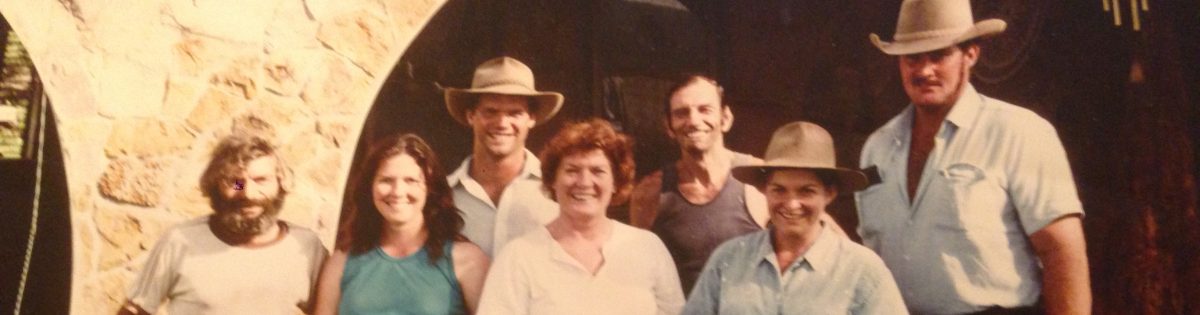
Twenty-Five — Truck Cripplin’ and Bull Tipplin’

By comparison to top-hatted penny-farthing marathoners, the balance of the cattle work at Twenty-Two mile was standard stuff. We moved cattle from pen to pen, occasionally leaping onto or over the metal panels to avoid the rebels in the crowd. We branded and castrated and dehorned and ear tagged. In a single day we processed 431 calves through the calf catch and back to their waiting mothers. The critters bawled and balked and baled up in the runways, forcing us to untangle them with whistled cajoleries and vigorous prodding. By the end, several hundred bullocks had been loaded onto cattle carriers and the rest released into the vast paddocks for another year of unmolested grazing. Again, our efforts left behind pounded ground, organic debris, and a return to the sparsely punctuated quiet of the bush.  We spent several days deconstructing the portable yard, again stacking the vast quantity of metal onto vehicles before transporting it to the next muster site in Bull Creek, where the entire process would repeat itself. Before the season was finished we would complete this cycle of deconstruction and reconstruction five times.

Even as I gained experience working with the tools and animals at Bullo, the potential for disaster remained a constant. Indeed, on the first day transporting the bulky gear to Bull Creek, my inattention cost the enterprise dearly. I was driving the King, with Danielle as passenger, a full load roped into place in the bed of the small pickup. We were in good spirits, with the first chopper muster behind us and the path ahead clearly delineated. As we jostled down the rudimentary dirt track between Twenty Two mile and Bull Creek she and I sang songs—American Pie, Delta Dawn, the Gambler. Suddenly the truck shuddered violently and stalled. Danielle blanched when she scanned the instrument panel. I followed her eyes and read the temperature gauge, pinned past the red warning mark.

“Oh, bloody hell! We’ve overheated her! Pop the bonnet!” She said as she hopped from the truck. I joined her to see white foam seeping from the radiator cap. From the engine compartment arose a symphony of pings and hisses. We reflexively stepped back several paces for fear of some component rupturing fatally, taking us with it.

“Oh Christ!” I said with a sinking feeling in my stomach. “That doesn’t look good at all.”

“No, mate, it doesn’t,” said my fair companion. “We’ll give it a few minutes to cool down then see what happens.”

After most of the noises had subsided, Danielle dug an old towel out of the backseat and piled it upon the radiator cap. She slowly loosened the device, unleashing an absolute geyser of radiator fluid into the air. She jumped clear as we watched as the geyser flow. Time has the quality of standing still in such moments. When an action is expected to last several seconds a minute is an eternity. This eruption, the most impressive display of engine overheating I have ever seen, continued at least that long. Even after the liquid water discharged completely, a vigorous current of steam continued to blow from the radiator.

“Bloody hell, Dave, weren’t you keeping an eye on the temperature gauge?”

I wasn’t man enough to tell Danielle that the only thing I had my eye on as we’d rolled along in song was her lovely self.

“I guess not, darlin’. S’pose I was having too much fun,” I said sheepishly.

“Well it won’t be much fun when Charlie sees what we’re up to.” A dark look moved across her face. “That won’t be much fun at all.”

After a half hour we poured several gallons of water into the radiator from the large eskies we always carried in the bush. With a hopeful grimace, Danielle turned the key. Nothing beyond the click of the starter emanated from the engine.

“Not much to do but give it some time,” sighed Danielle. “I’ve never seen a display quite like that. We’ve been moving through a lot of sand with this big load. I should have been keeping my eye on the temperature gauge at least, even if you weren’t.” She gave me a disapproving look which cut me to the quick.

She had no business taking the blame. This wasn’t my first day; I knew better. I mean, I could have pleaded temporary insanity on account of being in the thrall of the beautiful young woman. I don’t think that would’ve gained me much ground. Though Danielle’s sweet side showed itself regularly at the homestead, when there was work to be done she showed a relentlessly and occasionally severely humorless side. Flirting with the lass while standing before a critical piece of station hardware I’d just transformed into Old Faithful was a losing strategy.

I’d come to attribute her prickly persona to an overcompensation, of sorts. I believed her to be quite a softy, by inclination, who’d cultivated a grumpy manner as accommodation to the demands of a difficult life. That she, to my mind, occasionally took the hard-ass thing too far I was willing to chalk up to immaturity. The girl was barely nineteen years old, operating in a theater too demanding for most men.

Yet here we were, stranded dozens of miles from home, having driven our vehicle to inoperability on one of those few occasions when she’d let down her guard, given into a moment of my own too-easily conjured gaiety. I wasn’t optimistic I would see that side of her again anytime soon.

“So what’s our next move?” I asked tentatively.

“Well Dave, we wait. We sit here and do bloody well nothing and wait.” Her lovely eyes were narrowed, her full lips pinched. Any delusions of making progress on wooing the young woman, an aspiration I’d nurtured from the moment I first set eyes on her, evaporated in a mist as fine as that we’d witnessed spewing from the crippled vehicle.

Eventually, we heard the clatter of another vehicle making its way our direction. Within minutes, Charlie was standing with us, his hands on his hips, gazing knowingly into the engine block.

“She’s not going anywhere. Looks to me like you’ve warped the headcover. Gonna need a complete overhaul.” Charlie looked at Danielle and I. “Who was driving?”

“I was, Charlie,” I said ruefully.

“And where was the temperature gauge?” The big man asked me.

“Well, by the time I looked at it, it was well into the red,” I said, shading the truth slightly. The fact is that it was entirely past the red by the time I bothered to look.

“And is that when you shut the engine off?”

“In truth, I did not notice anything until the engine failed on us.”

Charlie shook his head and said nothing for a moment. He then turned to Danielle.

“And what were you doing?”

“Well, Charlie, I–I–“ she stammered, “I didn’t see it either.”

“All this sand, all that weight, and you were paying no mind to the engine temperature?”

I did not need to bite my tongue to resist divulging that we were more paying more attention to our journey through Billboard’s Hits of the 70s than our journey to Bull Creek.

“No, I wasn’t. I stuffed up. I’m sorry, Charlie,” the girl said with a heartfelt pain.

“Wait, you stuffed up?” I blurted out. “I was driving! I stuffed up! I screwed up. You had nothing to do with it!” This wasn’t an act of gallantry on my part, but a recognition of a simple truth. To my eyes, Danielle had no part in this calamity.

“Yeah, you stuffed up Dave. You surely did,” this was Marlee speaking, “whenever you’re in a vehicle you pay attention to what in hell the vehicle is doing. But you’re still learning. Danielle knows this. You’re a rookie. She has no excuse.”

My face flushed in humiliation. I’d worked very hard to raise expectations among these people regarding my diligence and commitment. To hear that the bar was still set so low, that I could not be expected to keep an eye on a temperature gauge? The King wasn’t a B-1 bomber, for Christ’s sake. It has three gauges and a speedometer. This was not rocket science.

Yet I had no defense. I hadn’t watched the gauges. Due to that elementary failure, I’d fried a critical piece of equipment. Their low expectations were merited. I seethed at the inescapable conclusion.

“Guys, I am truly sorry. I will pay for this. Take it out of my paycheck. I should have been watching.” Even as I made this offer, which would cost virtually everything I’d earn at Bullo, I knew that my credibility couldn’t be re-purchased, even at a premium price. Vehicles themselves can be replaced, but credibility is more akin to a sandcastle. Sandcastles aren’t for sale. And once washed away, the only option is to begin rebuilding.

“No,” said Charlie evenly, “We’ll get it back to the shop and see what we can do. We asked you to drive it over here. You were doing your job. What’s done is done. Let’s take it from here.”

Over the following weeks Charlie and Uncle Dick, especially, set their minds towards rehabilitating the overtaxed work truck. I’m not certain where they scavenged a new headcover for the engine bloc. The head encloses an engine’s combustion chambers, confining the explosions which power movement. I assume some piece of the rubble surrounding the workshop suited perfectly the men’s needs for the rebuild. I may be being over-optimistic in my assumption; it’s possible that the closest the fellas could get was ‘close enough’. I fear that’s more likely the case; the King, when returned to daily chores, proved a lesser version of itself. Recalcitrant, hesitating, underwhelming—the old dog had been neutered. Its spirit was gone. And, from then on, every time I put it to use, gasping and wheezing as we moved along, I found my spirit sputtering as well.

Considerably more gratifying than contemplations of my ineptitude was the bullcatching which began the day after Bull Run’s yards were emptied. It’s likely that American ranch life includes an activity which mirrors bullcatching in Australia’s Top End. It’s likely—rogue bulls are undesirable in any herd—but I’ve never seen anything similar to our afternoon’s entertainment in any depictions of American Western life onscreen.

In Australia, or, at least, at Bullo River Station, bullcatching means hopping into a modified World War II-era Jeep with the roof, windshield, and windows removed, and one important addition added to the bull bar on the vehicle’s grill. Upon this stout bar two truck tires are mounted, slightly wider than the vehicle itself. With this crescent of overhanging radial rubber a driver can come up alongside a scrub bull and press the tire into the bull’s hindquarters in a rural PIT maneuver, similar to what we see highway patrolman back home do when pursuing a fleeing vehicle. By bumping the hindquarters of either a street racer or an ornery bovine its front quarters drift the opposite direction. So by pushing the hindquarters away our subject would find itself directly in the path of the jeep’s bull bar. A quick acceleration followed by hard braking knocks the bull on its side, its legs extending underneath the front bumper of the vehicle. At that point an accomplice jumps out of the jeep and binds the animal with straps.

What I’ve offered here is a dry recitation of a process which, when moved from the page to the bush, is half-crazy. The bulls we sought were those who’d eluded the muster, the orneriest of the ornery. This self-selected gang of tough old buggers were sure to be no more enthusiastic about our one-on-on pursuit than they’d been about joining their friends in the muster. This seemed to me a cage match, a bare-knuckled bounty-hunt for half-ton fugitives with marginal IQs and a world-class ill-temper. What could go wrong? Better; how could it possibly go right?

Bullcatching day found me seated alongside Marlee in the bull catcher. We ripped along the main track from home in the blue dawn, heading towards the paddocks surrounding Twenty Two mile. With the cold morning air rushing upon my unshielded face I felt like Gen. Patton bustling importantly into Vienna in our vintage military conveyance. But when we left the track and began bouncing about the scrub, I felt more like the protagonist in Whack-a-Mole, my knees and shoulders bouncing violently within the constraints of my seatbelt.

“Hang in there, Dave,” cried Marlee, the scent of fresh bull meat filling her nostrils as she wheeled madly into the bush. “We’ve got some ground to cover today!”

Within a few minutes we saw a sturdy scrub bull munching lazily at a tussock of grass several hundred yards to our right. Marlee turned the wheel sharply and headed toward the undesired Lothario.

“When I’ve got him down you hop out and tuck his tail between his legs! Pull up and he won’t be able to rise!” I was familiar with this mechanism for keeping cattle from getting to their feet. “Then take your strap and bind his two rear legs together. Take your second strap and lock his front legs. You’ll be right then!” As with most of Marlee’s instructions, the idea sounded straightforward. Executing—after discovering—the particulars was where things got sticky.

Marlee zoomed towards the bull. As we drew close, it sensed our predation and began trotting away. When we were within ten yards the bull notched up to an ungainly gallop, its shoulders then haunches rising and falling quickly in seesaw motion. Marlee pulled up alongside the fleeing fellow, then inched within a foot of its hips. We bounced wildly across the irregular terrain. When the bull turned its head to survey its pursuer long silvery strands of saliva spun from its mouth, tracing several feet behind, until the viscous threads met our front grill. With a practiced timing Marlee yanked her steering wheel to the right and the meaty beast, thrown off balance, veered to its left, stumbled, and fell directly in front of the Jeep. With an adrenaline-charged enthusiasm I leaped from my seat and ran to the downed critter. I’d pulled two leather belts off the collection looped around the roll bar over the rear seat of the jeep. Marlee expertly placed her front bumper against the animal’s ribcage. I rooted around for a moment in the spinifex to locate Ferdinand’s tail, wrapped it under the leg, and secured the captive bull.

Marlee radioed our position to Danielle, who was following in a six-wheel drive army hauler Charles Henderson had scored years ago via his military contacts. This monster was a war machine, capable of handling any terrain while hauling beefy loads, making it the perfect vehicle for carrying scrub bulls out of the bush. The truck’s flatbed had been outfitted with a heavy duty cage. Inside the cage hung an electric winch. Danielle pulled the truck alongside the frustrated bull as it lay in the grass, wild eyed and snorting. We lowered a smooth ramp built into the side of the vehicle’s cage. Marlee hopped onto the bed to unwind the winch’s cable.

The next procedure spoke volumes to me about the incredibly sturdy composition of these musclebound critters. Marlee secured the wire cable around the bull’s horns. She activated the winch, the wire rope tightened, and the bull was pulled by its head up the ramp and into the truck. Now, this beast would have weighed a full ton. Watching the big fellow being dragged by its horns, akin to lifting a person off their feet by their ears, made me cringe. Bulls are built differently than humans, mercifully, but I couldn’t shake the desire to go visit my chiropractor after watching the uncomfortable spectacle.

But the big bull didn’t suffer by the process. Once in the truck we carefully loosened the straps holding the bull’s feet in place. He skittered to his feet, shaking off the insult by putting his head down and challenging us nose-to-nose. He tested the metal piping with a dynamic sweep of his broad horns.

Marlee threw a length of rope around his neck, then secured the other end to one of the cage bars. With our subject secured, Marlee and I hopped back into the bullcatcher and headed out to find our next quarry.

By the end of the day we’d captured eight bulls, fellows who would have otherwise spent the year spreading their scrubby seed amongst the heifers, producing a generation of youth less desirable than the Brahmin stock Sara and the girls had begun to introduce several years earlier. Our scrubbies bulls were destined for the meat works. Though we Westerners like our chops fatty, many Pacific Islander and Asian palettes prefer lean beef for the chopped and marinated preparations those cuisines feature.

Bullcatching occupied Marlee, Danielle, and me for the next several days. We ended up extracting nineteen scrub bulls from the fifteen thousand acre paddock we’d recently mustered. Each pursuit was its own adventure, with Marlee wheeling wildly across the untamed terrain, regularly whooping as she careened left and right, accelerated and braked with abandon. The girl was clearly enjoying herself; it was all I could do to keep from being ejected by her Mad Max imitation. It was thrilling and harrowing at the same time, ripping around the outback in an open-air vehicle with an unleashed Marlee Henderson at the controls.

My duty was, with one exception, routine. Typically the animals were exhausted by the time we bumped them to the ground, and Marlee was expert at pinning them gently but securely with the Jeep. One time, however, we executed the PIT maneuver on an animal within only ten seconds of locating it. Marlee bumped and it fell on its side, but its momentum carried it onto its back, then over onto its other side completely. I jumped the gun and exited my seat before Marlee could secure the bull in its new position. As I ran to tuck its tail, I was a dozen feet from the Jeep. As I seized the great beast’s tail it rose and began running away. It didn’t take more than a few of my brain cells for me to realize I’d put myself in a bad spot. When the bull turned to see what manner of impertinent creature was hanging onto its tail, he and I shared eye contact, six feet apart. Its mien wasn’t inviting conversation.

“Watch out, Dave!” yelled Marlee in alarm. “Don’t let go of that tail!”

She needn’t have worried; scratching its chin was not in the cards, and a sprint back to the Jeep invited disaster. My sole connection to a happy future consisted of my grip on the animal’s tail.

I’d seen Charlie pull a nifty maneuver in the yards; he’d thrown full-sized cows to the ground by manipulating their tails. He’d grasp the animal’s tail, then, when the cow turned to look at him, Charlie would pull the tail sharply to the same side as the cow’s turned head. This tug compromised the animal’s center of gravity, dropping it onto its side. The critical element involved timing the pull for that brief moment when the animal’s head turned completely around.

Pulling this cow tipping maneuver in the yards with cows is tricky enough. I’d upped the ante by putting myself in a position to practice cow-tipping with a pissed-off scrub bull in the middle of the bush. If I released the tail I’d be able to take no more than two steps before I would’ve been performing Stupid Human Tricks upon the concrete slab of the bull’s forehead, or playing hide-and-seek with its horns. I hung onto that tail with every ounce of energy I possessed, and when the bull again turned to look at me I tugged with all I had. The big beast barely budged. Instead he attempted to hook me, the bastard. I danced away, his sloppy tail still in my hands. He decided to run; I had no choice but to half run and half water ski behind him. After a short excursion, he stopped again to investigate the nutcase trailing from his keister. I knew my opportunity to come out of this encounter with my various bones remaining in their appropriate sockets was dwindling. With his massive head no more than three feet from my waist, I threw my entire weight to that same side and was astonished to see the massive creature fall like a sawn great oak.

“You got him!” screamed Marlee from close behind. “Now wrap that leg!”

I snapped out of my wonderment at what I’d accomplished and, leaning back in order to keep my head away from the powerful kicks of the downed bull, I passed its tail between his hind legs, and lifted his leg high. I put my foot against his flank to prevent him from freeing himself by rolling. In an instant, Marlee was there with two leather straps and the bull was secured.

“Christ, mate, why didn’t you get back in the Jeep when you saw he wasn’t pinned?”

“I don’t know,” I said breathlessly, “I guess I was committed.”

“Yeah, I think you need to be committed, running around the bush holding a bull by its tail. Don’t get out of the bullcatcher until we’ve got the thing trapped, will you?”

“Shoot, Marlee, what’s the fun of that?!” Exhilaration had replaced the fear coursing through my veins. I’d brought the big fella down, and I knew I had a story to tell.

Marlee had her own story to tell. That night, at the dinner table, Marlee offered a proposal.

“I think we oughta sell the bull catcher. We might get a few dollars for her. Then, when we need to do some bullcatching, we’ll just drive Dave out into the bush and let him run ‘em down. He’d be right keen on the enterprise, eh Dave?!”

“Or maybe we just outta trade it in for an ambulance if that’s what we’re gonna do. He’ll soon enough have a face on him like a kicked in jam tin, getting run over by a bloody great bull,” contributed Danielle. I fancied she said this with a hint of concern on her face.

“I reckon we’ll be putting a new head gasket on you pretty soon, mate, if you keep up those kind of antics.” Charlie eyed me with a level gaze, but his slight smile and the direct quality of the insults I was receiving let me know they were all, in fact, quite impressed by what I had done. I felt, in that moment, more a member of the ringer fraternity than at any point until then. Usefulness is a valuable currency on station life, and while unnecessary risks aren’t encouraged, at the end of the day getting the job done is a ringer’s reason for being. My success with the bull shaded slightly the sting I felt for causing the calamity with the King.

“Sure guys, I’ll give it a go,” I said with exaggerated bravado, “I get some exercise and we save a little gasoline. Why not?”

“Sounds good,” said Charlie, then added with a wry grin, “So the only time you need a vehicle to take down an animal is when you’re off to get a killer then, eh Dave?”

Now, why Charlie had to bring up my roadkill beef expedition in the moment of my greatest glory I will never know, but this much is certain — the juxtaposition certainly got a big laugh from Sara and the girls.

Twenty-Four — Strangers Real and Surreal

No such difficulties intruded when working with Eddie. The capable Aboriginal worked consistently, quietly, efficiently. With him there was no chatter, no distractions. His inscrutability intrigued me; one morning as we worked linking yard panels I decided to probe.

“So how old a man are you, Eddie?”

“Not really sure. Probably mid 30s, I reckon.”

“Really? Well, when’s your birthday?”

“July 1.”

“Oh, you’re a Cancer.” The reflexive cultural conceit tumbled unbidden from by lips.

“Cancer? What do you mean I’m a cancer?” The dark man had uncharacteristically paused in his work and looked directly at me.

“In astrology! I mean your astrological sign! I am a Taurus, the bull. Your birthday falls in the constellation of Cancer, the crab,” I said weakly. I don’t give a moment’s credibility to astrology; I was just making conversation.  “I didn’t mean cancer, like a medical thing.”

“White folks give me this birthday. Now you tell me I’m cancer.” He chuckled dismissively.

“Forgive me, Eddie. I meant no harm. This is not my land; talk of astrological signs is common back home. I didn’t even think about being misunderstood. Truly, I’m sorry.”

“It’s okay, Dave,” he said quietly as he returned to the work.

As the Europeans spread across the Australian continent they worked to integrate indigenous Australians into the European paradigm. Those aboriginal children who entered European-style schools therefore needed a birth date in order to be sorted into the appropriate grade level. In aboriginal communities birth was noted according to season, undifferentiated by day and month. So it was common for the white schoolmasters to designate July 1 as a birth date for youngsters who reported being born in winter. Fully a quarter of aboriginal people born before practices changed in 1967 were assigned a July 1 birthdate. That Eddie had no great connection to that date is understandable.

After a period of silence I opened a topic which I thought might be less fraught with minefields.

“So do you have family, Eddie?”

Again, the native stock hand paused his work and looked directly at me. “I only have family, Dave.” He held my eyes a moment, then returned to his work. Though I wasn’t entirely certain what his answer meant I again let the subject lie.

Stumpie had joined the stock camp at Twenty-Two mile with his bushman’s cooking set up to prepare our meals for us on site. Fried biscuits with butter and jam, salted beef, billy tea — the food was rustic and satisfying. I typically sat with Charlie and the girls to eat my meal. Denny separated himself a bit so he could smoke. Eddie also sat a ways away from us, serving himself a meal only after the rest of us had filled our plates with chow. Trepidatious after my early stumbles but still intensely curious about this man so different from me, I asked him about his lunchtime habits.

“I can’t just go in and please myself, step over the girls. I give them room, wait until they finish.”

“So Arunda men and women always eat separately?”

“Of course. Respect.”

“I like that, Eddie. Does that make it difficult for you to work with women, though?” I’d sensed in him a hesitancy when dealing with the outspoken women of Bullo.

“Woman is the boss at home. Man should be the boss in camp.”

I did not need to share this comment with the girls in order to know that Marlee and Danielle would have found this sentiment unbearably sexist. Though Bullo was far removed by geography from civilization, the currents of contemporary thought nonetheless flowed through the place. These were liberated women, in the sense of the word which stipulates strength and independence. For Eddie to so plainly state an idea anathema to what I took to be a given highlighted for me the distance in culture between him and me.

This recognition made his secrets even more intriguing. I’d noticed what appeared to be a geometric pattern of ritual scarification on his arms. I summoned my courage and asked gently about the marks.

“It’s not to say,” he said in his clipped and accented manner. “You lose your father, you lose your blood. But you be careful. A stranger talks about this and they can be hurt. They can be killed, even. This is not for you. You are not a stranger to me. But this is not for you.”

My mind flashed back to the scene I’d witnessed on my bus ride up, when the young man was abusing the female pool players.

“I appreciate that, Eddie. Thank you for helping me understand the boundaries. I mean no disrespect, certainly. Let me ask you this. On my ride up I saw a young aboriginal man disrespecting a couple of aboriginal women. Part of me wanted to step in and defend the girls, but there were several aboriginal adults nearby, so I didn’t. Did I make the right move?”

“Did you talk to the girls?”

“Yes; I asked one young lady what her name was.”

“This was a bad place for you. It’s good you do nothing. You could be hurt, very bad. Very bad.”

A chill went down my spine at the realization that I myself was probably the cause of the fracas, and that I was apparently so close to personal peril. I thought of the abusive storekeeper, and how he had encouraged me to get involved. It felt a betrayal, not of our white “tribal” affiliation, but of decency itself. He, and all the rest of the whites in the room, must have been aware of the thin ice upon which I was treading when I entered the pool room. That none bothered to enlighten the clueless traveler seemed an affront. Were they hoping that my missteps would lead to a brouhaha, a bit of entertainment to break up the dull and humid monotony of their day? The notion struck me as likely, and deeply angering. Eddie must have read the frustration on my face.

“You make good decision. You feel danger, you stop. That good.”

“Thank you. Yes, I try to keep my antenna out. I don’t like danger, and I don’t like to cause people harm. That’s why I feel very bad about our earlier conversation. I fear I hurt you.”

“No, no problem. You not danger. I feel danger. In front and behind. When I wake, when I sleep. I sleep with eyes and ears open. I feel family problems. I know before I hear. It’s important.”

The word “semantics” has become in common use a synonym for “trivia”, but the meaning behind the word is the opposite of trivial. Semantics was the field of a Polish scientist and philosopher named Alfred Korzybski, who introduced me to the profundity of the concept. Korzybski dove deep into the relationship between language and reality. The insight of his which has stayed with me was this formulation: the map is not the territory. Words, like lines on maps, are approximations of the geography they seek to describe. But words, like drawings of mountains, are mere representations of the much richer and deeper reality they seek to convey. Words are no more than the shadows of clouds floating far above the true topography of meaning.

I recognized this dynamic at work in Eddie’s simple utterance. I knew that the type of awareness his clipped phrases sought to capture was beyond words, in the first place, and, further, a description of a universe I would never have the opportunity to explore. But I was glad he shared. Understanding that one cannot understand is understanding nonetheless, and understanding brings people together. Knowing the magnitude of stranger I was working with made me feel closer to him.


Once all the needed materials had been transported to the yard site some of us saved ourselves the trouble of driving back and forth every morning and night. Our stock camp was a “camp” in the loosest sense of the term. My “quarters” consisted of a tarp laid upon the ground, piled with a sleeping bag, a few auxiliary blankets, and a couple changes of clothes. A more elaborate set up would have been nice, but with clear weather and the need to haul, erect, and disassemble any other sort of contrivance, my simple setup was perfectly satisfactory. And when the starry skies are the caliber of brilliance found in outback nights, there’s a definite charm to going to sleep under the Southern Cross. I asked Eddie one night what he made of the Milky Way. He stretched his hand to the sky and traced a pattern, assigning it a name I had never heard before. He said it translates as emu, the large flightless bird and cousin of the ostrich, common throughout Australia. Just how the emu figured in aboriginal cosmology, I had no way of knowing.

He then pointed at the nearly full moon and said, “fat man.”

“In America we say there is a man in the moon. We also say the moon is made of cheese.”

“Fat man eat bad people,” he replied. “He dies, then comes again, strong and thin.” I heard in his description the moon cycle, from full to new, followed by the rising crescent, cycling through again to full.

The indigenous people of Australia are the longest continuously surviving people on this planet, with a history perhaps 60,000 years long. Unlike our contemporary cultures, so absorbed with tinkering with ourselves and our structures in the pursuit of societal perfection, aboriginal cultural traditions are cyclical. Sons do what fathers did, and their fathers did before them, and daughters do what mothers and grandmothers did. In the cyclical paradigm practices and rituals aren’t meddled with; they satisfy need. It’s the animating story behind the traditions, rather than the traditions themselves, which is perfected. So when Eddie shared with me his cosmology I was aware of participating, however peripherally, in a tradition twice as old as the earliest known cave paintings. The Jewish Seder, at 3500 years old, is a toddler in the world of traditions in comparison.

Denny meanwhile was sitting nearby strumming his guitar, reprising his Aussie Bobby McGee.

…windshield wipers slapping time

when I got stuck on the fourteenth line

of the fifteenth verse of Advance Australia Fair…


Between Denny’s lamentations and Eddie’s intimations of ancient mystery, I realized stock camp wasn’t nearly as rough as I’d been led to believe it might be.


In the morning, the boys and I were busy lining the long laneway leading to the yards with what the Australians call hessian, what we back home called burlap. Doing so makes the border fence more visible to the cattle, making them more likely to follow the fence line into the yard. In the afternoon we moved the beastly water troughs in place and filled them with creek water. This required setting up a pump and hose line from the creek to the yards. These were the last duties before the muster, set to begin at daybreak next morning. At sunset I took the opportunity for a bath in Bull Creek. When I hopped out and toweled off, I plucked three leeches off my legs as casually as a valet flicks lint off a tuxedo, then settled under my blanket of stars for a deep sleep.

Before sunrise, I joined Danielle in the King as we drove several miles into the bush. Eddie and Denny did the same with Marlee and Stumpie, respectively, each vehicle fanned in slightly different directions. As always, various mobs of cattle would stop munching as we approached, and eye us suspiciously. Given our agenda for the day, I credited their concern as well-warranted. Danielle parked in a swale and killed the engine. I hopped out to have a squirt. When I closed the door behind me, the metallic sound reverberating through the bush, Danielle wasn’t pleased.

“Quiet, drongo!” She hissed. “Let’s not have all the cattle run from us, eh?”

At daybreak, another sound filled the air. Two helicopters approached from the direction of home, then flew past us beyond earshot.

“Those fellas will begin pushing the cattle. When they reach our position, we’ll start driving behind the mobs and help push them up with the trucks,” Danielle explained. “When we get to the yards you’ll hop out to close the gate, okay?”

In the growing light we began to see cattle in the near distance, walking with a sense of urgency past us. As the morning went on the numbers increased, as did the pace of the animals. After an hour or so we heard the helicopters not far behind us and, for the first time, I witnessed the astonishing acrobatic ability of these bush pilots. Though the tallest trees were no more than 50 feet high the small choppers would regularly drop out of view, then reappear at cockeyed angles, swivel their tails dramatically a hundred eighty degrees, then drop out of sight again. They pitched and weaved and bobbed and turned constantly, masters of the stick and pedal in a battle of wills with the most willful of their four-legged adversaries.

When the nearest chopper reached our position, Danielle fired up the ute and we took our place in the process. Weaving back and forth, we urged the recalcitrant lollygaggers along. Given that we were not on a road, Danielle, not a tall woman, sat ramrod-straight and raised her chin to gain her best view of the terrain. I hung out the window or pressed my nose against the windshield to help her avoid major pits and termite mounds. The majority of the cattle corp’s rearguard were scrub bulls, decidedly less than smitten with the intrusion into their day. Most were veterans of previous musters who’d learned through experience that moving along obediently was strictly voluntary.

When we reached an open grassland near the head of the laneway, several of these bulls made their stand. Two or three easily evaded our pursuit and headed back into the scrub. When Danielle wheeled to get behind one particularly burly specimen, it turned and faced us, paused for a moment, then put its considerable head down and charged. Danielle turned slightly, so that when he contacted the vehicle its horns penetrated neither rubber nor radiator. The angry bull jarred us heavily upon contact, then jostled us in our seats as it attempted to flip the vehicle. Having made its point, it backed off several steps, snorted, and headed for the bush. One of the choppers made a last ditch effort to turn the cranky beast by hovering five feet over its head. The bull spent a moment trying to hook the chopper with its horns, tossing its head and raising its bulk off its front feet. The pilot, a determined fellow himself, was no fool, and recognized the imbalance of losing a chopper versus losing a bull to the bush. He wheeled to turn his attention elsewhere. As she did so, the mighty bull took two or three steps, then fell heavily on its side, dead.

I don’t know whether this bull suffered a fatal injury when it rammed our truck, or whether his heart simply gave out from stress and exertion. I do know that his eventually he would’ve been captured in the bush during bull catching season, tied up, and hauled off to the meat works. Bullo, like all cattle enterprises, needs to be very careful about which animals propagate the herd. So his ultimate fate was to be the same, essentially, as he experienced laying there in the field amidst the muster. But I couldn’t help feeling that his end was tragic, nonetheless. This bull clearly had a big spirit. The vehicles he was willing to engage were more ferocious by comparison to him even than he was to me. Yet there’s no way I would ever take him on, nose to nose, the way he faced up to our machinery. There was a nobility in his act that I admired, and, in its loss, for which I silently grieved.


But there was no time for sentimentality. We in the trucks and the choppers above funneled the last of the mob down the laneway towards the gate. At the very last moment, with the choppers hovering thirty feet above, Eddie and I jumped out of our vehicles and, awash in bull dust and adrenaline, raced to close the gates. When the chain locked in place, we had 2500 cattle contained, every single one of which needed to be categorized and processed. This was to be a long three days.

Being my second time around, the process was familiar. Fill the forcing pen, categorize, castrate, dehorn, ear tag, brand. In the morning and again in the evening we’d fill the water troughs and bust bales of hay in each pen. Evening brought a simple meal, a bit of conversation regarding that day’s accomplishments and the next day’s tasks, perhaps a bath in the creek, then a sound sleep under the stars.


One twist in the routine came from an unexpected source. On the morning of the second day we were joined by the government stock inspector, a ruddy and rotund man named Bluey Edwards. Bluey was a redhead, a coloring not well adapted to the relentless sun of the Top End. Despite his oversize Akubra, the sun had ravaged his bare arms, and the back of his neck above his collar. Bluey was there to certify that the herd’s inoculations were up-to-date and properly administered.

“I saw the damnedest thing the other day,” he said to Charlie and the girls as we sat together for our lunch break. “I was driving on the track a bit east of Kunnunarra when there’s this bloke with a handlebar mustache and wearing a bloody top hat, just rolling down the road on this bloody great push bike. It was the old-fashioned kind, you know, with the great front wheel and the tiny rear wheel. I reckon he was damn near two meters in the air! And he’s just rolling down the road, you know, happy as a dog with a bone. I give him a little wave, and he waves back, and away he goes. I actually pulled off the road in order to look back and make sure it wasn’t a bloody mirage! But no, there he was, wheeling off into the distance. Damnedest thing I ever seen!”

“You’d stopped off to knock back a tinny, I reckon?” Charlie jabbed.

“Or two?” Marlee appended.

“Or three!” Danielle guffawed.

“Bloody hell, mate! I saw the same bastard!” Denny exclaimed. “I tried to tell Dave about it, but he didn’t believe me!”

I locked eyes with Denny in a moment of silent discordance as I absorbed the possibility that the jokester’s fantastical tale upon meeting was true. “Well, I still don’t believe you,” I chuckled. “I believe Bluey, I suppose, but I still have my doubts about you!”

“Well, I’m telling you mate. There he was, plain as day, rolling down the road on his great big push-bike. Bluey saw him, I saw him, and now you’ll do well to believe me when I tell you something,” the troubadour said with a triumphant smile.

“Denny, the day I believe everything you tell me is the day no one else should believe anything I say, because that will be a sign I have lost my mind,” I said with a faux gravity.

“So what do you reckon he was up to?” Charlie wondered.

“No bloody idea, mate. I have no idea at all,” Bluey said, shaking his head.

What none of us knew, and which would have been beyond any of our conception, was that, as we spoke, Phil McDonald was pedaling his penny-farthing bicycle down the single lane of bitumen in this same inhospitable Northern Territory. McDonald’s self-propelled journey around the entire perimeter of the Australian continent in 1988 earned him a place in the Guinness Book of World Records. His 15,000 km ride was a fundraiser for Rotary Australia’s Polio Plus campaign. He raised over $100,000 for the cause, and along the way provided, for a small knot of folks sitting around a cookfire in the wilderness of the outback, a moment of surreal contemplation.