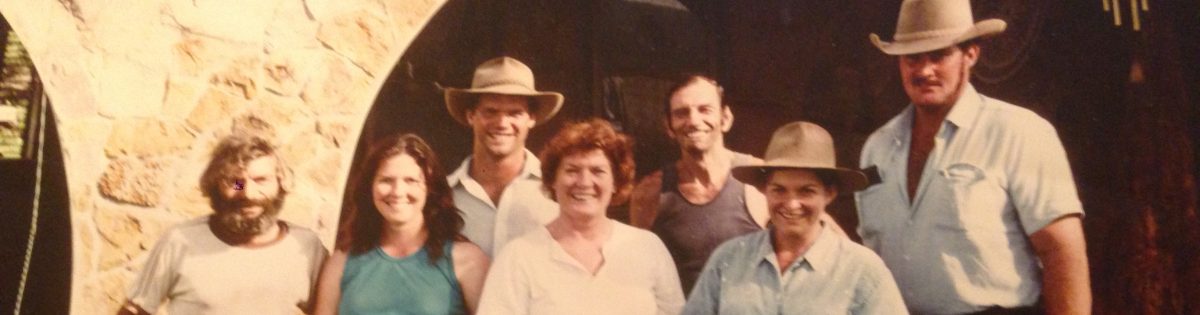
I had one last bit of housekeeping to attend to before the film crew arrived, with their probing cameras and microphones. Simply put—my wardrobe was a shambles. Danielle was handy with a sewing machine, and I’d been keeping her talents sharp for a while. The three pairs of jeans I’d brought to Bullo had become a quiltwork of reclaimed denim. Danielle had sewn patch after patch to knees and back sides and multiple split crotches per pair. Though the flimsy shorts favored by Australians served on most days, a habitable pair of blue jeans was still necessary on horseback, when bull catching, and were a good idea when at close quarters with mucky cattle. So once again I asked Danielle if she would patch the patches, in hopes I might on camera look at least slightly more the happy clown than the sad clown.
My shirts were in no better shape. I’d discarded the one T-shirt which I’d shredded in the Parkinsonia, and which afterwards resembled a used Advent calendar. My remaining tees were scarcely more serviceable, more apt to be seen upon tropical castaways than civilized folk. My several long-sleeved shirts remained in better shape, given their limited use—primarily on horseback—but even those were hashtagged with grease stains and zippered stitching.
The jeans I needed to fix, certainly. It’s bad form to have one’s privates hanging out for the world to see. But the shirts would have to do. After all, I was a castaway of sorts, an innocent wayfarer washed upon the Island of Bovine Prerogative.
As I was delivering my bifurcated jeans to Danielle’s gracious attention, I heard a distant plane begin its descent into Bullo. Our solitude had attuned my ears to the approach of incoming vehicles, be they by road or air. Walking to the homestead from my strange encounter with Erik, I’d heard, then watched, as a helicopter set itself down near the hay barn. This proved to be the Slingsby pilot hired for the shoot. This new sound was distinctively fixed wing.
“That would be the film people. Go see if they need a hand, Dave,” Danielle suggested.
I walked through the front archways of the house and watched an eight-seater Cessna drop upon the airstrip, whose stretch of lush green had become a distant memory well into the dry season. I opened the gate, and the pilot taxied near the house. As the drone of the propellers died, the staircase was lowered and out stepped the German film crew, their faces familiar from the earlier scouting mission. As before, I was struck by their bright, jaunty attire, a vivid contrast to my own decrepit togs. I felt no shame, however; I preferred my own storyboarded attire. Every stain found upon my clothing had been earned in the service of hard work, real work, every tear a scar earned in the service of necessity.
With the arrival of the production team a familiar element of my previous life arrived at Bullo. The possibility of a film shoot had become real. I was happy at the prospect of a slice of my Bullo experience being immortalized. My enthusiasm was, at best, marginally shared by the Henderson women, and not at all by Charlie, who was champing at the bit as he offered a cursory hello. We had a yard set up, primed for action, yet we would be spending three days bending ranching priorities to Hollywood’s needs. No doubt, he recognized the value of a couple thousand bucks in the bank, courtesy of the production company, but the value of doing critical tasks unmolested by frivolities has its own ineluctable worth to a man such as Charlie. With the crew here, the director would be shaping our day’s activities, activities designed around a camera, and light. Charlie set his jaw and approached this diversion with the same resolute commitment as any other inevitability. But that doesn’t mean he was excited about it.
Me? I was tickled pink, especially when I found we would begin in the morning photographing that most visually compelling of activities—bull catching. I was to be in position next to Marlee, and it would be me the world would see hopping out and strapping the big beast’s legs, tipping their horns. Yippee, Mr. Kruger; I’m ready for my close-up!
Amid jollity and welcoming banter, the Pelican cases of film equipment were unloaded and bedrooms assigned. Within the hour Sara and the girls, myself, Charlie, and the chopper pilot joined the film crew around the dinner table. Matthew, the Australian producer, did most of the talking, with Hardy and crew interjecting enthusiasms for the venture.
The film crew brought several bottles of decent red wine to share. Charlie and the two pilots demurred when offered a refill but I had no such scruples. Shortly after the meal was finished, Charlie disappeared with the helicopter pilot to talk helicopter talk, and Danielle and Murray Lee faded off to their rooms. Sara and I remained with our German guests. The nightly chorus of insectivorous life arose in the darkness to meet the voices of the two-legged types, as talk turned philosophic.
“You know, tonight I just feel lucky,” said the movie star. Hardy thumped his closed fists simultaneously on the tabletop while looking earnestly around him. “I just feel very lucky. So many in this world have so little, yet here we are surrounded by good people and good food, with an exciting day to come. I just wonder what we’ve done so right to deserve this.”
With this comment, a consideration of the cosmic origins of injustice and poverty and the myriad other man-made plagues of our world commenced. Being a bit of a yakker and amateur philosopher myself, I enjoy these types of conversations. Broad speculation typically flows easily from me.
On this night, however, I had little to add. It struck me that the lads were searching with words for answers that I’d found by doing. Their philosophical contemplations seemed gauzy abstractions, the privileged amusement of idle hands, profound in the drawing room but irrelevant in the bush. As I watched their wine-stained lips pour forth speculations on the great mysteries of existence I realized that some lifestyles generate questions, while other lifestyles generate answers.
The crux of the difference revolves around doing; taking action to satisfy daily needs, bridging the relationship between daily activities and the conditions of one’s daily existence. I knew exactly why we had what we had at Bullo; we’d built it, we’d dug it, we’d welded it, sunk it, drove it, branded it, rode it. We had what we had because we had done what we needed to do to have it. When we were hungry, we didn’t shift a pile of papers in order to earn another piece of paper with numbers on it that we’d take to a bank where they’d give us little paper rectangles we could use at the market to buy a roast beef sandwich to eat.
No; when we needed roast beef, we’d shoot a bullock and roast it. There exists a continuity of cause and effect to such streamlined interactions which keeps the dross of philosophical abstractions to a minimum. Life at Bullo was making clear to me that adding layers between cause and effect generates the wasted space philosophers fill with abstract conjecture.
Also, importantly, those elements we worked with were tangible, which aligned our gains directly with our physical efforts. The rewards of station life are material, comprehensible, eminently rational. Back home, a commodity trader, say, might spend twenty minutes clicking on a keyboard and gain—or lose—a fine house for his efforts. I make no moral judgment on that wildly speculative manner of free-agent living. But it certainly does have an inorganic quality to it, and within that synthetic and detached dynamic might potentially lie a cause of the rootless nihilism which afflicts so many people in our modern existence. What manner of sensible Creator could craft such a senseless machinery, where input and output have no apparent relationship? Does the fact that a twenty-year-old who throws a baseball well becomes rich beyond imagination, while others twice his age kill themselves at subsistence labor not suggest that Randomness itself is in charge of the universe?
Perhaps this disconnect between effort and result afflicts both ends of the modern spectrum. The world is full of desperately poor people who work desperately hard for miserly reward. I’ve seen 130-pound porters in Nepal hang 180 pounds from their heads and walk up the world’s biggest mountains for fifty bucks a month. And I’ve seen paper pushers earn more in an afternoon than those porters will see in three generations. I don’t think either lifestyle offers insight into why things are so. Lacking an answer to the question ‘why?’ makes for a poverty of spirit as debilitating as all but the worst material poverty.
The German philosopher Frederick Nietzsche pointed out that “he who has a why to live for can endure almost any how”. I suppose the corollary would be that “he whose how bears no clear relationship to why understands neither.” A disconnect between the efforts you make in life and the rewards you enjoy—when there is no meaningful relationship between the two—must be at least a portion of what lies behind the normlessness afflicting our world. When reward is disconnected from effort, even when the disproportion accrues to our benefit, our spirit loses balance and clarity of purpose. Our need for existential meaning goes unanswered. Some people react by indulging themselves in chaos and excess, numbing their cognitive dissonance with loud parties and booze, drugs, and every other synthetic stimulant they can get in their veins. Others practice extreme sports, looking for a hit of adrenaline to clear the fog. The more civilized types sit around with a glass of wine and explore the void in a cerebral way.
But there was no need for such talk at Bullo, where we had on a daily basis both a why, a reason for being—to survive—and a how—by doing. The rewards we reaped were directly proportional to the efforts we made. During my time on Bullo River Station I did not experience one moment of existential angst, never caught myself in a reverie on the meaning of it all. I was too damn busy doing what was evidently necessary, and important. There was no time left over to contrive such complexities.
The next day began like nearly any other. I say nearly as there was an exception in the person of Hardy Kruger, who appeared at the breakfast table wearing a bright pink jumpsuit. I was amused by the wardrobe choice, Charlie appeared astonished, and the get-up evidently made Danielle a bit frisky, for she offered a long, low wolf whistle upon seeing the neon outfit.
“That’s quite a bit of gear for wrangling, mate,” observed Charlie dryly.
“Well, it’s actually quite warm, and I’ll be easy to see from the chopper,” explained Hardy, with a smile.
“You’ll be easy to see from Sydney, I reckon. I hope you don’t scare the bulls off,” said Marlee, then added, “Or make ‘em want to mount you!”
After a slightly more leisurely than usual breakfast, we headed to the workshop. Tazzy and Erik, finding themselves with a few idle moments, and devoid of ideas for filling them, were engaged in a vigorous battle for hierarchical supremacy. Their field of battle, the corral, their weapon of choice, horse manure. As we approached, they called a truce to their dung fight, though neither was willing to cede the chivalric battlefield without one last mortar toss. Apparently, the outcome of the battle was unclear, for as they wiped their hands on their pants, each claimed victory. I had no doubt the fecal combat would ultimately be rejoined on another day, upon other Elysian fields, with the likelihood great I end up as collateral damage in that gallant struggle.
Juergen, the cameraman, spent a moment lashing himself and his bulky camera to the rollbar on the bullcatcher, then I hopped in next to Marlee and we set out to chase rogue bulls.
Danielle joined the freshly perfumed boys in the back of the 6 x 6. Charlie drove the ute, with spare fuel and other support supplies. To avoid alarming the animals in Bull Rush just before they were to be mustered, we drove to the outer reaches of the property to find our targets. I wondered how Charlie felt about this inorganic prerogative, this diversion from the natural order of things. I could have guessed his answer, but he revealed nothing by his demeanor. “This is our day,” his jawline read, “lets get ‘er done.”
After a long bumpy ride we entered the open flats of River paddock. With the helicopter filming from above, kicking plumes of fine dust in its wake, Marlee and I set upon the first scrub bull she identified. I’m not certain Juergen knew what he was in for. He was a pro, so he’d strapped himself in well, but the rapid accelerations and braking and wheeling left and right must have been a challenge for him as he tried to film the scene. Marlee was doubtless working as hard as she could to make his life difficult, her gritted teeth showing behind a wide smile. I was having a ball as well. This was not my first rodeo; I knew Marlee would be giving Juergen the same amped up treatment I’d received my initial time in the bull catcher.
With the first scruffy bull tipped and pinned, I hopped out, my adrenaline accentuated by a theatrical vim, and gave my best performance strapping the huffing beast’s legs together. I looked back at Marlee, then at the camera, a big grin upon my face.
“That’s great, Dave” said Juergen in his accented English, “but next time don’t look at me afterwards, okay?”
“Yeah, how about you stop mugging for the camera, grab the horn saw, and tip the bastard, eh?” said Marlee in a wry voice. Danielle and the boys arrived in the six-wheeler, and went through the familiar process of winching our captive into the caged truck. I hopped back into the bull catcher and we caught three more of the critters before lunch.
As we munched upon steak sandwiches, I discovered I wasn’t the only one ready for my close-up.
“Hey Marlee, can I do some strapping after lunch?” This was Tazzy, evidently tired of his supporting role.
“It doesn’t matter to me,” answered the elder sister.
“Ah, that might be a problem,” said Matthew, sitting nearby. “We’ll be doing some different shots after lunch and editing it all together, so we need some continuity in terms of personnel.”
I resisted the urge to jump up and kiss the man. Instead I said, “Shucks, Tazzy. It would’ve been okay with me but, you know…” I let Tazzy’s disappointment dangle upon the end of my sentence as I gestured towards Matthew.
“How about if we just switch shirts and hats?” said Tazzy, brightly.
Sorry, partner, I’d rather switch undies with you than poss–
“Yeah, that could work,” Matthew acceded.
Wait—what?! You guys are going to kick me out of my catbird seat and make me wear Tazzy’s stanky, dung-riddled garb to boot?! Not an option!
“Hang on a second! I’m not gonna wear that rotten rag! No way—not gonna happen!”
Evidently my protest was delivered with an abundance of comedic flavor and not nearly enough sincerity, because the whole camp had a good laugh—then moved on to other subjects. The matter was settled.
After lunch, I peeled my recently laundered T-shirt and, along with my trusty Akubra, handed them over to the Tasmanian. I stood holding his sweaty hat and filthy shirt for a moment, lamenting my miserable fate, until Danielle pointed out, helpfully, “Well, you best get dressed, Dave. You can’t be bare-naked. We’re not making that kind of film.”
I looked at the lovely lass incredulously, then robotically fed my arms through Tazzy’s grimy plaid shirt. I set his floppy sweat-stained hat upon my head and felt my enthusiasm for the movie business dim to a new-moon-in-the-outback level of darkness.
The second day of shooting involved only Sara and the girls, so Tazzy, Erik, and I spent the day making final preparations for Bull Creek muster. Our unintentional Beer Summit largely dissipated the tension between me and Erik. Erudition and good humor such as I’d found in Peter is, I know, a rare find in any endeavor. My bar for these boys wasn’t nearly that high, and by my reset parameters I managed to enjoy my time with them. Had I scooped up a nice ripe cow pie and hurled it in their direction I might have been transported to a whole new level of camaraderie with the lads. Alas, that price was too high for this city boy; the joy of sending warm cow muck up against the side of my coworker’s heads would not have compensated for the sensation of discovering the same up against mine. Call it nature, call it nurture; with good friends I can talk shit all day, and can put up with a fair amount of bullshit when I must. But I’m always going to bow out when the good times call for actual fecal material.
Back at the homestead, the Hendersons were suffering their own unpleasantness. The family was being asked to play along with a synthetic narrative Hardy had contrived to explain his visit to Bullo.
Charles Henderson served as an aviator in World War II, and Kruger had been conscripted into the German Wehrmacht in 1944, when he was sixteen years old.
Hardy wanted his viewers to believe he and Charles Henderson had some sort of interaction during the war, so Hardy was here to visit his old friend. It was a gentle conceit—entertainers are storytellers, always, and the truth should never get in the way of a good story—but Charlie, Sara, and the girls are alien to artifice of any sort.
Hardy crafted a scene where he would be passed by the two girls on horseback at full gallop as he drove towards the homestead. He would get out and ask the “gentlemen” if they knew where he could find Charles Henderson. This question setup a big reveal; the girls would turn towards Kruger and remove their hats, revealing their flowing locks and evident female forms. For it to work, the girls would need to channel their inner shampoo-commercial-vixen selves.
Had this been an organic moment, had a strange man approached them and called them gentlemen, Marlee would have kicked the fool in the nuts and called him a drongo, or worse. But that was not in the script. The girls needed simply to turn, unloose their tresses with a flourish, then say in charming if slightly indignant tones one word of dialogue, “Gentlemen?!”
For these girls, who interacted with mass media on the order of minutes per year, Hardy’s request was nearly a bridge too far. They ultimately settled on a take where the girls were smiling, if self-consciously, and released their hair from under their hats with only a hesitant shake. It’s not that they were offended in any way by the request. These cowgirls just don’t have, ironically, any bullshit in their makeup. The paradigm is not familiar to them. They are frank, open, honest, real; all charms quite irrelevant to success before the camera. If, however, you can fake those qualities convincingly, Bob’s your uncle in the acting game.
The third day of shooting brought salvation for the girls, and for Charlie. The delayed muster would finally take place and Charlie would be in his favorite vehicle, a chopper, as we got about the business of clearing Bull Creek.
Before daybreak, Hardy joined Charlie and another chopper pilot for the pre-flight inspection mandatory before every takeoff. Hardy would ride shotgun with Charlie, though the shotgun he’d carry was a useless prop.
In the normal course of things Charlie would have wielded the shotgun, loaded with rounds of rock salt to use on the rumps of rogueish bulls, as a final means of persuasion — after the specter of a helicopter hovering ten feet overhead failed to do the job. Charlie could fire the 12 gauge while simultaneously flying the chopper. Besides mustering, the most common occupation of chopper pilots in the Top End is culling wild pigs, or other unwanted animals thoughtlessly introduced into this island nation by western settlers. On culling days Charlie would fly the chopper with the control stick between his knees as he reloaded and fired at his quarry, below. Perhaps there’s something of the old West in that tale; it’s hard to imagine that any coherent flying protocols would allow such a thing. But neither do I discount the truth of the story; I’ve no doubt that the opportunity for unfettered freedom in the air is part of what attracted Charlie to choppers in the first place.
Hardy sitting alongside with his toy gun perhaps amused Charlie; I doubt Charlie realized that Hardy Kruger knew his way around weapons. But on this he would have been wrong. Kruger had been impressed into Hitler’s army at sixteen years old, just as the Nazi cause was coming to the ignominious end it deserved. Young Kruger deployed immediately to the front, a boy leader in Hitler’s desperation SS Nibelungen. Kruger’s command, consisting of green Bavarian schoolboys, was ordered to face down an American force advancing upon the Danube River. They engaged in several exchanges with distant troops, but when an American patrol appeared at close range before the dimly committed boy soldiers Kruger found himself unwilling to pull the trigger. The immediacy of the foreigners, the human faces put upon what had been abstractions, made the teenager hold his fire. Since he, as the leader, did not fire, neither did any of the other conscripted boys under his charge.
Young Hardy’s decision made its way up the ranks, and he soon found himself standing before a military tribunal. When summarily found guilty of cowardice and sentenced to execution, a senior officer stepped in and offered the child soldier the option of a more noble death. Hardy was made a messenger, running encrypted instructions between different units of the disintegrating line. He took this position with every expectation of dying in its course, but after a couple of runs he found himself, against all odds, still alive. Kruger found his moment and headed for the hills, leaving behind him the madness and mayhem of the Third Reich’s dying days. Over Bullo Kruger was merely an observer, very likely his preference. Following his war experience, he’d become a committed pacifist and antiwar activist.
There were other aspects of his time at Bullo which certainly must’ve been familiar to Kruger. In 1962 he’d made a movie with John Wayne called Hatari, in which a band of Europeans capture wild African animals for zoos back home. The bullcatching action at Bullo involved the same techniques as seen in the film, where open utility vehicles chase unruly beasts around a dry and unforgiving landscape. In our horse opera Charlie would have been John Wayne, either of the girls could have played heartthrob Elsa Martinelli’s role, Hardy was the sidekick, and I guess I would’ve been one of the uncredited Bantus running around, looking busy and jabbering incomprehensibly.
At day’s end we had a full yard of cattle. We opened all the internal gates in order to let the animals spread out as we headed to the homestead for a staged meal with the principals, then a beer and a pizza party for all.
Sara could play the acting game more naturally than her daughters, but Charlie was even worse—or better, depending on the virtue one is assessing—than the girls. The staged portion of the evening called for Hardy to share a meal with the three women, talking about old Charles Henderson, when Sara asks Marlee to call her husband for supper.
“Charlie!” Marlee calls out, to Hardy’s evident amazement. He understands Charles Henderson to be dead, and now Charles’ name is being summoned. Out walks Charlie Ahlers and Hardy “learns” that Marlee’s husband has the same first name as her late father.
Now, an actor would have played against Hardy’s astonishment, had a little fun with the man who thought he was about to see a ghost. But Charlie has not a dram of the thespian about him. He’s called to supper. He walks out, stone-faced, sits down, and begins eating his meal. Watching him, it is almost possible to hear him thinking, “I’ll buy into this long enough to wait for a cue. But I ain’t pretending nothing. It’s bad enough we spent all yesterday chasing bulls who may well have been captured in the muster. Now, it’s dinner time; I’m here to eat.”
With only a few brief scenes to shoot in the morning, the party was both a thank you and farewell from the film crew. I won’t lie; the pizza—and I don’t know if a member of the crew made it or it was flown in that afternoon from Kunnunarra—was delicious, and the extra cold beer — or three — was welcome. But the beer and pizza party kept us up later than we would otherwise have been. And in the morning the several beers would take a toll otherwise not necessary to pay.
Charlie was the first to bow out of the revelry, followed soon after by the rest of us working folk. With 2500 cattle waiting for us, the next several days were certain to be full.
 Barking in Nutwood