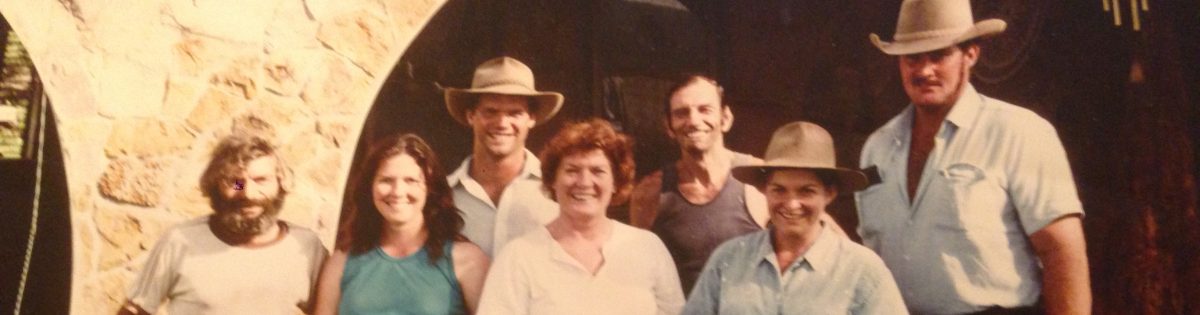
With the road train in place, we were able to spend the morning of our third day in the yards loading cattle. We ran the animals in single file through a chute and up the ramp onto the trailers. Each trailer had two decks, and the decks were divided into small pens which held two or three animals apiece. After several hours, and with a maximum of clattering and trumpeting, the decks were loaded, the ramps raised, the gates secured, and the road train started ponderously back towards the distant highway, and, ultimately, to the meat works.
It’s easy in our contemporary world to conceptualize our favorite chops and steaks as saran-wrapped entities we pull from the butcher section of the local supermarket, and think no further. But I believe all meat-eaters should be required, at least once in our lives, to spend a moment eye to eye with the animals we deign to toss upon our barbecues. I’m sure the experience would mark the last time some people would eat meat. I don’t suspect it’s true for oysters or scallops, but beef in its living form has an unavoidable sentience. Cattle are mothers and fathers and children with big eyes who feel pain and fear and, to those humans who are paying attention, relief, when left to their own devices. To cultivate them in order to kill them in order to eat them is a pretty damn dramatic thing to do.
I’m not one of those people who stopped eating meat after experiencing the reality of it, however. The experience did not conflate my understanding of the philosophical, perhaps the theological, distinction between humans and animals. If I believed that humans are simply cattle with bigger brains I would have no justification for eating cattle. The world where the smart guys eat the dumb ones is not a world I’d care to live in. No; I believe that humans are distinct from all other animals in that we have a spark of the divine in us, an aspect of our being which transcends this world. I realize this is an act of faith, perhaps an act merely of wishful thinking. But because I operate on this understanding, I feel it’s appropriate and morally defensible to utilize animals to our end.
But this opportunity brings with it a balancing obligation. I think our elevated status requires that we treat animals with the respect that honors that part of them which intersects our own experience–that is, their status as sentient beings. I think we’re obliged to treat them decently, handle them gently as possible, minimize their suffering. I think we should be scrupulous about not disrespecting the sacrifice stock animals make for us by wasting the gifts of meat, eggs, milk.
I realize this talk is thin gruel for animal rights activists, that to their thinking any suffering we inflict upon animals debases us, voids our status as elevated in any manner. But I think animal rights activists ultimately debase humanity itself by consigning us to simply another cell within the confines of an idealized natural world. Nature is not a gentle mother. Nature is brutal, merciless, predatory, incessantly at war with itself. In that tumult it finds a balance, certainly, but that balance is achieved by pooling the blood of one critter against an equal measure of the other. If we are simply animals among animals, if there is nothing special about us, then our predations upon other animals–be it cattle, or any other–is the most natural thing of all. If the activist’s world view was logically consistent they’d acknowledge that, in the state of nature, either you eat the bear or the bear eats you. And neither act is either more elevated nor less than the other.
But many animal-rights activists don’t take that stance. While some agitate merely for humane treatment of animals, the most militant among them say that, though we have no special status, we do have a unique obligation; the obligation not to eat that which comes naturally to us. But that obligation is based on, what exactly? The fact that we have a caliber of emotional awareness which puts us in tune with the feelings of other critters? Empathy is a beautiful quality which can inform our moral judgment certainly, but empathy alone, feeling alone, does not a moral system make. If emotions were sufficient, we humans would simply leave the victims of crime, for example, to decide the fate of their offenders. In that system some murderers wouldn’t be prosecuted because they killed a person no one liked or cared about, and some thieves would be executed for stealing items of profound sentimental value to the victims, who would want the offender dead. Running a moral system based on sentiment alone is the path to moral chaos.
So even as I looked into the big brown eyes of the cattle heading up the ramp and was saddened by their consternation, heard the concerned bellows of the departing animals as they called out to their herd mates, I’m still able to sit down and enjoy a good ribeye steak. I just don’t fool myself that it sprang ex nihilo upon a Styrofoam plate in the reach-in cooler of the meat department at Safeway.
Perhaps it’s in line with that sentiment that I perceived a vaguely post-apocalyptic feel to the yards with the animals gone. After three days of bovine cacophony the silence was eerie, the sounds of constrained animals still echoing within the clefts of my mind. The hard ground was pounded fine. Burned firewood and ash lay scattered among withered divots of earhide removed in the ear tagging process. Nubs of clipped horn and the occasional gnawed testicle joined among the organic detritus of a patently carnivorous jamboree.
There were at least two animals who came out of the process feeling better than they had going in. Both were young cows whose growing horns took a malevolent turn; rather than curving up or out, they’d curled inward towards the heifer’s faces. The first got off the easier of the two, as the horn’s tip had placed itself against her skull, an aggravating pressure to be sure, but not nearly as sinister as that of the other unlucky beast. Her left horn had actually aimed itself directly for the poor girl’s eye. It’s excruciating to imagine her experience of the inexorable menace of the invading horn as it slowly approached, then kissed, then penetrated her eyeball itself. We clipped several inches off the horn and extracted the tip from her eye socket, which surely offered some relief. But the object lesson the poor cow received in the impassive cruelty of Mother Nature doubtless remained firmly imbedded in her uncomprehending head nonetheless.
With the first drive behind us, we turned our attention to the next of the five planned musters. This second was to be a more complicated affair. We needed to assemble from scratch an entire yardworks twenty-two miles into the bush. We’d need to load several hundred yard panels plus the calf catch and water troughs and all the other accouterment necessary to capture, contain, and process somewhere around 2500 cattle. This muster would be the first of the season to utilize helicopters to push recalcitrant cattle from the wide-ranging bush lands, and during the time the cattle were in the yards we would be sleeping in an improvised stock camp.
Before that cumbersome process began Charlie suggested we take a day off, as there would be no more rest days until the Twenty-Two Mile yards were emptied. Peter used the day to pack his belongings and load them into his ute. I helped him with the task, our jocular banter belying my disappointment at his departure. Down in the stockman’s quarters Bundy was doing the same and soon had his minimal swag tucked in the back of Peter’s truck.
“You’ll be hard to replace,” Charlie said at the dinner table that evening, looking directly at Peter. I heard his words as a startingly frank compliment among hardened stockmen, whose language is typically couched in understatement or even insult. “Best of luck to you.”
“It’s been an honor to work with you lot.” Peter said, continuing in the same tone, “I thank you for all you’ve done, for the hospitality and for giving me the work.”
“Yeah, thanks,” Marlee said hesitantly, as if the need to find non-ironic language had her a bit tongue-tied.
The rising sentiment among an unsentimental people felt awkward. Peter was the first to burst the bubble.
“Maybe I’ll be back up this way some day.” Sara’s face started to brighten as he continued. “If so, I’ll be sure to send you a postcard from Kunnunarra.” The laughter brought the room back to equilibrium. Peter’s comic timing remained deft to the end; the subtext under his expressed desire to never see these folks again darn near qualified as pillow talk. Had he truly felt that way, he wouldn’t have said a word.
There’s a certain logic to the crusty ethos. Besides the obvious inclination to keep lovey-dovey talk to a minimum among working men (and women) there is also an acknowledgment that theirs is a difficult life. In the sarcastic desire to never return lies an admission that the people left behind are strong enough and capable enough to face the challenges the departing will no longer need to confront. It’s an expression of humility in the shape of a compliment, a double serving of virtue which plays well among uncomplaining folk.
Daybreak the next morning found Peter, Eddie, and I working alongside the girls to pile every available vehicle with the first of many loads of muster gear. By noon our motley loads, piled high and strapped in place, were ready for departure. Over a pan of Sara’s roasted steaks we settled the matter of which vehicle would be driven by whom. Peter’s destination lay well beyond the stock camp so he and Bundy would join our caravan but then bid adieu at Twenty-Two Mile and continue on. Our plans were modified when Sara announced that a new stock hand would need a ride in, as he was due to be dropped by a passing vehicle at the bitumen late that evening.
“Dave, I reckon we’ll send you out to pick him up. That way if Peter is rolling a flat tire back towards Twenty-Two Mile you can go rescue Bundy,” Charlie directed with an impish grin.
“Or if Bundy is rolling a flat tire back towards Twenty-Two Mile you can come wake me up for supper,” said Peter, taking the bait.
Of course, there was no rescuing to be done that evening. Twenty-two miles of jolting and rattling along the dirt track brought us to our proposed yard site. Then, with a handshake and a nod, Peter departed. With him went some of the best of Australia. His rawboned humor, commitment to excellence, and inquisitive mind which belied his roustabout occupation – all were gone in a diesel roar and a cloud of bull dust. I was happy to have the distraction of a backbreaking afternoon of work to take my mind off the abject absence which moved in in its wake.
At last light, as the remainder of the crew headed back towards the homestead in empty vehicles, I pointed myself the opposite direction to pick up the new hand. At this point in the season the two river crossings were no more than bouncy jumbles of river rock crossed by a rivulet. I made it to the highway well after nightfall. My headlights illuminated a bearded gentleman with a guitar case and a middle-aged paunch.
“How you doin’? I’m Dave; been waiting long?” I asked of the stranger.
“Aw, not too long mate. Just enough to where I wadn’t sure whether those were your headlights or the min-mins coming to get me,” chuckled the new arrivee, referring to the mystical apparitions of aboriginal lore. “Me name’s Denny O’Reilly.”
I reached for his guitar case as he swung his swag into the bed of the pickup.
“Oh no! I’ll get Roseanne. She’s a touchy sort; doesn’t like most blokes.”
“Sorry mate,” I said. “So you brought your guitar, have you?”
“Guitar?, No mate. It’s me wife in there. She’s sleeping. You’ll meet her later,” deadpanned the bearded fellow, then, after a beat, “You don’t mind if I have a smoke, do you?”
“No, go ahead,” I said, a chuckle in my voice.
“It’s me only vice, smoking,” he said, “well, that and telling lies.” He darted his eyes my way to gauge my reaction, then turned his head out the window to ignite a cigarette. “In fact, I was sitting here right around sunset waiting for you, having a smoke, when I saw the damnedest thing.”
I glanced over at my companion in an attempt to figure out which vice this story concerned, but could discern nothing from his expression.
“I’m just sitting here, minding me own business, and a bloke on a bicycle comes along. And not just any bicycle. He had one of those old fashion kinds, you know, with the big wheel in front and the tiny wheel behind.” He paused to take a long drag on his cigarette, then continued. “And what was he wearing? Naught but a tophat and tails, is what! He just tipped his hat at me and rolled on down the road. Damnedest thing I ever saw!”
I squinted my eyes and met Denny’s, whose own were firmly fixed on me with a look expressing pure astonishment. I am a credulous soul, a man who tends towards believing people’s words as my first impulse, but with all I’d learned about this gentleman in our three short minutes I knew this story was bunk.
“Uh-huh. And did he have a parasol? Perhaps a pink one?”
“No, Dave; I’m right serious!”
“I’m sure you are, mate,” I answered. “I’ll just wait for Roseanne to fill in the details. When she wakes up, that is.”
“Okay mate, as you wish. I only wish you’d seen it. It was quite a sight.” Denny said, his voice trailing off as he turned towards the window and blew out a long stream of smoke.
Happy to change the subject I asked, “so you’ve been there a while; did you see my mate Peter and his wife heading out?”
“Peter, you say? No, don’t believe I did. But I once knew a man name of Peter.”
Yeah, I thought. Who hasn’t?
“Yup, sure did. And his pecker was more than a meter. His girl was afraid, that before getting laid, when unloosed it might jump out and eat her.”
“Is that right?” I said, taking the cue, “Well I once had a friend name of Keith, whose mustache resembled a wreath. But on closer inspection, it proved a collection, of pubic hairs, caught in his teeth.”
“Quite a fella, that Keith. His poor dental habits didn’t seem to keep the girls away, reckon,” Denny acceded. “Well, I once had a mate name of Bates. Was a pirate, he was.”
“You don’t say! Could he dance the fandango on skates?”
“Aye, he could, Dave. At least, ‘til he fell on his cutlass…”
“Which rendered him nutless?”
“And practically useless on dates!” we chirped in unison, laughter filling the cab over our newfound mutual affection for limericks.
Outside, our headlights stabbed the ebony night, solo pinpricks in the vastness of the vacant Australian Outback.
During the next week Denny, and Eddie, and I settled into the massive undertaking of creating a portable yard at Twenty-Two Mile. We loaded vehicles with endless quantities of clangorous hardware, transported it down the track, and off-loaded it with equal cacophony. As we were wrestling the calf-catch onto the flat-bed I found myself reflecting on the time I’d helped a buddy move between apartments in Hollywood. Derek had inherited a fanciful antique cupboard from the previous owner and being that he was an aspiring actor the substantial piece was the only thing of real value he owned. There was no chance he would leave it behind, despite living in a second-story walkup. We, his friends, very much wished that the departed tenant had bequeathed to him something more akin to a gold pen, especially when we discovered that the upgraded apartment was a third-floor walk-up.
Derek roped four of us young bucks into helping move the several hundred pound, six foot tall piece. The first leg of the move quickly devolved into a bouillabaisse of whimsical stratagems and idiosyncratic if passionate assertions on the particulars of physics and architecture, followed soon enough by a plethora of grunts, exhortations, and curses as the various theorems met brute reality. The uphill portion proved a similar buffet of diaphanous assertions and rubicund grimacing, with gravity and the extra floor magnifying the relevant elements by multiples. When we finally shoved the beast into its new position we all felt as though we were qualified to open our own moving business, none of us having lost digits or vertebral discs in the process. I believe we world-beaters congratulated ourselves with tankards of beer, if I recall correctly, though the particulars are a mite fuzzy.
The point is that heavy stuff weighs a lot, and it’s heavy, and hard to move. And moving heavy stuff is hard, because it doesn’t want to move, and when it does it has a tendency to crush fingers and, if it’s not handled properly, it falls down and hits people where they don’t want to be hit, like, on their heads, or knees, or toes. Did I mention heads? And on Bullo River Station we handled articles twice the size of Derek’s cupboard, and four times the weight, then set it in place, and turned around to get another thing just as big, or bigger. We’d do that for a couple of hours, drive for a bit, then reverse the process. Finally, after doing that all day, we’d have a tinnie of Emu Export Lager waiting for us, if we were willing to part with a couple of the precious shekels we’d earned doing the things that warranted the Bush Chook (as Emu Export was known among its several aficionados).
I think that many of us urban and suburbanites lose track of the grueling work that goes into making the comfortable air-conditioned and plushly carpeted spaces in which we spend so much of our time. Steelwork and concrete-forming may not require a Harvard MBA, but Harvard MBAs require steel and concrete buildings in which they can study and practice their arcane axioms, buildings built by men, mostly, who posses virtues other than cerebral, but virtues no less. The gritty work of manipulating large-scale machinery to create large-scale structures requires persistence and resilience in spades, a willingness to put one’s well-being at risk of pain or death as a matter of daily duty. Why we in America disparage this kind of work, feel that herding all our kids towards university educations and oft-vestigial degrees in oft-tangential disciplines as the only honorable track, I began to understand less the more time I spent at Bullo. What I do know is that we’re robbing ourselves of magnificent young tradesmen and women by not honoring and encouraging the virtues of body and mind which come from unrelenting physical labor. Having a category labeled “Jobs Americans are Too Spoiled to Do”–because that is the filleted truth behind “Jobs Americans Won’t Do”–does not bode well for a society. Lose our spine, our structure, our foundation, and our brains end up sitting in the dirt. They’re not much use there.
Besides the deeper gratifications of working in the world of things, there are visceral joys as well. Stand close to a 90 ton D10 bulldozer loading itself onto a flatbed trailer and see if there isn’t a gob-smacking might and majesty in the forces at play, an unavoidable admiration at the man-made materials which both generate and constrain such forces.
Watching a simple metal chain at work is astounding. When Charlie pulled the stuck road train up the dirt grade with the dozer he connected the two with a steel chain, welded links just a bit thicker than your average rope of red licorice. With that old-school piece of gear he overcame gravity—one of the four forces of nature! Tens and tens of thousands of pounds of vehicle cheated Mother Nature with a bit of metal ore customized by us to our purposes. Were any of us to find ourselves landed upon a blank-slate earth possessing all we know of what’s possible it would still be countless generations before we could replicate that mere chain, yet in this life any of us can wander down to our local hardware store and buy it by the yard for a relative pittance. On those regular occasions at Bullo where I would get to see chain at work I’d find myself riveted in place, teeth clenched, nose wrinkled, head gently shaking in wonder.
This is not to suggest that everyone at Bullo was equally enthralled with the process. Very early on I began to recognize that Denny’s enthusiasm for work didn’t quite equal his zeal for yarnin’ and rhymin’. His water breaks were frequent and began to grow in length as the week progressed.
“Hey mate, give us a hand here, will ya?” I called out to him one afternoon as we were unloading coils of barbed wire from a pickup. Barbed wire grabs everything, always, making it a bear to handle heavy reels by oneself.
“Sure – just a sec,” answered Denny from a dozen steps away. I continued fruitlessly tugging at my spiny load, expecting help which didn’t arrive within any time I considered “a sec.”
“Denny!” I called out with a bit of exasperation, with both the balky wire and the desertion.
“Christ, mate,” he retorted while sauntering distractedly my way, “you’re not my bloody boss!”
“No, man, I’m not. Just trying to get stuff done around here, that’s all.” I saw that he was occupied rolling a cigarette.
“Well, it’ll get done, mate. And we’ll work together to do it. But you’re not the shop chief here, and I’ll appreciate you remembering that. I take a blow, you take a blow.” His jovial demeanor had dissolved entirely.
He did have a point. Though my three months had given me a strong stake in the welfare of Bullo I was no more than another hired hand in the situation. So I acceded to his pace, and the rest of the afternoon proceeded in a peaceful, and leisurely, fashion.
After dinner that evening I walked down to Stumpie’s quarters, where Denny and Eddie were just finishing their dinner with the diminutive Bullo fixture. I was interested I ratifying the peace.
“Is Roseanne still sleeping? Or can we get a chance to meet her?” I asked in a chipper tone.
“Well, let’s see how she’s feeling,” said the new hand broadly. He disappeared into his room for a minute and returned with a handsome rosewood guitar, its pick guard nearly worn through with use. The middle-aged man placed the instrument upon his knee and within moments the air was filled with a beautiful instrumental melody, evocative of an American Bluegrass ballad or an Arcadian lament. Denny was a marvelous guitarist, and as his hands flowed across the fretboard his eyelids lowered and his head tilted slightly forward. Eddie sat nearby, impassive but engaged. Stumpie smiled broadly through his facial shrubbery. After months where the only music I’d heard was the constant loop of the Best of Kenny Rogers on Sara’s stereo, it was mesmerizing to hear original music, organic and up-close. At that moment, I was sure this was the most beautiful song I’d ever heard. The silence, when it returned, was excruciating.
“Wow,” I said, as the melody faded into the starry sky. “Dude, that was beautiful. Did you write that? What’s it called?”
“I did,” said the troubadour. “It’s called Tanzy’s Waltz.”
“It’s beautiful. Really. Who is Tanzy?”
The bearded man responded with a simple shake of his head, a gesture that sealed the topic. Instead, he launched into a cover of James Taylor’s Sweet Baby James. His voice was full and soft at the same time, as if he’d just gargled with caramel schnapps. One song led to another, then another, until the stockquarters and the workshop and the night itself ceded its presence to the bushman’s cri de coeur. For his last tune Denny played an Australian-ized version of Kris Kristofferson’s Me and Bobby McGee:
Busted flat in Wollongong
Headed to the bus
Feeling nearly jaded as me jeans
Sheryl thumbed a Holden down
Riddled through with rust
Took us all the way to Narrabeen…
I eventually walked back to my room, knowing there was no concert I’d ever seen, nor any I could conceive of seeing, more impactful than that performance by Denny O’Reilly, sitting upon a tree stump in front of the humble stock quarters of Bullo River Station. It was more than the novelty of the moment, or the freshness of hearing live music after a hiatus, though those surely were elements. More at play was the sentiment behind the music. Denny revealed through his music a disquiet, an unknown affliction, for which his music was medicine. He was alone, as he played, as was I as I listened, and within that solitude he and I were one.
The next day, back at Twenty-Two Mile, I let Denny know how much I enjoyed his music.
“Aw, mate, just a bit of plucking,” he said with deliberate understatement.
“So Denny, do you have a family? Wife or kids?” I suppose I was digging at the root of the sentiment I’d seen last night.
“Nope.” He said flatly, turning back to the task at hand, “not to speak of.” I didn’t know whether by this he meant he did not have close family, or that the subject itself is not open to conversation. Either way, I understand the topic to be closed. “I’m going to have a smoke,” he said quietly as he stepped towards the shade of a nearby tree.
For all the softness I felt towards the man, the obvious sublimated sorrow and the tender soulfulness of his music, I could not help but become increasingly agitated by the quantity and duration of his work breaks. I was accustomed to working with Peter and his relentless diligence. His pace suited my own. A great deal was accomplished in short periods that way, and there was always a great deal more to do. With Denny, the punctuations within the workday were beginning to take up nearly as much time as the work itself. This was especially true when he and I were left unsupervised by either Charlie or the girls. I decided to raise the issue one evening with Charlie.
“Look, Charlie, I like Denny. He seems to be a good man. But he’s driving me nuts with his regular smoke-Os. Is there anything you would have me tell him on the subject?”
“It’s not your business to tell him anything, Dave. You just do your job and do it as well as you can. He is a bit of a bludger, sure. But that’s not your problem, and it’s not yours to fix,” the big man said sternly. “You take care of Dave. Denny will take care of Denny.”
 Barking in Nutwood