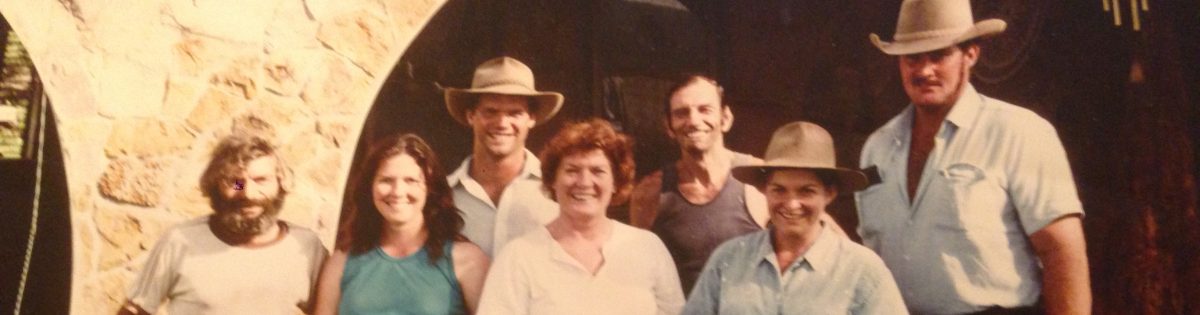
One afternoon after an easy romp through Bull Rush Peter smiled broadly, turned to me, and told me he was planning to leave Bullo. From his saddle he said something about becoming a father. His wife Diane was pregnant, they felt pretty sure, and would go down south to live with her parents for the happy event.
I reflexively kicked Silibark and mouthed a big congratulations, even as I realized in that moment that my Bullo River experience had changed dramatically.
Peter Clark has a manner about him which invites friendship, and I had come to quite enjoy his company. He finds humor in the most unlikely moments and has a casual style about him which de-escalates tense or demanding situations. I’d come to admire his integrity, his commitment to doing things the right way, every time. In that he mirrored Charlie, which is why Peter was spending this season, his second at Bullo, despite having the qualifications to be a station manager himself.
“So what will you do down south?” I asked that evening after dinner. I did not know if he had brought the subject up with Charlie and the girls yet, so I hadn’t raised it at the dinner table.
“Oh, I don’t know mate. I need to earn a bit more money if we’re to have a new mouth to feed,” the slender man said, looking past me. Returning his gaze to me he said, “I would like to run a station, if anyone will have me. It’s more sheep down south, and I’ve actually spent more time among them anyway.”
“Geez, Pete; I can’t imagine you’ll have much trouble finding a spot. You’re a conscientious guy, and not a pain in the ass more than a couple of times a day,” I said with a chuckle.
“Yeah, I don’t know Dave. There are still plenty of small minded folk around who wouldn’t be too happy to see their manager bring along his aboriginal wife, and little brown baby.”
Coming as I had from Los Angeles interracial relationships are irrelevancies to me, but I had noticed during my time in Australia that folks of different colors did not mingle readily. I’d seen some Asian faces in Sydney, but once I left skylines behind white faces were ubiquitous. Where I had occasion to come across Australia’s indigenous population they were keeping to themselves, as in the roadside eatery on my bus ride up. In fact, Peter and Diane were the first interracial couple I had observed, much less spoken with. And I had right from the start admired them for their non-conformity against the unsavory inclination to maintain a rigid separation of the races. To do so in the city is one thing, but to flout convention in the bush was another level of commitment to a beautiful principle altogether.
“I have noticed Australia is not much of a stew, ethnically speaking. Do you really think it will be a problem for you guys?”
“It won’t be a problem for me, mate. The problem is theirs. I have no interest in working for someone who’s got a problem with Diane. If they won’t have me for that reason they need more than a station manager. And I’d have no time left over when running a station to be training up owners on matters of basic decency.”
“That sounds like a great attitude, buddy. I hope you find something quickly where you guys can settle into the family life. Meantime though, what am I to do here? Wait for some other bozo to show up? What if it’s one of those small-minded types we were just talking about?”
“Oh, I reckon the girls and you can just throw a rope over him and hogtie him until he sees the light.”
“I suppose you’re right. Hell, the girls could de-nut him if he is too much of a problem,” I said with a breeziness I wasn’t feeling. The thought of losing Peter was a gut-punch.
“So the clown is leaving the circus,” Bundy said when he heard. “Since you’re driving out can I catch a ride with you?”
“So the jester is going bush also?” Peter said with evident surprise.
“Yeah, I think so. It’s the first rule of station life, you know. Never let a good opportunity for escape go to waste.”
I don’t know if Bundy had family issues to attend to back home, or whether these three months in one place were his limit; regardless, the crew which had become family through many days of hard labor was, just like that, disintegrated.
With these men I had been introduced to the rigors of station life. It had become a given that I would wake before dawn, that I would squat underneath a cow in the final cold tendrils of night, that I would have a simple breakfast, and that at daybreak my hands would be busy in the field. My hands themselves had started to toughen, which gave me some relief from the nuisance cuts, pinches, and bites constant in this life. Ever since my spate of fencing with its constant bashing of metal against metal the hum of agitated nerves had become a constant undertone in my hands. I assumed that this tingling, or its cousins – ache and pain – were simply part of the fabric of this physically demanding life, in which the human body is often the most fragile element. Yet there really wasn’t much talk about discomfort among these coworkers, though the occasional involuntary winces or other understated exclamations revealed the otherwise unspoken difficulties. I admired this stoicism, especially when evinced by Uncle Dick, whose thin and weathered frame and battered calloused hands were testimony to a lifetime of abuses.
Work in the outback is hard, and the people who make their life here are hard. The people are tough, the regimens are tough, the elements are tough, the language is tough. In our urban lives we are accustomed to regular periods of relief. Certainly, there is much hard work to do in any productive contemporary life, but in the city we have the benefit of air-conditioned buildings, stocked vending machines, icy-cold drinking water at the push of a button. We spend our lunch hours at smart cafes, end our workdays with cold beers in stylish pubs, then hop in posh vehicles for a pleasant cruise back to our comfortable houses. Station owners and workers rarely enjoy any of these comforts in these lives they have voluntarily chosen, with hot hours in the sun breathing clouds of bull dust, tough sliced steak between two slices of buttered bread for lunch, a cold beer from a tin can after nightfall often the sole refuge from the demanding days.
But I had come to find that that simple sandwich under the shade of a Coolibah tree or that cold beer offered a satisfaction not often found in our city lives, where the comforts available to us are so constant they’re easily taken for granted. I suppose part of the magic of that tinnie of Emu Export Lager was the contrast it offered to what had immediately preceded it. Combined with the tangible evidence of the day’s work as we drove towards the homestead the unadorned quaff offered a pleasure simple yet bold, a substantive satisfaction unknown to me in my previous life.
An unexpected revelation of this rural life was the different caliber of freedom it afforded. In urban America we revel in our freedoms, but we experience freedom too often as an abstraction. Freedom to move and do as one pleases is constantly inhibited in the city. In a purely physical sense our pace and direction is constantly regulated; by traffic lights, don’t walk signs, the presence of other people and vehicles and structures and fences and signs and security gates. Add to those limitations the blitzkrieg of laws and regulations and policies and procedures and homeowners association covenants and it becomes wry fact that the stout freedoms we so boldly celebrate have, in practice, been incrementally bonsai-ed into a quaint topiary.
In the outback impediments exist, certainly, but more due to the obligations we voluntarily take on — animals which need feeding or pipes which need mending. Taking care of those things which must be done certainly is not unfamiliar to city dwellers, but the manner of doing so is more constrained when navigating the labyrinthine maze of the artificial environment. Out here, we’d throw some gear into the back of the truck and head out to our worksite along the dirt track, pulling off the track whenever we needed or wanted, at whatever speed we desired, stopping when and where we wanted. Never is there concern for checking the rear-view mirror for patrolling officers, nor security cameras or nosy neighbors. This freedom to move about freely and under one’s own authority is alien to urban residents yet is a freedom as pure and primal as anything promised in the U.S. Constitution. We city folks will spend a few hours with a ball game and some fireworks on the Fourth of July, sure, but then we’ll spend the next few hours getting in each other’s way as we try to exit the parking lot and get back home.
So the idea that Peter and Bundy would roll up their swags and move on without sentiment was an expression of the free man’s prerogative, I suppose. It’s the nature of this life that work is easy to find – the need is great and the pool of men and women willing to put in these kinds of hours doing these kinds of tasks is small, and getting smaller. Certainly, this decision was no shirking of responsibility by these fellows; I’d watched them bust their butts for endless hours doing unforgiving labor. They simply decided it was time to fly, so off they would go.
Fortunately there were still two busy weeks before anybody left. Mrs. Henderson left nothing to chance and put in a call the next day to the employment agency in Katherine, asking them to send someone. She was long since familiar with the peripatetic habits of outback ringers, so she took the news of the boys’ departure in stride and crossed her fingers that the next fellows to arrive would be competent workers who would put in some quality hours until they, in turn, headed elsewhere.
Two days later Mike from the Northern Territory roads department pulled into the homestead for some manner of official visit. Accompanying him was our new workmate. Charlie met the government man at the back gate and welcomed his Aboriginal passenger. A few short sentences had the dark broad-featured wrangler sitting beside me as I drove him over to Stumpie’s guest house for a meal and a place to unroll his swag. His name was Eddie, and his family was of the Arunda tribe, a band of aboriginal Australians whose ancestral home is the center of the country around Alice Springs and its famous Ayres rock. The Arunda are, by my understanding, considered keepers of what we in the English-speaking world have dubbed the Dreamtime, the foundational and mythological history of the origins of the aboriginal people. The strong and unassuming man looked straight at me as I welcomed him to Bullo, a place that had come to feel as much mine as any other.
Eddie and I worked together the next day, spending a full day in the yards. For several hours we lugged homemade water troughs around, placing them within the various pens. The troughs were cumbersome bastards, made from old fifty-five gallon drums cut in half lengthwise and held together in a frame of metal pipe. When Dick made the first few he overbuilt them, making them unnecessarily heavy. Even the modified design, made using less pipe, were north of two hundred pounds. It was all Eddie and I could do to shift the massive troughs by hand, and I was happy to see that my new workie was unfazed by the effort. This was quite obviously not his first rodeo. We then spent the afternoon staking the portable yard panels into position by bashing fenceposts into place in anticipation of the stresses the yard would need to withstand when packed full of agitated cattle.
As always, sunset brought the promise of dinner and the short refuge from work darkness affords. As we collected our tools I was enjoying the fading light, leaning on a panel, watching the sweat drip from my forehead and make tiny bomb craters as it hit the fine dust. I raised my eyes and noticed in the distance a plume of rising dust, the vehicle at its point noiselessly piercing the empty horizon. As the wheels of the vehicle churned against the dry-season bull dust it lifted the powder high into the air, forming a tapering cloud in the truck’s wake. From my vantage point across the horizon it appeared as if the alien Toyota was dragging a tornado as it approached the homestead.
By the time I made my way back to the house Sara had been joined by an assemblage of men whose dress set them apart from the usual visitors to Bullo, typically working men wearing utilitarian togs and ready for some manner of work upon the soil. These fellas wore attire drawn from catalogues appropriate for a day of rustication, certainly, but which showed no signs of wear, no residual stains. The most vocal of the crew, who seemed to share a familiarity with the Bullo matron, was dressed in rust-colored pants of rough denim, a plaid shirt of complementary coloring, and a yellow down vest. A tweed hunting cap completed the assemblage. As to the two other gentlemen, one was a thin man wearing floor to ceiling khaki – with the addition of a pith helmet he’d easily been taken for a zookeeper — and the other a distinguished looking fellow with a grey beard and a smart ensemble straight from the pages of Eddie Bauer. The bearded gentleman seemed vaguely familiar to me. They listened as their behatted compatriot spoke.
“Mr. Kruger simply loves the outback, what you folks represent. We’ve been talking along the drive — which means plenty of time for talking, as you know — and Mr. Kruger would very much like to share your story with his viewers, make you and your wonderful family a part of his journey.”
At this the bearded gent spoke up in accented english. “Yes, Matthew is correct. I am taken by this isolation, these wide-opens spaces you call home. I understand your late husband was a flier during the war. I myself served in World War II. Perhaps we could use this as a connection, this shared experience, as justification for my coming to visit,” said the graying man in his soft German enucuation.
As I sawed through a steak and some roasted potatoes I listened to the pitch unfold. They were evidently here to pursue the possibility of a TV shoot, an episode of a German show entitled Hardy Kruger, Veltenbummler. Mr. Kruger was an actor, know to American audiences as the German U-Boat captain in the riveting film classic Das Boot. I had seen and very much enjoyed the movie, which explained my dim recognition of the man. Veltenbummler, I learned, meant “World Traveler”, and the show was simply that — an exploration of the ties Mr. Kruger had made in a career globetrotting on the film circuit. So the idea was that Hardy Kruger and a film crew would return to Bullo in a month or so for several days of shooting.
I was excited at the prospect. My isolation on Bullo had been complete; all I’d done in the long days of toil had been done in a vacuum unimaginable to those of us who generally live our lives within a web of social and technological connections. I had been enjoying the isolation; there was a clarity and calm available when one is the master of one’s own day. But the possibility of having some of these gritty days documented and shared with folks back home had a real allure. I was proud of the choice I’d made, and the types of work I found myself doing. Having a vehicle for sharing that in the well-understood paradigm of television would go beyond my letter writing efforts when sharing the experience with folks back home, where “Pics or it didn’t happen” is a thing. Had I known as I sat there eating my dinner the impact the eventual filming would have on my life, and on the life of Bullo River Station, I would have sent the TV crew packing at the point of a rifle.
 Barking in Nutwood