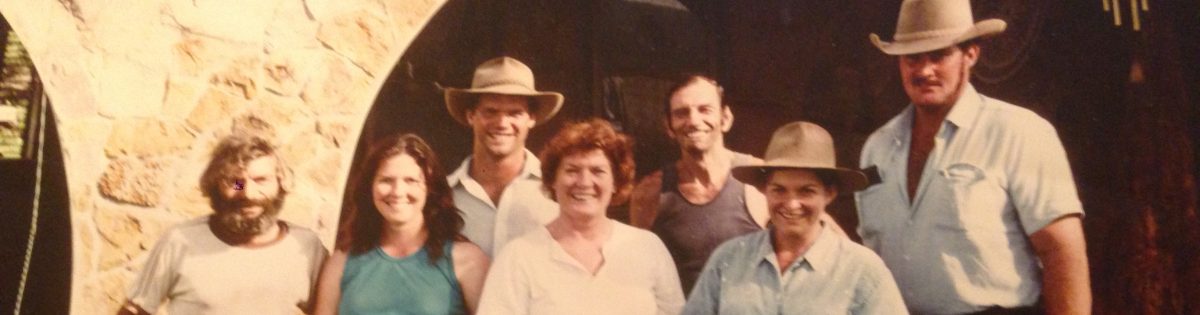
A charming tradition devoutly honored at Bullo is the birthday dinner. Like Arab princes – or condemned prisoners – birthday boys and girls are given free rein in choosing the menu on their special day. This wasn’t nearly as limited an offer as circumstances might lead one to believe. Sara and the girls would pull out all stops to fulfill the wish, beginning with a visit to a stone shelf stocked with cookbooks. This well had been tapped so many times over the years that the books were little more than stacks of loose-leaf paper stuffed between the vestiges of collapsed bindings.
With our preoccupation entirely upon the upcoming muster I was unsure what Danielle had in mind when she gathered a few of the dilapidated tomes and invited me to join her at the stone counter.
“It’d be your birthday in two weeks, eh?” she asked. I didn’t remember mentioning the date to her, but evidently I had.
“It is, yeah. The eighteenth. What, uh…what about it?”
“Aw, you get to choose your dinner, mate!” she said cheerily.
“Probably ought to stick with beef, though. We’ll not be knocking over a calf with the ute for your veal parm,” added Marlee.
“Unless we send you out on a dingo hunt…aw, nevermind that,” said Charlie, in a confirmation there were no secrets at Bullo.
I ignored the taunts and dove into the books with Danielle. I was fantasizing of a dinner of beef stroganoff and cherry cheesecake, my go-to birthday treat back home. After paging through a sheath of the stained and dog-eared pages we found a stroganoff recipe, and the next two mail planes brought the recipe items Sara ordered via radio phone.
Noodles turned out to be the main stumbling block. I’d tried to describe egg noodles, those wide yellow strips of happiness whose al dente texture undergirds the creamy beef, turning the whole into a toothsome gnaw. “Egg noodle” was an unknown quantity to the grocer, so Sara put me on the phone. My foreign accent filtered through the penny-whistle/conch-shell accompaniment of the radio transmission made for minimal progress.
“Just send what you have,” Sara said, as she moved on to the next item.
That Friday we were the proud owners of ten coils of angel hair pasta.
“Yeah, that really won’t do,” I protested gently, and Sara tried again.
“Do you have anything with a little more…” she paused, her voice in drawn-out contemplation, “…oomph?”
The next plane, our last chance, brought several pounds of spinach seashells. “Those’ll work,” I said, given that they arrived along with a tub of sour cream, the true hero of the dish.
On my birthday Danielle knocked off early to begin preparations, allowing her to begin the bake right when power came on. At sunset I finished my work and headed to the homestead, offering a big smile to Danielle and Sara in the kitchen. I lubricated the festive machinery with two cans of Emu Export Lager before I hit the shower, and three more after.
Just before mealtime Uncle Dick strode through the rear door, a pained look on his face. He and Stumpie would be joining us for the evening, along with Bundy. I smiled broadly at the bony mechanic.
“Where’s Charlie?” he asked, his brow furrowed.
“In the office, I think,” I said through my liquid grin. The scrawny man did a double take at the inexplicably jovial American then hurried into the dining room. A moment later, I watched him parade out the rear door, followed by Charlie and Peter. I fell in behind.
I soon realized what was causing the stir. A cow had been drawn to the tantalizing growth of juicy grass within the wire fence surrounding Dick’s cabin. The animal stuck its head through Dick’s ornate metal gate, happily lapping away at the broad blades. When Dick stepped outside he’d startled the cow, sending it loping into the salt flat wearing a new and highly unorthodox metal collar.
In a flash of transparent – well, perhaps translucent — clarity I recognized this as my opportunity to finally do some cattle wrangling. What fortune! On my birthday, no less! I hastened my pace to catch up with the others. Across the flat I spied Stumpie keeping an eye on the unintentional gate thief amongst the trees bordering Homestead Creek. As we approached, Bundy walked from the workshop carrying a coil of rope.
Our subject was a small brown cow with the stubby horns and skittish nature of a youngster. She was standing alongside the bank, preoccupied with the newfound ornamentation wedged around her thick neck. Peter circled to her left. The cow backed away from Peter’s approach, moving towards Bundy. The aboriginal stockman coiled his rope, threw it, and pulled. He’d sent a perfect loop sailing around the animal’s head. He wrapped his end around a nearby tree to constrain the disconcerted beast. Peter rushed to help Bundy.
Meanwhile, I’d figured out how I could be useful. The scared animal was moving in an arc at the end of the rope, headed, by good fortune, my way. By my lagered understanding with the animal secured the next logical step was removing the gate from the critter’s head. I stepped in and prepared to grab the gate.
“Careful!” I heard a men’s chorus sing.
My contemplation of why these men would choose this moment to break out in song ended when I found myself flying through the air. The cow, much larger than it had been mere moments before, painted me with silver strands of saliva and mucus as it planted its forehead in my sternum. I landed with a thump, rolled several times, then hopped to my feet. Unfortunately, my steps, if not my intentions, took me deeper within the animal’s radius, and again it introduced itself, this time to a more intimate region.
Physics being the ineluctable forces they are, I again found my head and limbs following my groin on a brief journey, several feet up and more than several feet backwards through space. When I arrived at my new destination a considerably more friendly face loomed in front of me.
“Are you okay?” Peter asked, his expression a spin-art of concern, astonishment, and hilarity.
My immediate judgement—an admittedly unreliable arbiter at the moment–told me I was. Ten feet away Charlie stood over the fallen cow. Using my contribution as diversion Charlie’d grabbed the beast’s tail. With practiced timing he’d used the tail to force the cow off-balance. When it fell on its side, he’d wrapped its tail under its rear leg and held it high to prevent the girl from rising. While Bundy removed the rope Stumpie and Uncle Dick got busy pulling the gate off the creature’s concrete noggin.
We returned to the house, I flush in equal parts with malted adrenaline and a numb delight in the drama of my first close encounter with the wild cattle of Bullo. I’d had an object lesson on the difference between these cattle and the two spoiled strumpets whose spongy udders I’d been draining of milk each morning. Pumpkin and Daisy were pampered heiresses in lacquered salons as they wandered their limited fiefdom behind the garden fence, nuisance level — coquette. But the uncouth bovines whose presence had accompanied my periphery for the past several months were a different breed, clearly.
I’d been lucky. My acrobatic partner was mild, everyone told me, nothing like most rude beasts of the bush. They had a point. She was sociable enough to go nosing around Dick’s cottage in the first place. But its head felt substantial — locomotive-like, actually — and she seemed plenty menacing when eyeballing me from twelve inches away.
“Well, I guess I came out alright,” I offered as face-saver; this while eating the most enjoyable plate of beef stroganoff I’d ever had.
“That’s only because you followed the first rule of station life,” counseled Bundy.
“I can’t remember, Bundy; remind me what that rule is?”
“Make sure you have a bit of piss in you if you’re gonna get run over by a cow. Keeps you from being hurt that way.”
“Maybe the first rule ought to be ‘don’t get run over by a cow’,” offered Charlie.
“Or, if you are gonna get run over by a cow, and you have been doing some drinking, make sure all your mates see. Because watching you fly through the air like a rag doll was the funniest damn thing I believe I’ve ever seen!” said Peter, as we all dissolved into laughter. “And twice, no less! It may be your birthday, but we got the best present!”
That weekend one of the subtle changes of life amidst uncircumscribed nature took place. Donna, Sara’s knock-kneed German Shepherd, came into heat. Danielle’s Kelly followed suit the next day. On Saturday night Peter’s Spike and mangy old Banjo became four-legged Tony Maneros in their white polyester fever, looking for babes in all the wrong places. Kelly found refuge curled up beneath my bed, looking a bit bewildered by all the attention. Banjo had his sights set on Donna, but Spike, being a fox terrier and therefore only nine inches taller than a snake, felt his chances were better with three-foot-tall Kelly than three-and-a-half-foot-tall Donna. He set siege outside my door, his nails clicking on the concrete floor as he trotted restlessly back and forth.
In the dead of night, the stars alone interrupting the bituminous sky, I was awakened by a noise. Pointing my flashlight towards the louvered windows which lined one wall from floor to ceiling I spied Spike worming his way between two glass panes. His wiggly body was half in, half out. He had no feet on the ground, having jumped to where a pane of glass was missing. The poor fellow almost deserved his reward for such gymnastics; would Dame Gothel have chased out the Prince had he managed to get to Rapunzel without the benefit of the marooned damsel’s two-story hairdo? Effort should have some reward, should it not?
Despite my empathic commiseration I chased the little fellow away and carried Kelly to Danielle’s room. Let her play Mother Superior for the night.
I spent the last leisurely Sunday before the muster in Sara’s office, thumbing through her books. I’ve always loved reference books, especially, and the Henderson’s shelves were heavy with knowledge. I was surprised to see the encyclopedias been lightly used, given the great diversity of topical knowledge required in ranching life. The wildlife identification books and atlases and neatly catalogued volumes of Encyclopedia Britannica mostly sat uncracked.
Te dusty tomes were relics of the girls correspondence school days, I decided. Knowledge at Bullo needs to be closer at hand than a bookshelf, and deeper in practical understanding than text affords. Indeed, one of Charlie’s favorite expressions was, “If all else fails, read the instructions.” For most of us that statement is a comic defense, offered to cover our own haplessness when brute intellect or common sense fails us. For Charlie, reading instructions was an admission that a person didn’t know where to begin, or the next step logic dictates, and was most likely a sign that the person didn’t belong at the task in the first place. Whether tuning up a chopper, changing a clutch on a bulldozer, castrating horses, or organizing a muster, I never once saw Charlie Ahlers reading instructions.
One afternoon I asked Sara about the trove of unopened reference books.
“Oh, my Charlie loved the encyclopedias!” Bullo’s matron said in a chipper tone, referring to her late husband.
“Did he read them?” I asked.
“Oh goodness, no!” Said Sara, “Charlie would tell you he didn’t need to – he knew everything!”
Charles Henderson had been an American flyer in World War II, and when the dashing ace found himself in the company of Sara, a daughter of Sydney society and a nationally-ranked tennis player, he was smitten. What Charles Henderson wanted, Charles Henderson got, and before long Sara found herself raising two young daughters in Baltimore, Maryland. Charlie was no fan of what he saw as the disintegration of American society in the 1960’s, and as he’d done business shipping Australian cattle to Asia his opt-out was outback, this refuge being about as culturally distant from Berkeley, California as the English-speaking world offers.
Sara imagined Bullo would mean English saddles and proper posting technique enroute to the luncheons a lady might expect to attend as the wife of a country squire. What she found upon arrival was a tin-roofed shed open to the elements, a fire pit for a kitchen, and plenty of aborigines to assist with daily routines intimately familiar to them but foreign as Sirius to a Sydney socialite.
With the force of his indomitable will and profound self-confidence Charles managed over the years to forge an occasionally profitable cattle station, though there were many difficult days in the autocracy he’d created. His management style was, from all I heard, considerably less than collegial. It’s no surprise that someone who would take on the life Charles Henderson selected for himself and his family might have a willful streak wide as the Top End skies, and there was no denying the tension which crackled in the air whenever his name was raised among the three women. Neither was it possible for me to deny that, arriving as I had within a year of his passing, all the virtues I found at Bullo – the committment, the gracious decency, the comfortable if spartan fullness of life I found myself happily amidst – was in some significant way a manifestation of Charles English Henderson III.
This disciplined order, along with his books – and a considerable debt – were tangible reminders of the late scion. Sara explained that Danielle and Marlee had occasionally used them, having been taught at home for their first ten years. The girls were smart but rebellious students, preferring helping their father with his far more interesting duties to the formalities of book-learning.
No drill sergeant worth his stripes would let his cadets drop out uncredentialed, however, and so it was with Charles Henderson and his girls. A proper education required high school diplomas, at minimum, and Charles’ conservative sensibility demanded a private education. The girls were sent off to what they each speak of with a rare unanimity – two unhappy years at an academy in faraway South Australia. Adelaide is the Charleston, South Carolina of Australia, a shady home of gentility and tradition as close to prim as Australia gets.
The girls mostly left it to my imagination the unkindnesses patrician girl culture inflicted on these cowgirls from distant and dusty plains, young women who could’ve roped and castrated their Phys Ed teacher more easily than they could follow the labyrinthine machinations of adolescent females.
Marlee mentioned being especially unhappy with the cafeteria fare. The crisp greens standard among the dieting debs didn’t satisfy her appetite, built around daily ten thousand calorie burns. Sara found many of her daughters’ complaints justifiable and, buoyed in their righteousness, the girls were forever getting in trouble with the academy’s Mother Superior. Estranged from their classmates and distrusted by their teachers, the most useful thing the girls learned during their distant estrangement was the depth of their bond with home, with Bullo River Station. Here, the world made sense, and the lessons relevant to this life made them masters of their own destinies.
I found myself reading, on a crisp gilt-edged page, about Bobby Fischer, the boy wonder from the US who conquered the chess world in the 1960s before descending into lunacy. A description of correspondence chess, in which all the squares of the chessboard are numbered and games are played with written instructions, was followed by a replay of a classic match between Fischer and Mikhail Tal. The idea of two grandmasters of anything going head-to-head gets me interested automatically, but two chess masters, their meat computers plotting seven moves ahead – well, I decided that getting inside their heads would be an engaging way to spend the afternoon. I took the encyclopedia into the lounge next to the kitchen, where a wooden chessboard sat on a side table. I began replaying the game, trying to figure out the strategy of each player. I replayed the game all the way through but remained in the dark as to what either the young Mr. Fischer or the elder statesman Tal were up to, until the obvious final blow.
Despite my futility I do believe Charles Henderson would’ve been happy to see me with his fine encyclopedias, sweating it out, though by Sara’s reckoning the opinionated ex-pat would have all the while been castigating the chess giants for what Charles judged to be poor decision-making. And not a soul – least of all I – would have argued with the man who managed, by sheer force of will, to fashion a full life from the salted hardpan of the Bullo River valley.
 Barking in Nutwood