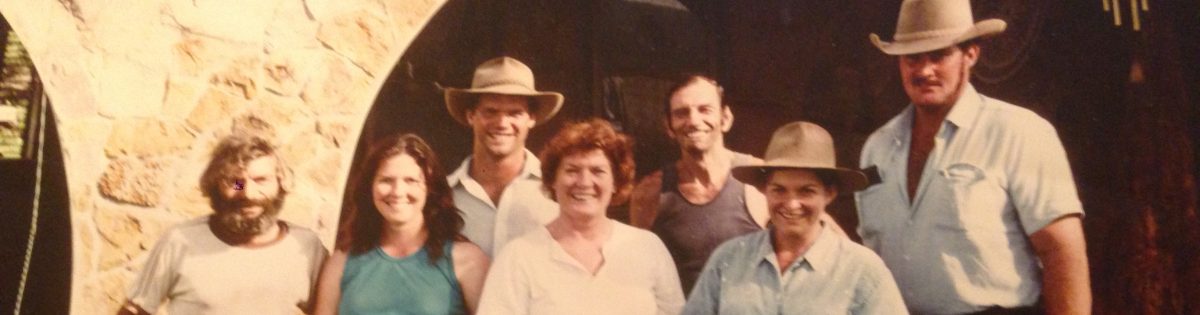
That evening at dinner, amid talk of scheduling choppers and vets and road trains, Sara pointed out that we were getting low on groceries – beef, specifically.
“We’ll need to get a killer tomorrow, then. There’ll be no time for it with cattle in the yards,” Charlie said.
I was reminded of the different calculus involved in meeting the basics of life in my new situation. In the suburban world I’d left behind it was a simple enough matter to slake one’s hunger. With a quick trip to Ralph’s for a pound of ground round the meat locker would be stocked and I’d be able to get back to the important task of polishing my car, or trimming the hedges.
Here in the outback, with its fifty-mile odyssey just to clear the driveway, filling the cupboard requires rather more forethought. Each spring a semi-truck would make its way along that prodigious dirt track, aided across various creek beds by heavy chains and the tractor sent to meet it. After several hours of labored progress, the truck would pull up in front of the homestead and unload pallets of canned beans and biscuit mix and Emu Export Lager. This supply would get those crusty souls marooned upon this remote patch of contorted scrub and cracked hardpan earth through the muster season. Small amounts of canned or dry goods could be ordered via the radio phone and would arrive each Friday with the medicines or mail that swooped down from the open skies onto the airstrip, the bush pilot weaving between livestock as he taxied to the front door.
Biscuits and beans do not a station meal make, however, the critical element being the pan of roasted beef steaks that are the centerpiece of every meal on Bullo River Station. There’s nothing precious about these steaks – no milk-fed, free-range, hand-rubbed, dry-aged nothing. Nor was to be found a white-coated service captain offering seven varieties of salt and pepper to complement its piquant essence, no carver laboring under a monolithic toque to cut the beef just-so. No, Sara would take a hank of cow, slice chops into a roasting pan, shove it in the oven, pull them out when she heard the work crew returning from the field. As I’d discovered in my first week at Bullo, said hank of cow didn’t arrive neatly wrapped in cellophane. No, on a cattle station the beef supply is close at hand – that cow watching the mail plane clear its hindquarters just might be tomorrow’s dinner.
I’d learned by now to use the word ‘cow’ advisedly. Cows are the mature females of the bovine species; young females are called heifers. Cows are valuable for their inclination to bring more cattle into the herd, and are preserved for that function. Cows, therefore, are not good candidates for the dinner plate.
That leaves the fellas. Young males are called mickeys, and it’s a resolute fact of station life that virtually all mickeys early in their lives experience the confounding practice of having their testicles removed. In fact, a main task of the upcoming muster season is to separate all but the very finest specimens of young males from their testicles, so that only those few pass along their winning physical attributes to the heifers cheering from the sidelines.
Meanwhile, the newly-minted candidates for the boy’s baroque choir grow up to be amiable castrati, blithely munching grass and growing fat before their eventual road trip to the meatworks. It’s these big fellows, now known as bullocks, which are the revenue source of every cattle operation as well as the supply, for us, of our mid-day repast.
Charlie had made dispatching the killer so easy; standing in the back of the pickup he’d raised his rifle, pulled the trigger, and the unsuspecting animal had collapsed where it stood. One and done, quick and humane.
The fact that Charlie was a crack shot was a benefit not only to the bullock but to the rest of us as well. When an animal is scared it releases adrenaline and other hormones into its bloodstream and lactic acid into the musculature which becomes ribeye and top sirloin. Whether eating lactic acid is a bad thing for its taste or because when eaten it generates a craving for soprano chorale I’m not sure, but it was crystal clear that running the killer is a no-no.
That admonition was foremost on my mind the next morning when Charlie thrust a rifle in my arms and said, “I need you and Danielle to go get a killer.”
I handed Danielle the rifle with a dubious look and saw that her expression matched mine.
“Oh Charlie,” she moaned, “You know I’m not a very good shot. How about you come along?”
“Can’t,” said Charlie at his monosyllabic best.
“Charlie and I have to meet with the vet and make plans for getting brucellosis vaccine into the mob we’ll have here shortly,” Marlee explained.
“Let’s go then,” said Danielle heavily, as she handed the rifle back to me. “You shoot. I’ll drive.”
“Wha’? I’ve never fired this gun before!” I didn’t want to remind her of our encounter with the dingo. It was highly unlikely she needed any reminder.
“You shoot. I’ll drive.” She repeated with the authority that comes from being the comely daughter of a station owner.
Charlie gave me a bit of parting advice before striding off.
“Just make an X between the eyes and the ears and hit ‘im right in the middle of the X.”
Are you kidding? I thought. Just hit the bullseye and everything will be fine? Is that what you’re sayin’? That’s all there is to it – just put the lead within a space the size of a silver dollar from the back of a pickup truck at forty yards with this old blunderbuss and I’ll be in the clover? Well la-dee-dah!
I wanted to squeeze off a few practice shots before commencing our fool’s errand, so I tapped on the window and directed Danielle to pull off the track. I spotted a branch sticking out of Homestead Creek, about thirty yards distant. I raised the rifle, carefully placed the front sight directly in the V-shaped rear sight, took a deep breath, released my breath slowly, and just as my lungs emptied squeezed the trigger. A splash of water rose four feet from the branch.
Danielle looked blankly at me. “How about you try aiming this time?”
“I did…” I started to protest, panic rising in my belly.
I repeated my steps and fired again, missing the target as badly in the opposite direction.
“This sight is off!” I exclaimed. “There is no way I missed it that bad!”
“Let me see that thing,” said Dan, pulling the rifle from the hands of the hopeless American with a look equal parts contempt and worry. She sighted and fired with a result little different from mine.
“Whoa! I think you’re right!” she exclaimed. A second shot confirmed that the rifle was defective. “We need to go tell Charlie!”
Back at the yard Charlie and Marlee were meeting with veterinarian Bluey Edwards, planning the inoculation regimen.
Charlie cocked his head and squinted as we got out of the truck.
“The sight is off on this gun; we can’t use it.” Danielle stated flatly. Marlee, seeing an opportunity to initiate her sister into the ways of adulthood, stepped up and took the gun from my hands.
“See that limb?” she said, pointing to an outcrop of dead wood sixty yards away. She raised the gun, disintegrated the limb, then thrust the gun back into my hands. “Now go get a killer. We’re busy.” She and Charlie returned their attention to the livestock as Danielle and I departed with an enthusiasm equal to what Ethel and Julius Rosenberg likely experienced when served their last meal.
There are times in life where things just are what they are. Cavities have to get drilled, broken limbs set, Aunt Fanny’s bean casserole eaten, killers gotten. Danielle and I realized we were at just such a moment, and with a silent requiem playing in my head for the star-crossed creature that was to be our subject we pointed the Toyota back into the bush.
Several miles from the homestead we slowed, surveying the cattle innocently grazing along the track. These critters are nothing like Elsie, the Borden cow. They spend their days apart from human interaction, growing skittish when people are around. The Australian outback is nothing like the lush grasslands so common in the States, either, so these animals are skinny and ragged looking. Visible sporadically among the herds were scrub bulls, unmistakable for their malevolent expressions and hides cross-hatched by the signs of battles they’ve endured defending their scruffy domain.
So as we neared the mobs they raised their heads and stared back, aware of our approach, prepared to high-tail it into the distance if they didn’t like our movements. Danielle slowed before one large congregation.
“Hop in back! There’s a few good ones in here!”
I grabbed the errant rifle and clambered into the bed. I grabbed the rail rising behind the cab with one hand and held the gun with the other as we bumped off the road.
I barely managed to keep from pitching over the side as we traversed the terrain, rutted by eons of critter traffic and weather. Just as the animals raised their head, tensed to run, Dan cried out, “There’s a good one!”
I looked the direction she was pointing and saw a large buckskin animal eyeing me with great suspicion. It was tall and fat and seemed as tasty to me as any of the others so I raised the rifle, braced myself, and wasted a prayer that the creature would fold onto itself, insensate, as I squeezed the trigger.
At the crack of the gun the creature stiffened, its eyes expressing a loss of innocence as stark as mine at that moment. “Fall, you poor bastard!” I beseeched pitifully. Instead, it took off running.
“Damn!”, Danielle exclaimed, and accelerated away from where my quarry was headed.
“Where are you going?!” I cried. “It’s going towards the road!”
“What?” she screeched. “It’s right in front of us!”
I saw a shaggy brown bullock loping in front of the truck and cast a mortified look over my shoulder at the animal at which I’d fired. I saw that it had been joined by a calf as she galloped into the distance. I realized that in His mysterious way the Lord had answered my prayer with a clean miss on the mother cow. I turned my attention to the bullock Danielle was doggedly following. We were no longer driving slowly at this point; I was tossed like a rodeo cowboy as the bed pitched and heaved over the landscape. The bullock paused for a moment to eyeball the Hapless Reaper on its tail. Danielle slammed the brakes. The jarring stop caused me to crash against the rear window of the truck, hunched and clinging onto the gun with everything I had.
“Get ‘im!” she yelled.
I pulled myself to a standing position, attempted to still my jumbled brain, and squeezed off a round. The bullock flinched its rear leg in response to the lead I’d deposited there and resumed running, if less gracefully. Thirty seconds later it paused again and I put a bullet through its ear. Off it went again, and I resumed my Raggedy Andy routine in the rear of the truck.
The next time it stopped Dan drove within ten feet of the poor benighted creature and I fired a bullet somewhere in its braincase. Fueled by adrenaline and fear and with enough operative skullmeat to put one foot in front of the other the poor fella tried running away yet again. Danielle accelerated and hit it in the midsection with the front of the Toyota, knocking it on its side. I hopped out of the bed, ran around to the downed creature of God, put the rifle up against the “X” I was originally supposed to hit from half a football field away and finally, mercifully, dispatched the woeful beast.
Death in this earthly realm is often cruel, unexpected, random. I suppose, for that particular bullock, death had been all those things. For me, though, at that moment, the demise of this creature was a comfort. Once its fate had been determined I wanted nothing more than to see its large eyes close for good. That it had been so messy was a travesty. I know there are people who would say that the entire enterprise was a travesty; that to raise creatures just to eat them is an abomination.
I don’t see it that way. Had I managed to extinguish the beast in a split second, one shot to the frontal lobe, it would have suffered not at all. Its friends wouldn’t mourn its passing, its family would hold no vigils. It would have been gone and forgotten, and we stockhands would enjoy the blessing of nourishment to carry us through our long and demanding days. The only sadness for me wasn’t the death of the beast, but that I ushered it so inelegantly into the Great Beyond.
But usher I did, and we finally had our quarry. Danielle and I quietly went about the sanguinary business of prepping and transporting its carcass back home. As I was washing up I noticed Charlie stride into the abattoir to examine the quarters. Charlie doesn’t miss much, I thought, realizing that he would likely see the bullet holes in inappropriate places.
“How’d it go?” Charlie asked at dinner that night.
“Well,” I said slowly, “it wasn’t textbook, but we brought the fella home.”
“Did you run him?” For a moment I thought Charlie was asking whether we ran OVER him, and I was about to say “well, yes,” before Danielle piped up and said, “Just a bit, I’m afraid.”
“Well, I guess I’d run too, if someone shot me in the butt. Anyway, we’ll cut ‘im up tomorrow.”
And that was that. Charlie let it be known that he knew things hadn’t gone perfectly, but in the outback the thing that matters most is results, and the bottom line was we had the meat we needed to carry us through.
Back home in LA I’d once met a woman who described herself as “vegetarian, except for road kill”. Turns out her mom, less excited about the vegetarian lifestyle than the rest of the family, had mounted a set of bars on the front of the family wagon and periodically went looking for deer to catch in her headlights. I’d listened to the woman’s story, mortified. Never, I remember thinking, would I ever eat a meal in which an automobile was involved in its demise.
Within a week of our hunting expedition that certitude was proven wrong, one in a growing list of illusions I had about myself and the parameters of a sensible life I harbored before venturing onto Bullo River Station.
 Barking in Nutwood